


_____ Conducting a GEO audit in 14 steps
How to conduct a GEO audit
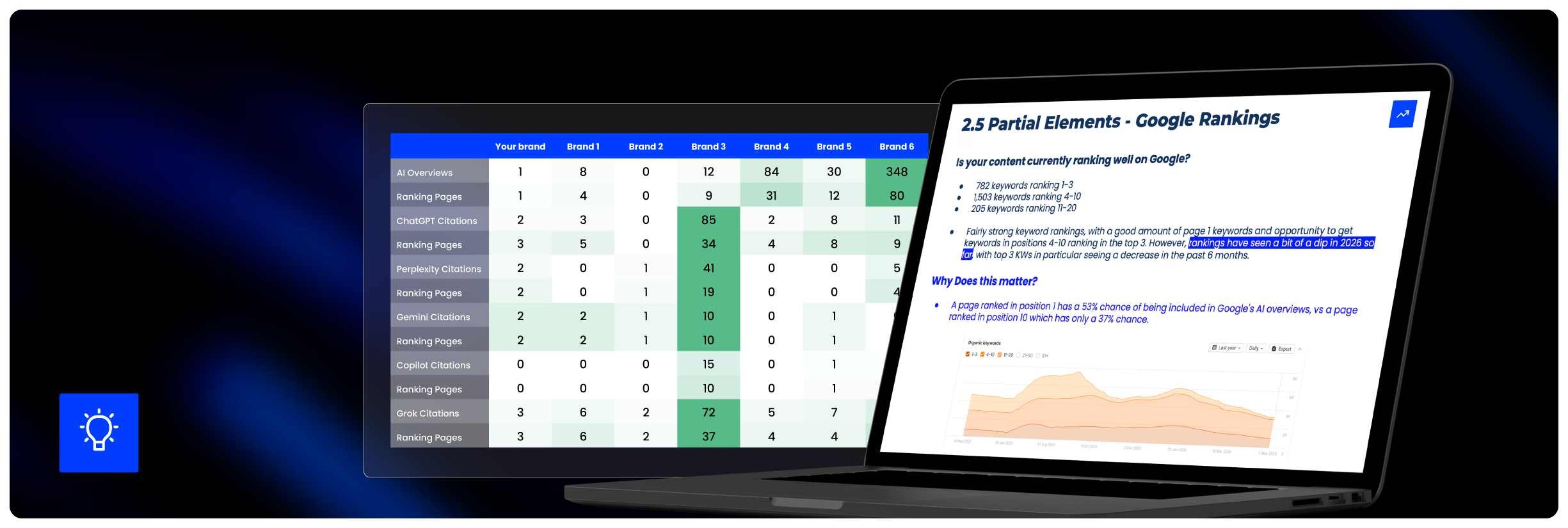
Appearing in ChatGPT does not automatically mean your brand has strong AI visibility. In reality, your brand may still be missing from the prompts that influence buying decisions and, in other cases, AI platforms may present the business inaccurately or rely on sources that do not match how it wants to be positioned.
Conducting a GEO audit means looking beyond whether your brand appears to understand what is helping or hindering your brand’s performance. In this guide, we've broken down how to conduct a GEO audit into 14 simple steps, based on the core areas we review as part of our own auditing process.
As a leading GEO agency, we combine AI visibility data with organic search analysis to explain why a brand appears in some answers but not others. From there, we turn those findings into clear recommendations linked to the areas where stronger visibility could make the greatest commercial difference.
What is a GEO audit?
A GEO audit assesses how well AI platforms find, understand, mention, cite and recommend a brand.
A GEO audit should answer three questions:
 Where is your brand currently visible?
What is helping or hindering that visibility?
What should you prioritise next?
This includes looking at whether the brand appears for relevant customer questions - but visibility is only one part of conducting a GEO audit. The process must also establish whether the brand is being described accurately and where AI platforms are getting their information from.
As a result, a useful GEO audit needs to look beyond AI answers themselves. It should assess the information available on your website, technical and search performance, and external sources that influence how your brand is understood.
There are similarities between SEO and GEO, so they should not be treated in silo. Traditional organic search performance gives important context when assessing whether your website is discoverable and has enough authority to compete in its chosen market(s).
The overall aim when conducting a GEO audit is to identify the gaps most likely to affect AI visibility and commercial performance - the latter being key for businesses. Once you have these, you can roadmap them into a plan.
Get the 90-day GEO roadmap to AI visibility
Follow a phased plan that turns foundations into delivery across onsite, technical and offsite work, with milestones your team can work towards.
Download
What should a GEO audit measure?
For the purposes of this guide, we have simplified what a GEO audit should measure into five broad areas:
 AI visibility
Does the brand appear for relevant commercial and informational prompts?
Brand representation
How does AI describe the brand, its products, services and reputation?
Citation sources
Which websites, publications, review platforms and pages are influencing AI answers?
Referral performance
Are AI platforms sending useful traffic, conversions or revenue?
Technical readiness
Can search engines and AI platforms access (and interpret) the relevant information about the brand?
That’s why AI visibility tools are just the start - no tool (yet) can assess all five areas. AI monitoring tools can show mentions, citations and share of voice, whereas analytics platforms (like GA4) show what happens when someone visits a website.
Human analysis is important for assessing the accuracy, context, and quality of sources, and for clearly understanding why competitors may be performing more strongly than your brand.
In the market for a GEO tracking tool?
Our specialists have reviewed five GEO visibility tracking tools to determine the best one on the market.
Read more
How to conduct a GEO audit in 14 steps
When conducting a GEO audit, we tailor each audit to the business, market and questions being investigated. The 14 steps below explain the main areas we assess, how we interpret the findings and what in-house SEO and GEO leads need to report back to senior stakeholders.
Before any data is collected, the first step is to agree on what the audit needs to find out and which business questions it needs to answer.
Step 1 - Define the purpose of the audit
First off, before using any tools, establish what you need to understand and why the audit is being carried out. A GEO audit can produce a large amount of data, but that data is only useful when it is tied to a clear commercial question.
For example, you may want to find out:
- Whether your brand appears when customers compare providers
- Whether AI systems understand what you sell
- Why your competitors are recommended more often
- Whether customer reviews are influencing how your brand is represented
- Which sources are citing your brand
- Whether your AI visibility is contributing to enquiries or revenue
- Whether your performance differs between products, services or markets
These questions are important as they help to set the scope of the GEO audit and determine which platforms, prompts, competitors and markets need to be included. Without this direction, there are few guardrails, and it’s very easy to compile a large amount of data that says very little.
Your audit should focus on the areas of the business where stronger AI visibility could make a commercial difference. For instance, a company looking to increase visibility for a new service line will need a different audit scope from one trying to correct inaccurate information or understand why competitors dominate comparison prompts.
A clear brief gives the rest of the audit direction and makes it easier to decide which findings need action first.
 Reminder
Before agreeing the audit scope, establish what the business needs to decide afterwards. That might be where to invest, which market needs attention first or whether the current content and authority strategy is fit for AI search. This gives you a clearer way to report the findings than simply presenting changes in mentions or share of voice.
Step 2 - Identify the topics and prompts
The prompts included in your GEO audit should mirror how real customers research, compare, and assess businesses. They shouldn't be limited to the keywords you already track through traditional SEO.
Depending on your business, this could include:
- Broader research questions
- Product or service categories
- Comparison prompts
- “Best provider” questions
- Use cases
- Location-based searches
- Branded prompts
- Trust and reputation questions
- Questions about price, experience or suitability
It is important to cover multiple stages of the buying process. Google describes the non-linear period between a trigger and purchase as the “messy middle”, where people move between exploring their options and evaluating them before making a decision. AI search adds another touchpoint to this process, influencing how your brand is compared and assessed before a user visits a website.
The wording of each prompt set should be carefully considered, as the way they are phrased can affect results. For example, someone asking for “the best project management tool" may see a different answer to someone asking for “the best project management tool for a large regulated company”. Even though the two prompts relate to the same service, the second prompt introduces more specific requirements, resulting in ChatGPT sharing different answers.
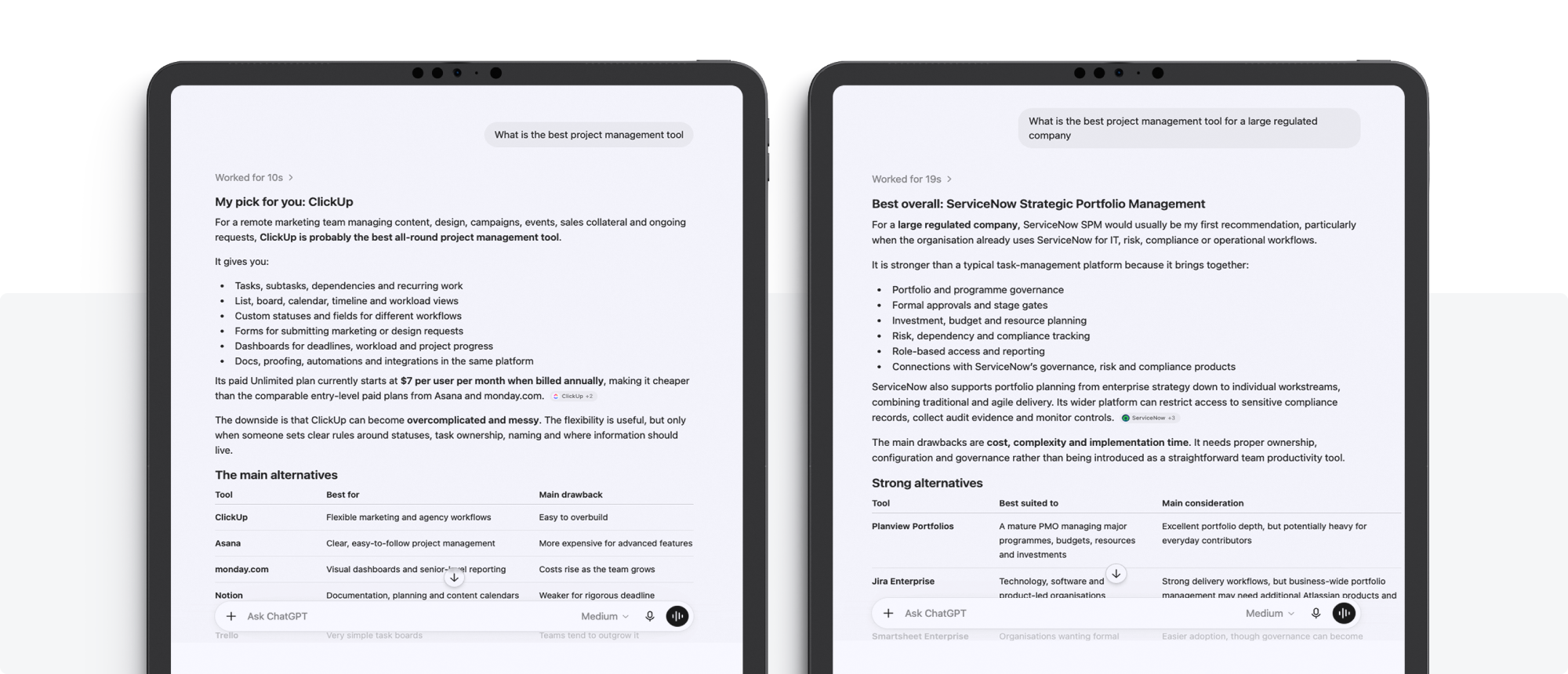
AI platforms can also expand a single question into related sub-questions - often referred to as query fan-outs. These may cover things like pricing, comparisons, reviews, implementation, alternatives or suitability before a final answer is formed. If these related angles are not included in the audit scope, important visibility opportunities can be missed.
Therefore, your prompt set needs to consider your audience and how they make decisions within each target market. A narrow or unrepresentative sample can give a misleading view of your performance and hide important commercial gaps.
Step 3 - Establish the baseline
Before focusing solely on AI platforms, review your brand’s organic search performance. First-party search and analytics data can provide useful context around where your brand already has visibility and demand.
This helps to answer questions like:
- Which topics already perform well in search?
- Which pages attract qualified traffic?
- Where is demand growing or falling?
- Which commercial areas have little existing visibility?
- Are AI referrals leading users to suitable pages?
Despite the similarities between SEO and GEO, you shouldn't treat SEO performance as a direct measure of GEO visibility. Instead, the data gives a starting point for understanding whether your website is already discoverable for the topics being audited and whether that visibility contributes to commercial performance.
Fiona Brindle, our Head of Organic, explains that this wider context is essential when interpreting the results of a GEO audit:
"A GEO audit should not sit separately from the rest of your organic search work. Rankings, content performance and first-party data all help explain why a brand appears in some AI answers but not others. Looking at GEO in isolation risks missing the search issues, content gaps or authority signals that may be influencing AI results."
This is why we review several data sources together before drawing any conclusions about GEO performance. Google Search Console is one of the first places we look.
 Google Search Console
Google Search Console (GSC) can help you to identify:
- Priority query themes
- Relevant topics and landing pages
- Existing search demand
- Branded and non-branded performance
- Changes in clicks and impressions
- Pages likely to surface in AI Overviews
Google Search Console can also help you review your performance within Google’s generative AI search features. Its Generative AI performance report shows how people are discovering your content through AI-powered experiences in Google Search, while your query and page data provides context around the topics where your website already has visibility.
This still only covers Google. It does not show whether your brand appears in ChatGPT, Copilot, Perplexity or other AI platforms, so the data should be compared with prompt monitoring and referral data. Our guide to checking AI visibility in GSC explains how to find and use this information in more detail.
Bing Webmaster Tools
Bing Webmaster Tools provides another view of search performance and can offer useful information around pages cited within Microsoft Copilot.
The data can help you to review:
- Search queries and landing pages
- Cited pages
- Citation trends
- Grounding topics
- Changes over time
As with any platform, the data should be interpreted alongside the GEO audit findings rather than treated as a complete measurement of AI visibility.
GA4
GA4 can be used to assess traffic arriving from LLMs and AI search platforms.
This may include:
- Referral sessions
- Landing pages
- Engagement
- Conversions
- Assisted conversions
- Revenue, where available
- Performance by source
At Reboot, we analyse LLM referrals within the broader organic search picture. This ensures any traffic from AI platforms isn’t treated as a separate channel, while still allowing us to identify which platforms are driving visits and commercial outcomes.
The useful insight often comes from comparing these platforms rather than reviewing each report separately. A page may perform strongly in Google search but receive no identifiable traffic from AI platforms, and another may attract LLM referrals despite having relatively modest traditional search traffic.
Neither result should be taken at face value. The later stages of the audit should investigate why the same page performs differently across search and AI platforms.
Together, these platforms establish the existing search and referral baseline against which the rest of your audit can be assessed.
Step 4 - Measure non-click AI visibility
Referral traffic only captures users who click through to your website. Many AI interactions don’t generate a single visit - this is becoming more apparent in Google search, with Ahrefs finding that the presence of an AI Overview reduced the average click-through rate for the top-ranking page by 58%.
Instead, a brand can influence awareness and consideration inside an AI answer without generating a website visit. Non-click AI visibility therefore needs to be measured separately from your website traffic.
Third-party GEO tools can assess:
- Share of voice
- Frequency of brand mentions
- Competitor visibility
- Prominence within answers
- Sentiment
- Citations
- Changes over time
- Performance across prompt groups
This kind of data can identify whether your brand is being included in relevant answers, even when no referral session is recorded. It can also reveal whether that visibility is concentrated in useful commercial prompts or limited to broader informational questions.
For example, an audit could find that one AI platform accounts for the most AI referral traffic, whereas another frequently mentions your brand but rarely generates clicks. Neither of these metrics gives a full picture on its own.
A citation also needs context. Being listed as a source does not necessarily mean your brand was recommended or even mentioned prominently within the AI answer. Instead, a page may have been used to confirm one fact or provide background information.
When reviewing citations, check:
- Where the citation appears within the answer
- Which claim or section it is being used to support
- Whether your brand is named alongside it
- Whether the citation links to a suitable page
- Whether the surrounding answer presents your brand accurately
This distinction is important because a high citation count can still hide weak visibility within the parts of the answer that influence a buying decision.
When conducting a GEO audit, you should consider both click and non-click data:
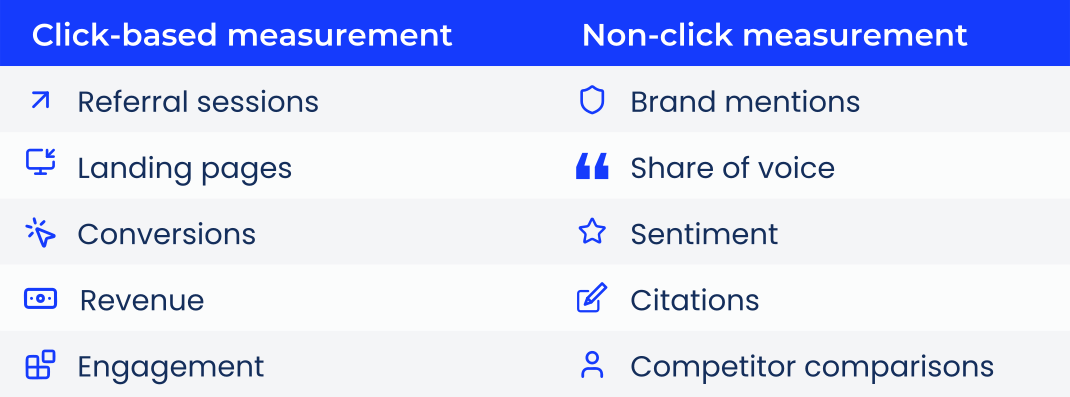
Tools can give you scale and consistency, especially when working with a large prompt set. However, the results depend heavily on the prompts, locations and platforms being monitored.
Your audit should therefore assess where your brand appears and what role it plays within the AI answer, to determine how commercially useful the visibility is.
What senior stakeholders need to know
A higher visibility score does not automatically mean stronger commercial performance. Reporting should distinguish between being mentioned for broad informational questions and appearing within prompts that influence provider comparisons, product selection or purchase decisions.
Step 5 - Test key prompts manually
You should always make sure you back up automated monitoring data with manual checks. Tools can show that your brand has been mentioned or cited, but they can't always explain whether the answer is accurate or aligned with how you want your business to be positioned.
This means reviewing a sample of AI answers to understand things like:
- How your brand is described
- Which competitors are being mentioned or recommended
- Which sources are being used
- What evidence is included
- What important information is missing
- Whether any answers are incorrect
- Whether small wording changes affect the answer
- How confidently the answer is presented
This can uncover problems that are easy to miss in a bogstandard visibility report. For example, an AI monitoring tool might show that your brand is being mentioned, but a manual review can reveal issues such as confusing your brand with another business, citing outdated or incorrect information, or recommending you for services you don’t even offer.
Manual checks also give you context as to why competitors might be appearing more often. The reason for this could be that competing brands have stronger reviews or more consistent references across trusted third-party sources.
You can use advanced AI features, like ‘Deep Research’ or similar research modes, to see which sources and evidence AI platforms are using to form their answers. Reverse engineering this information can establish a “hit list” of where your business should be earning citations and links, to strengthen offsite GEO signals.
However, these checks should be used to spot repeated patterns rather than judge performance from one response. Our Technical SEO Specialist, Anna Khlyshch, explains:
"One AI response is not a reliable benchmark because small changes to the wording, platform or search context can affect the answer. We look for patterns across repeated checks and related prompts instead. That gives us a stronger basis for deciding whether a visibility gap is consistent and what may be influencing it."
Recording each check consistently makes those patterns easier to compare over time.
 What should you record for each prompt?
Manual testing becomes more useful when the results are recorded consistently. For each check, make sure you note down:
- The exact prompt used
- The AI platform and mode tested
- The target market or location
- The date of the check
- Whether your brand appeared
- How prominently it appeared
- Which competitors were included
- Which pages or sources were cited
- Whether the information was accurate
- Any changes when the prompt was reworded
Keeping this information together makes it easier to identify repeated patterns across prompt groups. It also creates a baseline that can be used when the same questions are reviewed again.
Step 6 - Analyse related questions and topic gaps
AI platforms may expand a single prompt into several related questions before producing an answer. These are referred to as query fan-outs and often reveal the additional information the platform needs to compare providers or decide which business to recommend.
For instance, someone asking for a recommended provider may also need information about:
- Price
- Expertise
- Customer reviews
- Credentials
- Suitability
- Availability
- Location
- Comparisons
- Customer support
These related considerations can all influence the final answer produced by the AI platform, even when they're not included in the original prompt.
Query fan-out analysis can help to uncover the core subtopics and evidence associated with a broader prompt. Reviewing these related questions can highlight where your brand is lacking information both onsite and offsite.
This can uncover gaps that may not appear in a traditional keyword list, such as:
- Supporting content
- Clear product or service information
- Useful FAQs
- Comparison pages
- Proof points
- Independent, third-party evidence
- Topical depth
This stage of the audit is to understand whether your brand provides enough information to answer the questions surrounding the main topic, as well as the related sub-topics identified in query fan-out analysis. It should also assess whether information appears in the places AI platforms are likely to use when formulating responses. The findings here should feed directly into your on-site content review.
A simple way to turn query fan-outs into actions is to record the related question and the information already available, which will highlight the gap that still needs to be addressed.
The aim isn't to create a new page for every related fan-out question. Several gaps may be addressed through one useful resource and, in other cases, the answer may be clearer information on an existing page or stronger evidence from external sources. The GEO audit should decide which option best fits the question and the existing content.
Our guide to query fan-outs explores how AI systems expand prompts and how these related searches can uncover additional AI visibility opportunities.
Read more
Step 7 - Audit onsite content
The next step when conducting a GEO audit is to assess whether your website answers the questions customers need resolved and gives search and AI systems enough clear information to cite your brand.
This may include reviewing:
- Topic coverage
- Informational and commercial balance
- Search intent
- Content depth
- Headings and page structure
- Comparisons
- Lists and tables
- Internal linking
- Content freshness
- Supporting imagery and video
- Market-specific information (if applicable)
This list is not exhaustive, but it’s worth noting that there’s no single “LLM-friendly” page template that every website should follow. Onsite recommendations purely depend on what the audit has uncovered and where your existing content falls short.
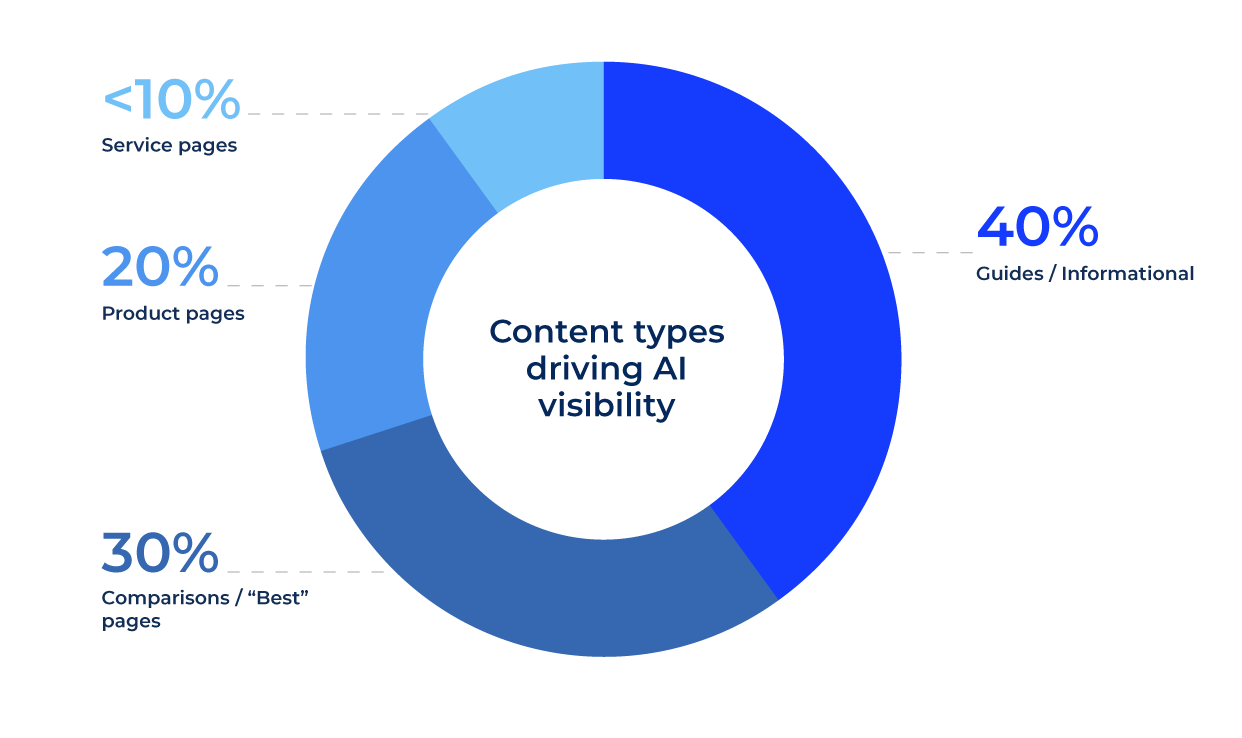
Our GEO audits found that informational content generated between 40% and 70% of AI traffic for the brands analysed. In some cases, individual page types generated up to 30 times more AI appearances than others on the same website.
Read more about the common GEO mistakes our audits have uncovered.
Read more
The onsite review is therefore not to recommend more content by default. Instead, it should identify which content is already contributing to AI visibility and where the website fails to answer an important question.
For example, your brand may need more informational content onsite to support earlier research and brand discovery. Alternatively, you may already have several detailed pages but describe your products or services in technical terms without explaining who they are suitable for or what problem they solve. We have also seen strong lower-funnel pages sit alongside much weaker coverage of the questions customers ask earlier in the buying process.
The review at this stage of the audit should look at the full content picture rather than honing in on specific page elements. You may want to consider how well pages are internally linked to give users a clear route from research to purchase, and whether important topics are covered in enough depth.
Content should be easy to navigate and understand, but it also needs to cover the questions and proof points that influence a customer’s decision. Our guide to onsite GEO details more information on how website content should be structured for AI search.
Step 9 - Review technical accessibility
Useful information onsite can’t contribute to AI visibility if search engines and AI platforms can’t access or interpret it. This is something we see often in our GEO audits, and is an important piece of the puzzle that is often overlooked.
At a high level, a technical review may cover:
| Crawlability |
Structured data |
| Indexability |
Structured data errors |
| Rendering |
Mobile performance |
| Snippet controls |
Site speed |
| Canonicalisation |
Internal linking |
Technical improvements don’t guarantee that a brand will suddenly start appearing within AI answers. However, crawling, rendering or indexation issues can prevent otherwise useful information from being discovered - which is key to AI visibility. Therefore, your review should focus on technical problems affecting priority content.
The technical checks also need to take into account how different platforms access and use website content. There is no single setting that controls visibility across every AI experience.
For example:
| Check | What to look for | Why it belongs in the audit |
|---|---|---|
| Google crawlability and indexation | Whether priority pages can be crawled, are indexed and are eligible to appear with a search snippet | Google’s AI search features use its existing Search systems and index |
| Snippet and preview controls | Whether noindex, nosnippet, data-nosnippet or restrictive max-snippet controls affect priority content | Restrictive controls can limit whether or how content appears in Google’s AI search features |
| OAI-SearchBot access | Whether your robots.txt file allows OpenAI’s search crawler to access important pages | Blocking OAI-SearchBot can prevent content from being fully included in ChatGPT search summaries and citations |
| Canonicalisation | Whether duplicate or conflicting URLs make the preferred version of a page unclear | Search and AI systems need a consistent source to retrieve and reference |
| Structured data | Whether the markup is valid and matches the information visible on the page | Incorrect or inconsistent markup can make machine-readable information unreliable |
| Important information in text | Whether key product, service and policy information is available in the page copy rather than only within images or interactive features | Textual information is easier for search systems to access and interpret reliably |
For Google, no separate AI file or schema is required to appear in AI Overviews or AI Mode - the same technical foundations used for traditional search still apply. OpenAI uses a separate crawler for ChatGPT search, so its access should also be checked rather than assuming Google indexation covers every platform.
Structured data, often called schema, should also be checked carefully, as it's one of the most common mistakes we see in GEO audits. When added to websites accurately, it gives search systems information in a machine-readable format, but it must match the content users can see and be set up correctly.
Our Technical SEO Specialist, Anna Khlyshch, explains that this is a recurring issue within the GEO audits we conduct at Reboot:
"One of the most common issues we see in GEO audits is incomplete or poorly implemented structured data. Organisation schema is often missing or not fully parsable, which makes it harder for search engines and AI systems to clearly understand who the brand is and what it does."
The audit should therefore check that the structured data is consistent with the information users can see across the website and can be parsed correctly. Depending on the business, this may involve checking its organisation name, services, locations and the relationship between separate brands or websites.
There is no special schema type that guarantees visibility in generative AI search. Its role within the audit is to identify missing, incorrect or inconsistent information and make sure your existing structured data can be trusted.
Our technical GEO guide covers the relationship between crawlability, structured data and AI visibility in more detail.
How AI-ready is your website?
Use our LLM optimisation checklist to review the onsite, technical and offsite signals that can affect your visibility in AI search.
Download the checklist
Step 9 - Map citations and source types
When conducting a GEO audit, you should look at where AI systems are getting their information from when they mention your brand or your competitors.
Instead of only listing individual websites, it is more useful to group citations into source types. This makes it easier to see patterns in what AI systems trust and reuse.
Typical source categories include:
- Editorial publications
- Industry websites
- Review platforms
- Comparison pages
- Forums
- Social platforms
- Video platforms
- Directories
- Regulatory sources
- Your brand’s own website
Your audit should also consider what role each source plays within the answer. For example:
- Discovery sources introduce or explain the topic
- Comparison sources assess several providers, products or options
- Evidence sources support facts, statistics or technical claims
- Reputation sources provide reviews and customer sentiment
- First-party sources explain your own products, policies and expertise
Therefore, two publications may influence AI answers in very different ways. For instance, one may be used to explain a subject, while another is regularly cited when providers are compared or recommended. The second is likely to have more direct commercial relevance, even though both belong to the same source category.
Your GEO audit should then break this down even further and answer practical questions, including:
- Which source types and roles appear most often in answers about your category?
- Is your brand present within the sources used for comparison and recommendation?
- Are your competitors mentioned more frequently or given more prominent coverage?
- Is the information being used accurate and up to date?
- Are there source types or roles where your brand is missing altogether?
GEO audit example
One international B2B brand we audited had strong technical foundations and detailed specialist content. Its own website appeared regularly within some prompt groups, but its visibility fell noticeably when questions became more specific or focused on comparing providers.
Citation mapping showed that AI platforms were drawing on a mix of sources, including social platforms (LinkedIn), video content, industry websites and user discussions. The brand had a much weaker presence across these third-party sources than it did on its own website.
Producing more onsite content alone would not have addressed the main gap, so the priority was to strengthen external authority through relevant editorial coverage, industry platforms and third-party proof, while continuing to improve the content supporting its priority topics.
 Strong technical and onsite performance can still sit alongside weak visibility if AI platforms don't find enough independent evidence elsewhere.
Citation mapping directly informs what needs to change next. If AI systems consistently rely on a small set of trusted third-party sources in a given sector, the audit should assess whether the brand is visible in those same places and has enough credibility there.
This is where AiPR® becomes important for GEO. The external coverage helps to create the authority signals and contextual mentions that AI systems tend to draw on when forming answers.
Step 10 - Review how your brand is understood
Visibility isn’t useful if your brand is being described incorrectly or associated with the wrong products or services. This stage of conducting a GEO audit focuses on how AI systems understand your brand and whether enough reliable, external information exists to support your brand's most important claims.
Brand representation
Review how AI systems describe your business, including:
- Its products or services
- Its audience
- Its market position
- Its relationship with other brands
- Its strengths and weaknesses
Look for issues such as:
- Unclear positioning
- Missing differentiators (USPs)
- Outdated information
- Inconsistent brand names
- Confusion with another company
- Parent and product brands being conflated
- Online and offline services being merged
- Incorrect assumptions about the offering
This is one of the clearest examples of why a manual review is imperative. A tool may count a brand mention as visibility, but a specialist’s eye is still useful to judge whether the answer is accurate.
Our guide to uncovering what LLMs don’t know about your brand explains how to check whether AI platforms understand your brand correctly and identify any important gaps in their knowledge.
Assess reviews and sentiment
Your audit should also review the third-party information that may influence trust and recommendations.
This could include:
- Review platforms
- Comparison sites
- Editorial reviews
- Specialist forums
- Social media discussions
- Recurring customer questions or complaints
At this stage, look for recurring themes in third-party sentiment rather than focusing on individual negative comments. Your GEO audit should then assess whether key concerns are being addressed clearly and whether AI systems have sufficient reliable evidence to form an accurate view of your brand. On top of this, it should also consider whether additional or more diverse sources of proof are required to support important claims.
GEO audit example
In another audit, several findings initially appeared unrelated: mixed third-party sentiment, confusion between two connected services, outdated informational content and inconsistent signals across separate websites.
Taken together, they showed that AI platforms did not have one clear and reliable view of the business. The recommendations therefore covered more than content updates. They included clearer links between the two websites, better explanation of the relationship between the services, closer review management and stronger third-party coverage within relevant publications.
 Brand representation problems rarely sit within one page or platform. The audit needs to establish where the inconsistency begins and which teams need to resolve it.
Verify supporting evidence
Your most important business claims need to be easy for both users and AI systems to validate. If a claim cannot be quickly backed up with clear, consistent information, it’s less likely to be trusted or surfaced in AI answers.
Start by checking whether your key claims are actually supported anywhere online. This usually includes:
- Accreditations or certifications (and where they are displayed)
- Years of experience or founding date
- Office locations or service areas
- Product or service specifications
- Pricing or pricing structure (even if indicative)
- Policies (returns, guarantees, service levels)
- Customer reviews and ratings
- Expert credentials or team bios
- Case studies and results
- Independent recognition or awards
The issue is rarely that this information does not exist. It may be difficult to find or described inconsistently across the places where search engines, AI systems and prospective customers look for information.
For example, a business may describe itself as an “established specialist”, but:
- The website does not clearly state when it was founded
- There are no visible team credentials or expertise signals
- Certifications are mentioned in passing but not explained
- Independent reviews or third-party validation are hard to find
In this situation, AI systems may struggle to confidently “prove” the claim, even if it is true. Focus on matching the right evidence to the right claim. Ask yourself - if an AI system or customer tried to verify this statement, would they find clear, consistent supporting information within a few clicks?
Step 11 - Compare performance with competitors
Competitor benchmarking in a GEO audit is less about “who ranks higher” and more about understanding why AI systems are choosing one brand over another in specific contexts.
Your audit should compare the same prompt sets, query types and AI platforms used earlier in this 14-step process. This ensures that differences are based on content depth, external authority, or how clearly each brand is understood by the model.
Compare relevant differences in:
- Topic coverage within AI answers (which sub-questions each brand is associated with)
- Frequency of inclusion across identical prompt sets
- Citation patterns (which domains consistently support each competitor)
- Depth of explanation when the brand is mentioned (surface-level vs detailed recommendation)
- Alignment between AI answers and real-world positioning
- Strength and consistency of third-party validation (reviews, editorial mentions, forums)
- Clarity of entity understanding (whether the model correctly distinguishes products, services and sub-brands)
- Supporting content breadth (guides, comparisons, FAQs, use-case pages that AI can draw from)
- Technical accessibility of key pages (indexation, rendering, structured data consistency)
The purpose is to identify the difference most likely to explain the result, rather than assuming that every advantage a competitor has must be weaved into your own GEO strategy.
For example, a competitor may have far more website content but only outperform your brand within prompts that rely heavily on independent reviews. In this case, increasing your page count would not address the clearest gap. The more relevant difference is the strength and availability of third-party evidence.
A competitor may outperform because it’s simply easier for the model to understand than your brand. This may be because it has:
- Clearer comparison content that matches how users phrase prompts
- Stronger reinforcement across third-party sources that AI systems trust for validation
- Clearer entity signals (consistent naming, structured information, and unambiguous positioning)
- Better coverage of “supporting” questions that appear in query fan-outs (pricing, suitability, implementation, alternatives)
- More consistent sentiment across review platforms, reducing ambiguity in model interpretation
Step 12 - Review your GEO findings
Once the individual checks are complete, the next step is to look at how the GEO audit findings relate to each other.
In most GEO audits, issues rarely exist in isolation. What first might appear to be a content problem may also involve weak external evidence or inconsistent messaging across the website and third-party coverage.
This is where the specialist human judgement we spoke of earlier comes into play. A strong GEO audit should look at how the different layers interact:
- Onsite content and structure
- Technical accessibility
- External authority and citations
- Customer sentiment and reviews
- AI visibility across different prompt types
- Traditional search performance
- Commercial outcomes such as leads or revenue
This is where specialist judgement is particularly important. The audit should look for findings that repeatedly point to the same problem. For example, weak visibility for comparison prompts may relate to limited third-party reviews and a lack of clear proof on your own website. These findings suggest a broader evidence and authority gap rather than unrelated issues.
However, the audit should avoid claiming that one finding has caused another unless the evidence supports that conclusion. You should identify the most likely explanation and show what further work or monitoring is needed to confirm it, where applicable.
Step 13 - Prioritise your GEO recommendations
By this stage, your audit will probably have uncovered several issues across visibility, content coverage, technical performance, external authority and brand representation. They will not all have the same effect on visibility, and they should not all be treated as equally urgent.
Start by looking at where each issue appears and which prompts, products or services it affects. A gap tied to an important comparison prompt is likely to deserve more attention than one affecting a question with little commercial value.
Your priorities should take into account:
- How important the affected topic is to your business
- Whether the issue is preventing your brand from appearing in valuable prompts
- How your performance compares with competitors
- What needs to be completed before the issue can be addressed
- The time and resource required
- How likely the work is to improve visibility or commercial performance
This helps prevent headline figures from giving a misleading view of performance. Your brand may appear frequently in AI answers, but only within low-intent informational queries. If it is missing from prompts used to compare providers or make a purchase decision, its visibility may be less valuable than the overall narrative suggests.
Fiona Brindle, our Head of Organic, explains the value of AI visibility depends on the types of prompts your brand appears for:
"A high visibility score can still hide a serious commercial gap. A brand may appear regularly for broad informational questions but be absent when someone is comparing providers or getting closer to a decision. That is why we look at where the visibility appears, rather than treating every mention as equally valuable."
The following example shows how an overall visibility score can hide very different opportunities across markets and product areas.
GEO audit example
For one international consumer brand, the audit showed that performance could not be summed up with one visibility score. One market had stronger AI share of voice but weaker traditional rankings, particularly for informational topics. Another market had better organic rankings but appeared across fewer AI topics.
The differences continued at product level. Some established categories were already contributing revenue, while commercially valuable adjacent categories had weak rankings, limited content coverage and little authority.
The recommendation therefore differed by market. One needed stronger informational content and better conversion paths from existing visibility. The other needed broader AI visibility, more authority around priority topics and content aimed at earlier research questions.
The same brand may need different GEO priorities across markets, topics and stages of the buying process. An overall score can hide where the commercial opportunity actually sits.
Step 14 - Convert GEO insights into clear actions
Your GEO audit should end with prioritised next steps that are easy to understand and free from jargon.
Each recommendation should be explicitly tied back to the evidence uncovered in the audit and clearly explain:
- What the issue is
- Why it matters for AI visibility and/or search performance
- What needs to change
- Who should own the work
- How urgent it is
- How success will be measured
Depending on the findings, your recommendations may involve any of the following:
- SEO and content strategy
- Technical development
- Digital PR
- AiPR® activity
- Brand positioning and messaging
- Review and reputation management
- Analytics and measurement
- Conversion optimisation
The same dataset can lead to very different recommendations depending on the commercial context and evidence uncovered during the audit. This is why a GEO audit can't be reduced a simple automated report.
A practical way to present this is through a prioritised recommendation table. It might look a bit like this:
| Finding | Why it affects visibility | Recommended action | Priority level |
|---|---|---|---|
| The brand is absent from trusted comparison sources | AI platforms frequently rely on independent comparison content when forming recommendations | Build relevant third-party coverage and strengthen supporting onsite content | Low / Medium / High |
| Two related services are being interpreted as the same offering | Inconsistent signals across platforms are creating confusion in AI responses | Clarify positioning across core pages and external profiles | Low / Medium / High |
| AI referrals land on outdated or unsuitable pages | The landing page does not match the intent behind the original question | Refresh key landing pages and improve internal journeys | Low / Medium / High |
| A priority topic lacks depth compared to competitors | Other brands provide more complete answers across related questions | Expand topic coverage with supporting guides (hubs), FAQs and internal linking | Low / Medium / High |
What makes a useful GEO recommendation?
A recommendation should tell the reader what was found, why it affects an important area of visibility and what needs to happen next. Compare the following examples:
Too broad - Improve the brand’s authority around the topic.
More useful - Your brand is absent from four of the five comparison sources cited across the priority prompt group. Focus external activity on relevant editorial and comparison coverage, beginning with the publications already appearing in those answers. Review changes in brand inclusion, citation share and referral traffic against the original prompt baseline.
The second version explains why the action has been recommended and gives the relevant team enough information to begin the work.
Priority should reflect what is most likely to improve your visibility and commercial performance, not just what looks most “broken” from a technical point of view.
When deciding what to fix first, consider:
- How valuable the topic or page is to the business (revenue, leads, pipeline)
- How far behind competitors you are in that area
- Whether improving it is likely to make a noticeable difference in AI or organic visibility
- How much time, effort and resource the fix will realistically take
- Whether other work needs to be completed first (for example, technical fixes before content updates)
- How quickly you’re likely to see an impact once changes are made
A good GEO audit shouldn’t overwhelm teams with a long list of recommendations. It should clearly show what to focus on first, what can wait, and what will actually make a difference to visibility and performance.
Reporting to stakeholders
When presenting the priorities internally, lead with the commercial gap rather than the audit category. For example, “We are absent from high-intent comparison prompts because competitors have stronger third-party evidence” is far more useful to a CMO than “offsite GEO needs improvement”.
What should the final GEO audit include?
The supporting analysis may contain hundreds of prompts, citations and technical checks, but the main audit should not ask stakeholders to work through all of that data themselves.
Fiona Brindle, our Head of Organic, explains the value of the audit lies in how clearly the findings are presented and prioritised:
"The person reading the audit should not have to work through every check to understand what it means. The main output needs to show where performance is being limited, why that is likely to be happening and what should be prioritised first. The supporting detail is still important, but it should sit behind a clear set of findings and recommendations."
A useful final audit should include:
- The platforms, markets and prompt groups reviewed
- A baseline showing where visibility is strongest and weakest
- The competitors and sources appearing most often
- Any inaccurate or inconsistent information about your brand
- The onsite, technical and external factors linked to each important gap
- Prioritised recommendations, with clear owners
- The metrics that will be monitored after the work begins
Detailed working data can sit behind the main report, but the central output should focus on the findings that change what the business does next.
What a GEO audit can't tell you
A GEO audit provides a view of performance at a particular point in time. AI answers can change when a prompt is reworded, a platform updates its systems or different search, location and personalisation settings are used.
Monitoring platforms also have limits. Their findings depend on the prompts, markets and platforms included in the audit, while first-party reports may only cover one search environment or provide a sample of overall activity. A visibility score should therefore be treated as one piece of evidence rather than a definitive measure of how every customer sees your brand.
An audit should identify consistent patterns and inform better decisions using the available data. It cannot guarantee inclusion in a particular answer or predict every future AI response.
TL;DR
A GEO audit cannot be completed properly through one platform or a handful of manual searches. It requires data from several sources, a representative view of customer questions and careful interpretation of how your brand appears across your website and the wider web.
The most useful output is a clear explanation of what’s limiting your visibility, what is working but under-utilised, and which gaps are leaving your competitors with an advantage.
The key takeaways from a strong GEO audit are:
Where you already appear in AI answers (and where you don’t) - which specific topics, services or prompts are you missing from
Why you are (or aren’t) being cited - is the issue content depth, lack of third-party authority, unclear positioning, or weak supporting evidence
What AI systems are using instead of your brand - the exact competitors, publications or sources being preferred and why they’re being selected
Whether your content actually answers the questions being asked - including gaps in supporting information like pricing, comparisons, use cases or proof points
Which issues are structural vs tactical - for example, whether the problem is a missing page, or a wider authority and content coverage issue across the site
What will realistically move performance - prioritised actions that link directly to visibility, referral traffic and commercial outcomes
Ultimately, a GEO audit should give teams clarity on what to fix first, what to build on and what is currently limiting performance in AI search environments.
Our GEO specialists combine technical SEO, content analysis, AI visibility monitoring and offsite authority insights to build a complete view of performance.
Speak to our team about a GEO audit to find out where your brand is visible in AI search and what could be holding it back.
Book a GEO audit
FAQs about GEO audits
What is included in a GEO audit?
A GEO audit can include AI visibility monitoring, prompt analysis, citation mapping, competitor benchmarking, LLM referral analysis, content reviews, technical checks and an assessment of how the brand is represented across its own website and third-party sources.
The exact scope should reflect the business’s products, audiences, markets and commercial priorities.
How is a GEO audit different from an SEO audit?
An SEO audit generally focuses on the factors affecting a website’s performance within traditional search results. A GEO audit also assesses how AI systems discover, interpret, cite and recommend the brand.
The two should not be treated as completely separate exercises - especially as technical performance, content, search authority and rankings all provide important context for AI visibility.
Read more about the differences between SEO and GEO.
Which AI platforms should a GEO audit cover?
The platforms included should reflect the brand’s audience and target markets. This may include ChatGPT, Gemini, Microsoft Copilot, Perplexity and other relevant AI search platforms.
Not every AI platform should be treated as equally important. Some will matter more than others depending on where your customers actually come from and which tools are driving traffic or visibility. First-party data and customer behaviour can help show which platforms are most worth focusing on.
How do you measure AI search visibility?
AI visibility can be assessed using a combination of brand mentions, share of voice, citations, prominence within answers, sentiment and performance across relevant prompt groups. These non-click signals should be reviewed alongside LLM referral traffic, conversions, revenue and organic search performance.
Can Google Analytics track traffic from ChatGPT?
GA4 can identify visits that come from ChatGPT and other AI platforms, as long as the referral information is passed through correctly. However, this only shows users who click through to your website. It doesn’t capture the full impact of AI-generated answers, such as when your brand is mentioned or recommended but no visit takes place.
How often should you conduct a GEO audit?
A full GEO audit is usually used to set a baseline before starting or updating a GEO strategy.
After that, key areas such as priority prompts, referral traffic and competitor visibility should be monitored on an ongoing basis. A more detailed audit may also be needed after major website changes, a rebrand, a product launch or a noticeable shift in search performance.
How often you run a full audit depends on factors like the size of your prompt set, how quickly your market changes, how much GEO activity you are carrying out, etc.
What tools are used for a GEO audit?
A GEO audit typically uses a combination of search analytics platforms, website analytics tools, crawling software, AI visibility monitoring platforms (like Peec AI or LLMrefs), and manual reviews. Data from each helps to build a picture of how a brand is performing across traditional search and AI-generated answers.
Each tool contributes a different layer of insight, from technical performance and content discoverability through to how often a brand is mentioned, cited or recommended within AI responses.
Does schema improve AI visibility?
Structured data (known as schema) helps search and AI systems understand information in a more structured, machine-readable way. It can also help highlight missing or inconsistent information during a technical review.
However, schema alone does not guarantee that a brand will appear in AI answers. It needs to work alongside clear on-page content, strong brand signals and wider authority across the web.
Why is my brand missing from AI answers?
A brand may not appear in AI answers for several reasons. It may lack relevant content, strong external authority, supporting evidence or clear connections to the topic being searched.
Other factors can also play a role, such as technical issues, weak search visibility, inconsistent brand information or an unrepresentative set of prompts being tested.
A GEO audit helps identify which of these factors is most likely affecting visibility.
How long does GEO take?
There is no fixed timeframe for generative engine optimisation because the work involved can vary. Some improvements, such as technical fixes, can be implemented quickly. On the other hand, content expansion, building authority and improving third-party brand coverage can take longer to show results.
Progress should be measured against a clear baseline using relevant visibility, referral, search and commercial metrics from the original GEO audit.
