


_____ Global digital PR examples
International digital PR campaign examples
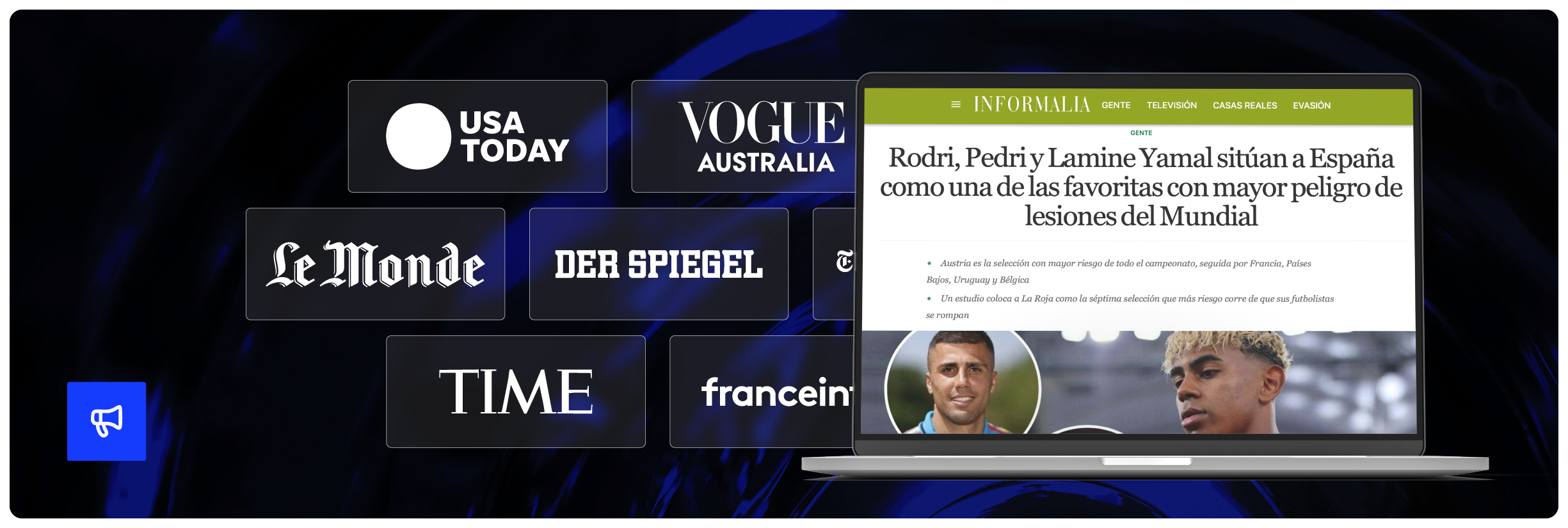
International digital PR campaigns can be used to build authority in one market, strengthen priority pages or grow visibility across several countries. As a global, award-winning digital PR agency, we have run a range of campaigns across multiple countries, tailoring them to the market, commercial priorities, and the level of local authority required.
Let's delve into some international digital PR campaign examples. The three examples in this post cover different market challenges, from building authority for local category pages to earning relevant coverage across 14 countries.
Three international digital PR campaign examples
Growing insurance authority in Germany
 The challenge
A leading insurance provider wanted to strengthen its position in Germany’s highly competitive insurance market, where established insurers and comparison websites already held stronger backlink profiles and greater organic visibility.
The priority was not simply to increase the number of German publications mentioning the brand. The activity needed to strengthen important insurance categories, particularly car and travel insurance, and help the associated pages compete for valuable local searches.
 The strategy - what we did
We created a Germany-first digital PR campaign based on subjects with a clear connection to the brand’s products and audience.
Campaigns explored topics including dangerous roads, commuter behaviour and travel trends, giving German national and regional journalists useful stories while retaining a credible connection to insurance.
Where possible, links were directed to relevant category and service pages rather than being concentrated on the homepage. This helped strengthen authority around the areas of the site most closely linked to customer demand.
The campaigns were also developed with German media expectations in mind. Clear methodologies, transparent sources and direct access to supporting data were treated as an important part of the story, rather than supplementary information added once outreach had already started.
 Results
The international campaign earned 625 links from German media, with an average DR of 69. This included 502 links to car insurance pages and a further 112 to travel insurance pages.
During the campaign, the number of referring domains grew by 278%, while estimated organic traffic value increased by 25%.
 What brands can learn
This example shows why international digital PR planning should begin with the pages and products that need greater authority. This is why the commercial pages that needed more authority were identified before campaign planning began.
General brand coverage can still be valuable, but it may do little to improve visibility for the products people are actively searching for. Identifying priority categories early allowed us to direct authority towards the pages most closely linked to customer demand and plan campaign themes and outreach around them.
It also shows why a strong methodology is particularly valuable in Germany. Journalists frequently expect a detailed explanation of where information has come from and how findings were calculated, so the evidence behind the headline needs to withstand scrutiny.
Our guide to digital PR in Germany explains how local editorial standards, campaign methodology and outreach conventions should reflect activity in the market.
Read more
Scaling healthcare authority across Europe
The challenge
An online healthcare brand wanted to increase visibility for its treatment services across several competitive and highly regulated European markets. The priority was to build local authority around the pages people reached when researching prescription treatments, rather than concentrating links on the wider brand.
The campaign initially covered the UK, France and Germany before its success led to an expansion into Spain. Health, lifestyle and treatment-related topics were relevant across all four countries, but the media expectations, search opportunities and regulatory requirements differed in each one.
The strategy - what we did
We created a shared digital PR campaign focused on health, lifestyle and treatment-related search demand. Campaigns included rankings of the healthiest cities, research into calorie-burn efficiency, analysis of treatment accessibility and consumer stories connected to health policy.
Our UK team led the initial research and data analysis, while native specialists reviewed and adapted each campaign before outreach began. This meant the underlying evidence and quality thresholds remained consistent, but the presentation changed depending on the country.
German outreach placed a strong emphasis on methodological transparency and gave journalists direct access to full datasets. Emails were formal, concise and led quickly into the evidence behind the story.
In France, pitches used short statistical hooks and clearly presented findings, with outreach sent in the morning and follow-ups kept to a minimum. UK activity leaned more heavily into consumer concerns, policy changes and cost pressures, while Spanish outreach used warmer language, positive framing and stronger visual assets.
This local input also helped the team review medical terminology and campaign framing before publication, which was particularly important when working across different healthcare regulations.
Results
Across the UK, France and Germany, the campaign activity secured 138 links, with average coverage DRs ranging from 64 to 72. More than 70% of the links were directed to commercial service pages across the markets.
The work also supported measurable improvements in organic visibility:
- The UK gained 1,031 new ranking keywords, while impressions increased by 87%
- France gained 101 new ranking keywords, alongside a 71% increase in clicks and 272% increase in impressions
- Germany gained 110 new ranking keywords and continued to strengthen visibility around core treatment-related searches
Alongside earning relevant coverage, the campaign improved visibility around the treatment searches most closely connected to its services.
The work was subsequently shortlisted for ‘Best Pan-European Campaign’ at the 2026 European Search Awards.
What brands can learn
This healthcare campaign was successful because, despite the delivery changing in every market, the high standards remained consistent across each country’s campaign.
The same expectations around data quality, relevance and reporting can be applied in every country. However, the story framing, tone, outreach timing and methodologies may all need to change.
In regulated sectors, inaccurate language or assumptions carried over from another country can create reputational and compliance risks. When choosing an international digital PR agency, brands should check that native expertise, local compliance and market adaptation are considered from the outset.
Localisation is therefore not a final tick-box exercise completed once the campaign is complete, but it should influence the research, framing and outreach from the start. Native specialists can help decide which findings to prioritise, how the methodology should be presented and whether the story will feel credible to journalists in each market.
Building visibility across 14 markets
The challenge
An AI technology brand wanted to strengthen its backlink profile and increase visibility beyond specialist technology media. To support growth across several markets, the brand needed to become a recognised source on the wider ways AI was affecting businesses and consumers, rather than being associated only with its product category.
The strategy - what we did
We created a series of international digital PR campaigns across the UK, US and Europe, using the brand’s understanding of AI as the connecting thread.
The campaigns moved beyond technical product stories and explored how AI was affecting business, work, lifestyle, consumer behaviour and online safety. This gave the team more opportunities to contribute to stories already gaining attention across different sections of the media.
This wider subject mix opened up opportunities across business, lifestyle and consumer publications while keeping the brand’s AI expertise central to each story. Its insight could be applied to questions affecting workers, businesses and consumers, rather than being limited to technology specialists.
Some of the research worked across several markets, but the leading findings, headlines and pitches were adapted for each country and publication.
Results
The international campaign contributed to a 549% increase in referring domains, with coverage secured across more than 14 countries at an average DR of 66. This strengthened the brand’s authority across the business, technology and consumer topics connected to AI.
The work was shortlisted for ‘Best Use of Data (SEO)’ and ‘Best Use of Content Marketing’ at the 2024 European Search Awards.
What brands can learn
A clear area of expertise can support coverage in several markets when it connects to questions journalists and audiences are already interested in. The brand still needs a credible reason to contribute, but the subject does not have to stay within its immediate product category.
Even when the core research works across several countries, the pitch still needs to change for each audience. Different markets may respond to different findings, examples or implications, so the strongest angle should be selected locally rather than copied from the first successful release.
Local specialists can judge whether the idea will work as it stands, needs a different lead angle or requires separate data for that market.
What successful international digital PR campaigns have in common
The examples above vary in scale, sector and market, but they all show several consistent details that can be applied when planning international digital PR campaigns.
 Start with the market
The target country should influence the idea and methodology from the beginning.
Brands need to understand where authority is weakest, which competitors are already visible and which local pages or products the campaign should support. They should also agree on how progress will be measured, whether through rankings, relevant referring domains or visibility for a priority service area.
Beginning with the market makes it easier to judge whether one idea can work across several countries or whether each territory needs its own campaign.
It also helps prevent international activity from becoming a chase for the greatest possible volume of coverage. A smaller number of relevant links in the right country can be more useful than wider coverage elsewhere, particularly when the aim is to build authority, visibility and growth in a priority market. This is ultimately why brands invest in international digital PR.
 Build local relevance into the campaign
Journalists need to understand why the story is relevant to their audience.
Local relevance may come from survey respondents within the country, market-specific findings, regional comparisons, national policy or commentary from a local expert. Adapting the currency, terminology and examples can also make the story easier for journalists to use.
Adding a country to a larger international table is rarely enough on its own. The data still needs to reveal something useful about the people, places or issues the publication covers.
A campaign that gives each market a meaningful finding will generally offer more outreach opportunities than one where most countries are included only to make the study appear international.
 Measure the results within the market
Total link volume gives only a partial view of international performance.
Reporting should show where the links came from, which local pages received them and whether search visibility changed in the intended market. Depending on the campaign, this may include local rankings, referring domains, impressions, clicks, organic traffic or enquiries.
Reporting by market makes it easier to see where an idea worked and where a different angle or delivery method may be needed. A campaign might attract high-quality coverage in France but require a different angle in Germany, even when both versions use the same central dataset.
Relevant local links can support country-specific domains, subfolders and commercial pages, which is why international links are important for global growth.
Planning digital PR in other markets?
Each market has its own media habits, journalist expectations and pitching style. Our international digital PR playbook brings together the key considerations for running campaigns across different countries.
You can also read our individual guides to digital PR in:
- Guide to digital PR in Germany
- Guide to digital PR in Spain
- Guide to digital PR in France
- Guide to digital PR in the USA
- Guide to digital PR in Canada
- Guide to digital PR in Australia
- Guide to digital PR in the UK