


_____ The key differences
Traditional PR vs Digital PR vs AiPR®: What’s the difference?
PR has always been about shaping how people understand a brand, but the places where that understanding is formed have changed.
For a long time, that meant earning coverage in the press, building reputation and making sure the right message reached the right audience.
When our digital PR agency entered the fold in the early 2010s, it added another layer, bringing PR closer to SEO, with online coverage, links and authority becoming part of how brands improve organic visibility.
AiPR® takes this even further, looking into how AI systems interpret information that exists about a brand, and whether they have enough evidence to cite, describe or recommend it accurately.
In this guide, we explain the difference between traditional PR, digital PR and AiPR®, where they overlap, and how brands should think about each one as search behaviour continues to evolve.
The key differences between traditional PR, Digital PR and AiPR®
Traditional PR, Digital PR and AiPR® all use third-party visibility to influence how a brand is understood. The key difference is where that visibility is expected to have an impact.
Here’s a quick breakdown:
| Area | Main goal | Main audience | Main output | Main measurement |
|---|---|---|---|---|
| Traditional PR | Build brand awareness and reputation | People, journalists, stakeholders | Media coverage, interviews, press mentions, crisis comms | Reach, sentiment, share of voice, brand perception |
| Digital PR | Build online authority and organic search visibility | People, journalists and search engines | Online coverage, backlinks, data stories, reactive campaigns | Links, relevance, rankings, organic traffic, authority |
| AiPR® | Improve how AI systems understand, cite and recommend a brand | AI systems, search engines and buyers using AI tools | Context-wrapped coverage, citations, expert signals, data-led assets, listicle placements | AI visibility, citations, recommendations, category association, brand understanding |
The easiest way to think about the difference betwen the three is to look at the job each one does.
- Traditional PR is usually concerned with how a brand is seen by people.
- Digital PR is concerned with how that visibility supports search performance.
- AiPR® looks at whether the wider web is giving AI systems enough clear, credible information to understand where a brand fits.
There is, of course, overlap between all three. A strong Digital PR campaign can build brand awareness, and a traditional PR feature can support search if it appears online. The difference is what the activity is planned to achieve from the start.
 What is traditional PR?
Traditional PR focuses on how a brand is perceived by people.
It is often used to support brand awareness, reputation, corporate messaging, product launches, events, stakeholder confidence and crisis communications.
Typical traditional PR activity can include:
- Press office activity and media relations
- Product launches and corporate announcements
- Founder or spokesperson profiling
- Broadcast and event opportunities
- Reputation and crisis communications
The main goal is usually to get the right message in front of the right audience, often through trusted media sources.
For example, a brand launching a new product may use traditional PR to secure national press coverage, interviews with senior leaders and trade media features. The value is in visibility, credibility and message control.
Traditional PR can support search visibility, especially when coverage appears online, but that is not always the main measure of success.
A national newspaper mention may improve brand awareness, but if the article does not include a link, clear topical context or useful information around what the brand does, the SEO and AI search value may be limited.
That does not make the coverage worthless, it just means it is doing a different job.
 What is Digital PR?
Digital PR focuses on earning online coverage that supports organic search performance.
It still relies on strong stories, relevant journalists and credible media relationships. But the outcome is more closely connected to SEO.
A Digital PR campaign is usually planned around:
- The links a brand needs
- The pages that need authority
- The topics a brand wants to be associated with
- The markets or publications that matter
- The search results a brand wants to compete in
- The commercial value of improving organic visibility
This is why Digital PR often uses data-led stories, expert commentary, FOI research, reactive newsjacking, product page link acquisition and international outreach.
The aim is to earn relevant, authoritative links and mentions that strengthen how search engines understand, trust and rank a brand - not just coverage for the sake of it.
For example, a travel brand may want to improve rankings for its family holiday pages. A Digital PR campaign could earn links from relevant travel, lifestyle and national publications, helping strengthen authority around that topic.
The strongest Digital PR activity is planned around SEO from the start. That means looking at the pages that need more authority, the topics the brand needs to be known for, the competitors earning stronger links, and the publications that are genuinely relevant to the audience and the search results.
The question is not 'Will this get coverage?', but 'Will this coverage help improve the brand’s visibility in the places that matter?'.
 What is AiPR®?
AiPR® is Reboot’s offsite approach to GEO.
It focuses on strengthening the authority, relevance and trust signals that influence how AI systems understand, cite and recommend brands.
This means looking beyond your own website and improving the broader evidence about your brand across the web. This can include the publications that mention you, the topics you are associated with, the experts connected to your brand, the original data you publish and the context that surrounds your brand mentions.
This is important to note because AI tools do not solely rely on your website to understand your brand. They also draw upon the wider information available across the web, including coverage, mentions, expert commentary, original data, third-party references and category associations.
For a brand to appear in AI answers, comparisons and recommendations, AI systems need to see consistent evidence of:
- What the brand does
- Which category it belongs to
- What topics it has authority in
- Which customer needs it is relevant to
- Whether credible sources mention it
- Whether its experts, data or proof points can be trusted
AiPR® focuses on strengthening these offsite signals through activity such as expert commentary, original research, industry reports, category-led rankings and relevant listicle placements.
Where do they overlap?
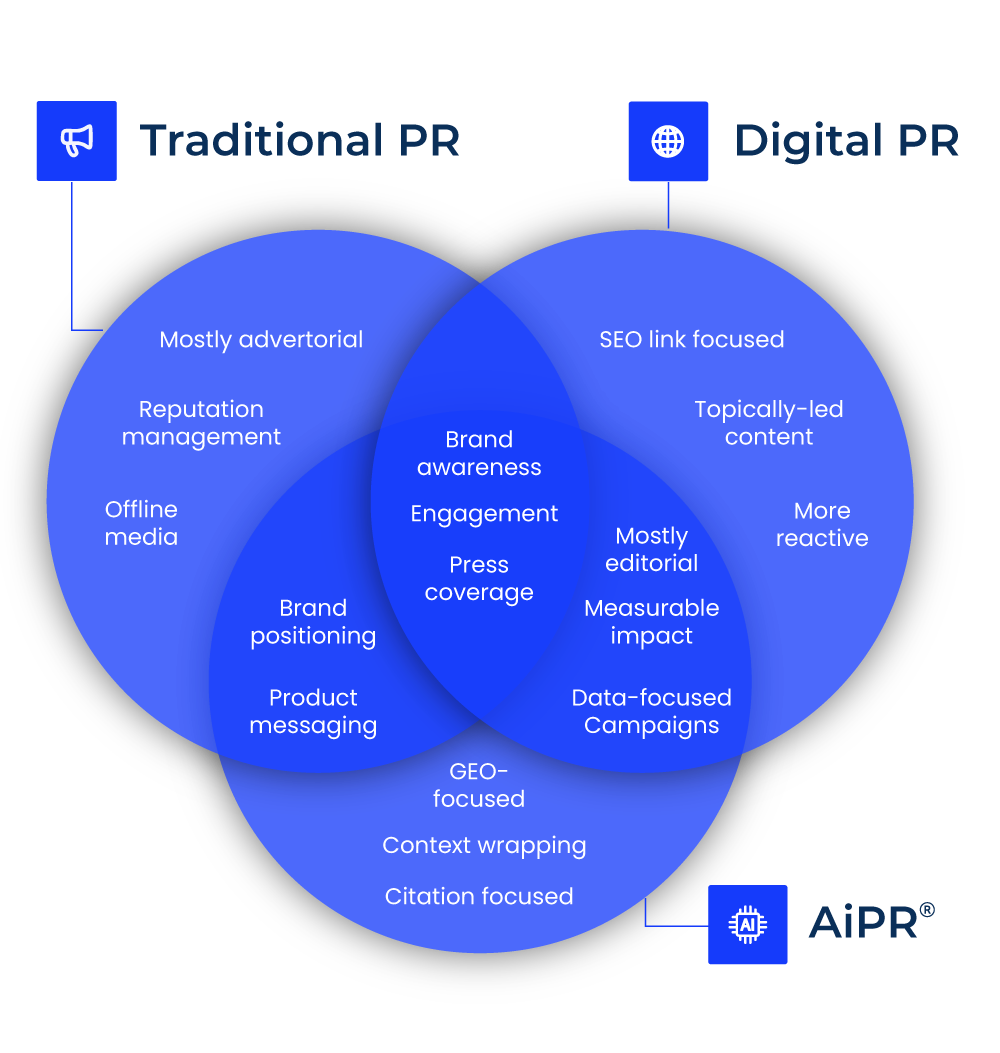
Traditional PR, Digital PR and AiPR® are not completely separate, as they all rely on credibility at their core.
Each one uses third-party sources to help shape how a brand is understood. That might be a journalist quoting an expert, a publication linking to a useful resource, or an industry listicle naming a brand as one of the best options in its category.
The overlap is usually found in:
- Media credibility
- Third-party validation
- Expert commentary
- Brand reputation
- Topical authority
- Audience trust
- Consistent messaging
The difference is how those signals are used. For example, traditional PR uses them to influence people, Digital PR uses them to support people and search engines, and AiPR® uses them to support people, search engines and AI discovery.
"When you’re thinking about the difference between traditional PR, Digital PR and AiPR®, the old-school SEO answer is - it depends.
Good offsite brand comms is what you need for all three, but they have slightly different outcomes and slightly different ways of working.
Traditional PR might be more product-focused or reputation-led, Digital PR connects coverage to search performance, and AiPR® brings in a third sphere, where we’re much more focused on relevance, context wrapping and making sure AI systems can connect your brand to the areas you want to be known for."
James Olliver
How the outcomes differ
A simple way to understand the difference is to look at what each activity is trying to influence.
| Question | Traditional PR | Digital PR | AiPR® |
|---|---|---|---|
| What are we trying to influence? | Public perception | Search visibility | AI understanding and recommendations |
| Who needs to understand the brand? | People and stakeholders | People and search engines | People, search engines and AI systems |
| What does success look like? | Positive coverage and awareness | Relevant links, rankings and traffic | AI citations, brand mentions and recommendation visibility |
| What does the content need? | A strong message or story | A linkable, newsworthy angle | Clear context, authority and citation potential |
| What is the risk of getting it wrong? | Weak reputation or missed awareness | Links that do not support SEO | AI systems misunderstand or ignore the brand |
In short, they each solve different problems.
For example, a brand dealing with a reputation issue may need traditional PR, a brand being outranked by competitors may need Digital PR, and a brand missing from AI answers may need AiPR®. A brand trying to grow visibility across search, media and AI may need an amalgamation of all three as part of its search strategy.
How does Digital PR support AiPR®?
Digital PR already does much of the groundwork for AiPR® by creating third-party signals that AI systems may use to understand a brand.
When a brand is mentioned in a trusted publication, supported by expert commentary, or tied to original primary data, it gives search engines and AI systems more evidence to work with. Over time, this can help reinforce what the brand does, the topics it has authority in, and the sources that are willing to reference it.
AiPR® takes this even further by being more intentional about the meaning behind those signals.
For example, a mention in a national publication may help with authority. But if that mention also clearly explains what the brand does, why it is relevant to the story and what area of expertise it should be associated with, it becomes far more useful from an AiPR® perspective.
Here's an example of this in action, using a piece of coverage earned for one of our clients:
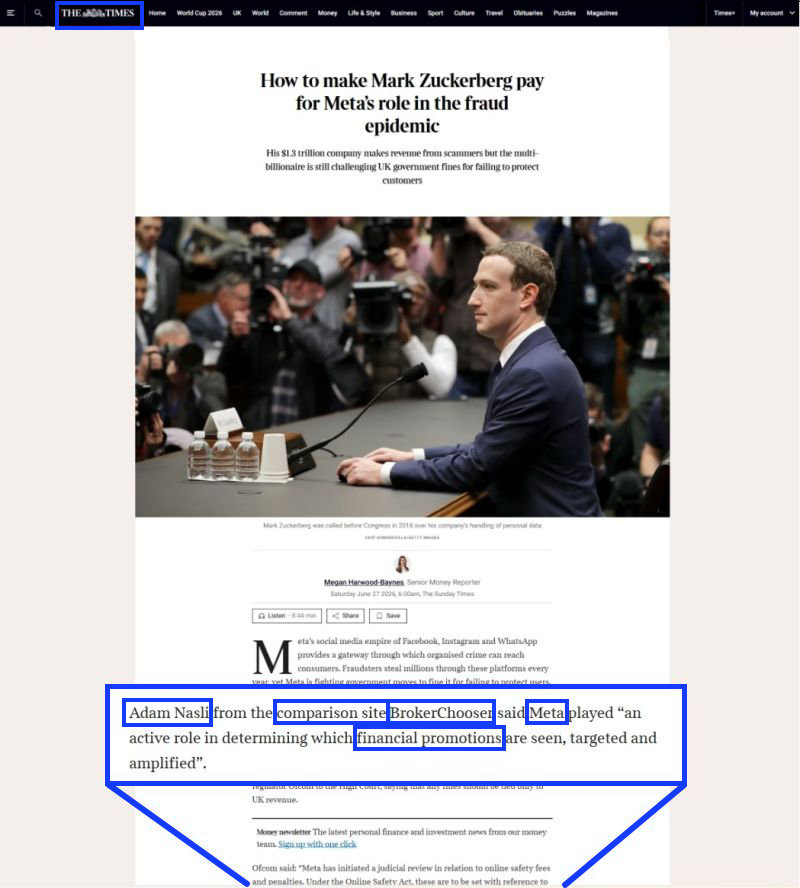
In this single branded mention, AI can learn:
- The brand is a comparison platform
- Adam Nasli is an expert representing the brand
- The brand has expertise in financial promotions
- The brand is qualified to comment on advertising and regulation
- The brand is being cited by a trusted publication - The Times
- The brand is contextually connected to Meta, financial advertising and consumer finance
This concept is something we focus heavily on in our GEO work, which we have coined 'context wrapping'.
Every mention of your brand in every article should try to reinforce what the company does, what subjects it genuinely has authority in, who speaks for the business, which entities it should be associated with, which problems it solves, and which conversations it belongs in.
Over time, large language models (LLMs) join the dots between this coverage and your brand, forming relationships, building knowledge graphs, and strengthening associations among brands, topics, and their expertise.
Choosing the right approach
Traditional PR, Digital PR and AiPR® are not competing services, as they collectively help brands earn trust in different places.
Traditional PR supports reputation and awareness, Digital PR strengthens the authority and relevance needed to compete in organic search, and AiPR® builds on this by looking at how AI systems interpret the evidence surrounding your brand.
As search behaviour evolves, brands need to prioritise messaging beyond their own website. They need clear, consistent and credible signals across the wider web, from the publications that mention them to the context that surrounds those mentions - context wrapping.
Want to understand how your brand appears across search and AI answers? Speak to Reboot about Digital PR, GEO and AiPR®.
Contact us
FAQs
What is the difference between traditional PR and Digital PR?
Traditional PR focuses on reputation, awareness and media visibility. Digital PR focuses on earning online coverage and backlinks that support authority, rankings and organic search performance.
Both rely on strong stories and media relationships, but the measurement is different. Traditional PR is often measured through reach, sentiment and brand awareness. Digital PR is more closely tied to links, rankings, organic traffic and search visibility.
What is the difference between Digital PR and AiPR®?
Digital PR focuses on earning relevant online coverage and backlinks. AiPR® builds on this by looking at whether earned coverage gives AI tools enough context to connect a brand with the right topics, services and customer needs.
In Digital PR, the link is often a key outcome. In AiPR®, the context around the mention also matters, because AI systems need to understand what the brand does, what it is trusted for and when it should be recommended.
Does AiPR® replace Digital PR?
No. AiPR® does not replace Digital PR. AiPR® builds on Digital PR by making earned media activity more intentional for AI visibility, citation potential and brand understanding.
For many brands, the best approach is to use Digital PR and AiPR® together, so offsite activity supports both organic search performance and AI visibility.
Why does context matter in AiPR®?
Context helps AI systems understand what a brand does and why it is relevant.
A brand mention is stronger when the surrounding content clearly explains the brand’s category, services, expertise and customer need. Without that context, AI systems may struggle to understand when the brand should be cited or recommended.
Which type of PR is best for SEO?
Digital PR is usually the strongest fit for SEO because it focuses on earning relevant, authoritative backlinks that support rankings and organic visibility.
Traditional PR can support SEO when coverage appears online and includes useful links or mentions, but SEO is not usually its main objective.
Which type of PR is best for AI visibility?
AiPR® is the strongest fit for AI visibility because it focuses on the signals AI systems use to understand, cite and recommend brands.
This includes brand mentions, expert commentary, original data, relevant third-party coverage, category association and context-wrapped citations.
Can traditional PR support AI visibility?
Yes, but it depends on the coverage.
Traditional PR can support AI visibility if it creates credible, accessible and context-rich information about a brand. However, if coverage only mentions the brand without explaining what it does or why it is relevant, the value for AI visibility may be limited.
How do I know if my brand needs AiPR®?
You may need AiPR® if your brand is missing from AI answers, being misrepresented by AI tools, or not being recommended for the topics, services or categories you care about.
It is also worth exploring if competitors are appearing in AI-generated answers and your brand is not, especially for high-intent comparison or recommendation prompts.