


_____ AI STATS
AI statistics 2026
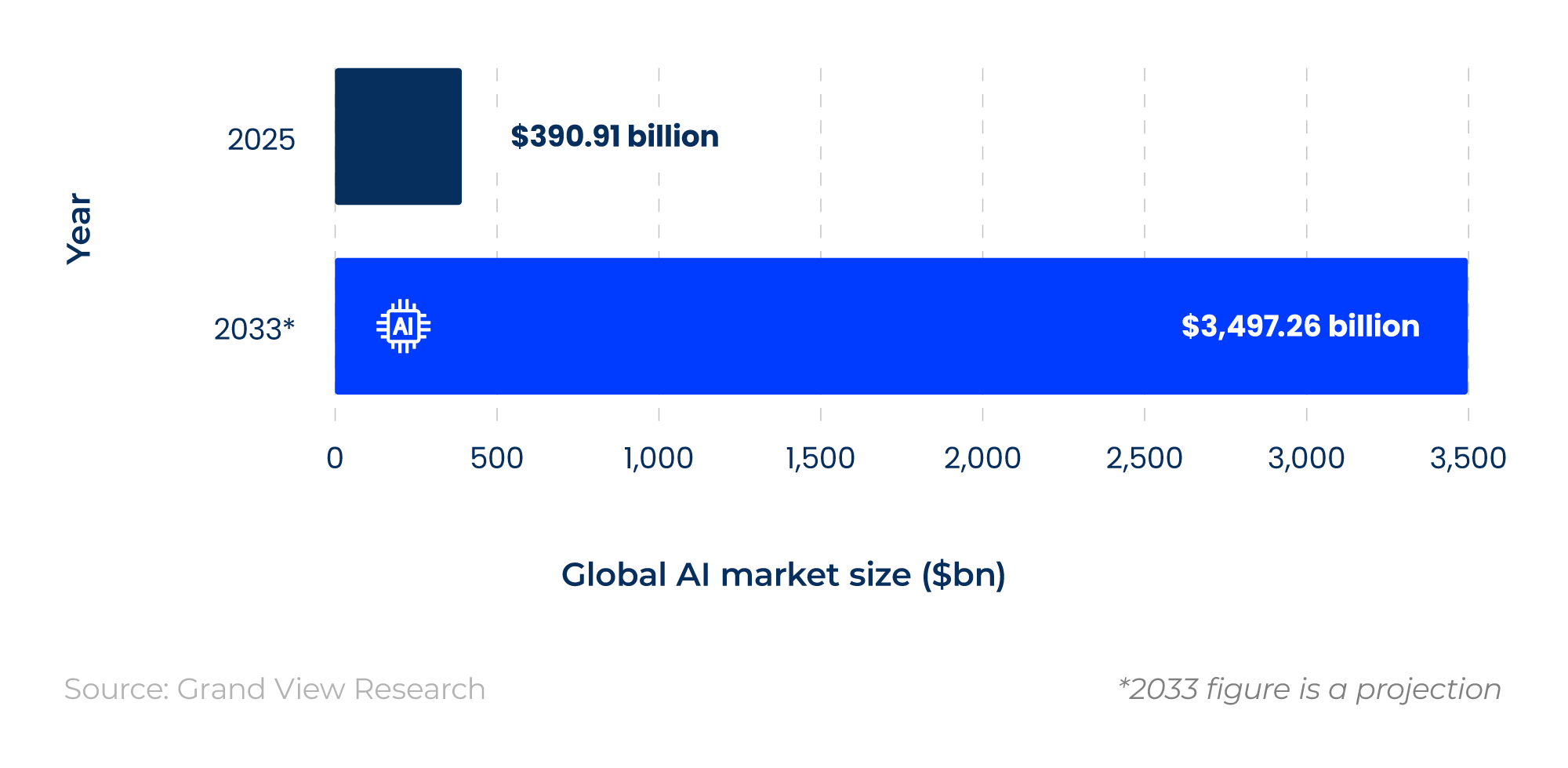
Since the watershed launch of ChatGPT in late 2022, generative AI has continued to develop at unprecedented speed, revolutionising many aspects of our day-to-day lives. The growth of AI was highlighted by a global market study, which valued the industry at over $390 billion in 2025.
Global AI market size by year, 2025-2033
From automating tasks to enhancing creativity, improving business efficiency, and transforming entire industries, AI is rapidly becoming an integral part of modern life - both in and out of the workplace.
But what does the future hold for artificial intelligence? To find out, search marketing and GEO agency Reboot Online has collated an extensive AI statistics report covering AI adoption rates, workplace trends, and an overview of how AI is shaping the present and defining the future.
Top 10 must-know AI statistics
The global artificial intelligence market was worth over $390.91 billion in 2025.

OpenAI was valued at $500 billion in 2025, making it the most valuable private company at the time.
Global funding to AI startups reached $202 billion in 2025, equating to 49.9% of all global startup funding.
88% of businesses worldwide were using AI in at least one business function in 2025.
67% of job listings in the translation and localisation sector reference AI – the most of any industry.
Non-profit and non-governmental organisations (NGOs) offer the biggest salary increases for AI skills on average, at 37.42%.
Jobs mentioning AI skills pay 5.84% more on average than those that don’t across all industries.
Around 60% of searches now result in no clicks, with users getting answers directly from AI-generated summaries.
Top-ranking Google results see a 34.5% reduction in click-through rates when an AI overview is present.
43% of companies expect there to be no or very little change in their number of employees due to AI adoption from 2025 to 2026.
AI market statistics
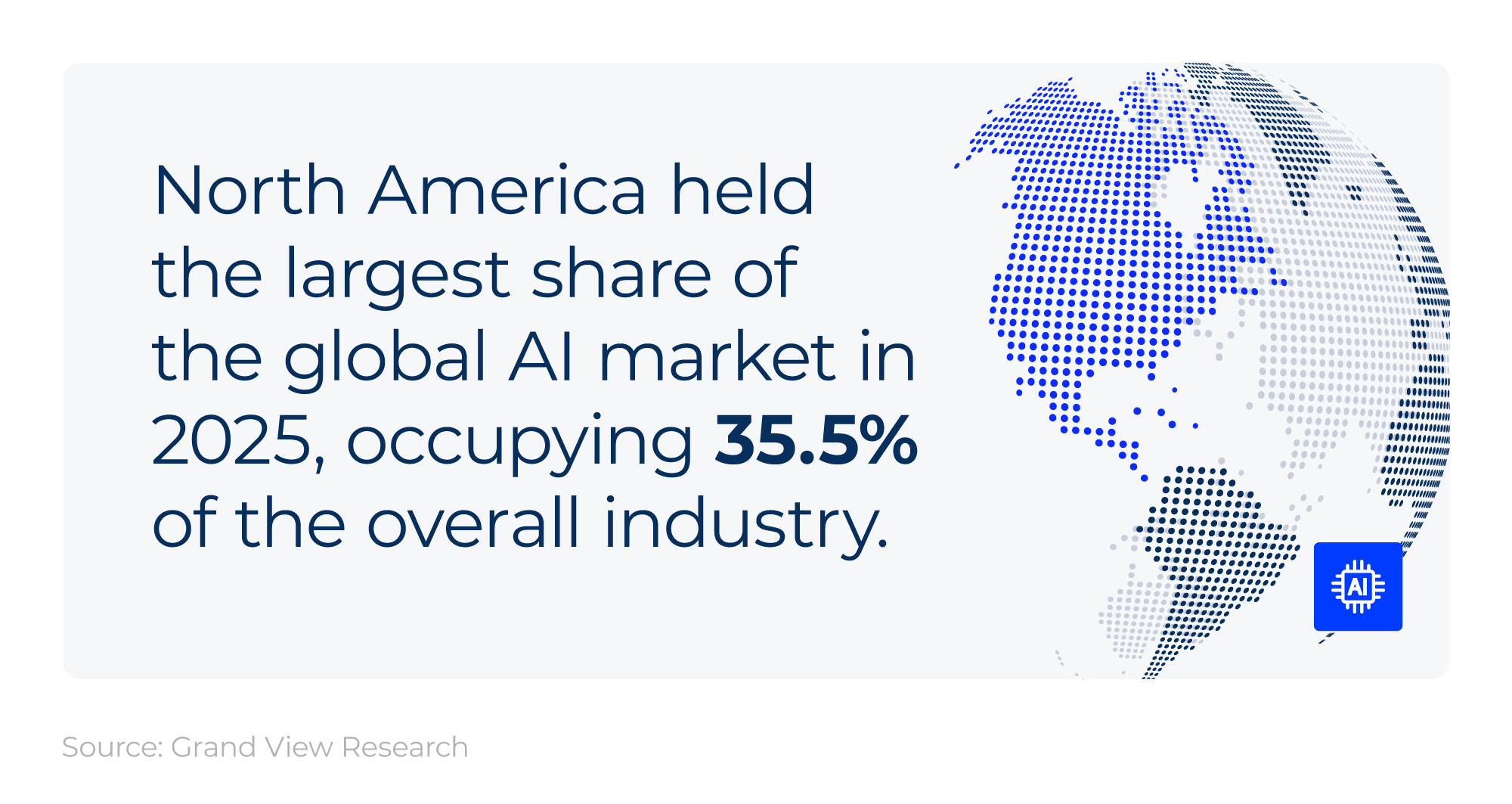
Recent AI statistics revealed that the global artificial intelligence market size was valued at more than $390.91 billion in 2025. Continentally, North America held the largest revenue share, occupying 35.5% of the overall industry.
 The service sector was the biggest revenue generator for AI, accounting for 36.3% of the overall total in 2025. In terms of specific technology, deep learning was the most profitable AI area, accounting for just over a quarter of all industry revenue.
The global AI market size is projected to accelerate in the coming years, with industry value surpassing $3.4 trillion by 2033. If correct, this will mark a compound annual growth rate (CAGR) of 30.6% between 2026 and 2033.
Current projections indicate that the global AI market will be worth more than ninefold in 2033 compared to 2025.
UK AI market size and growth rate
With an estimated value of £72.3 billion in 2024, the UK’s AI market is the third largest in the world, after the US and China. This also made it the largest AI market in Europe.
Key financial metrics around the UK AI market, 2024
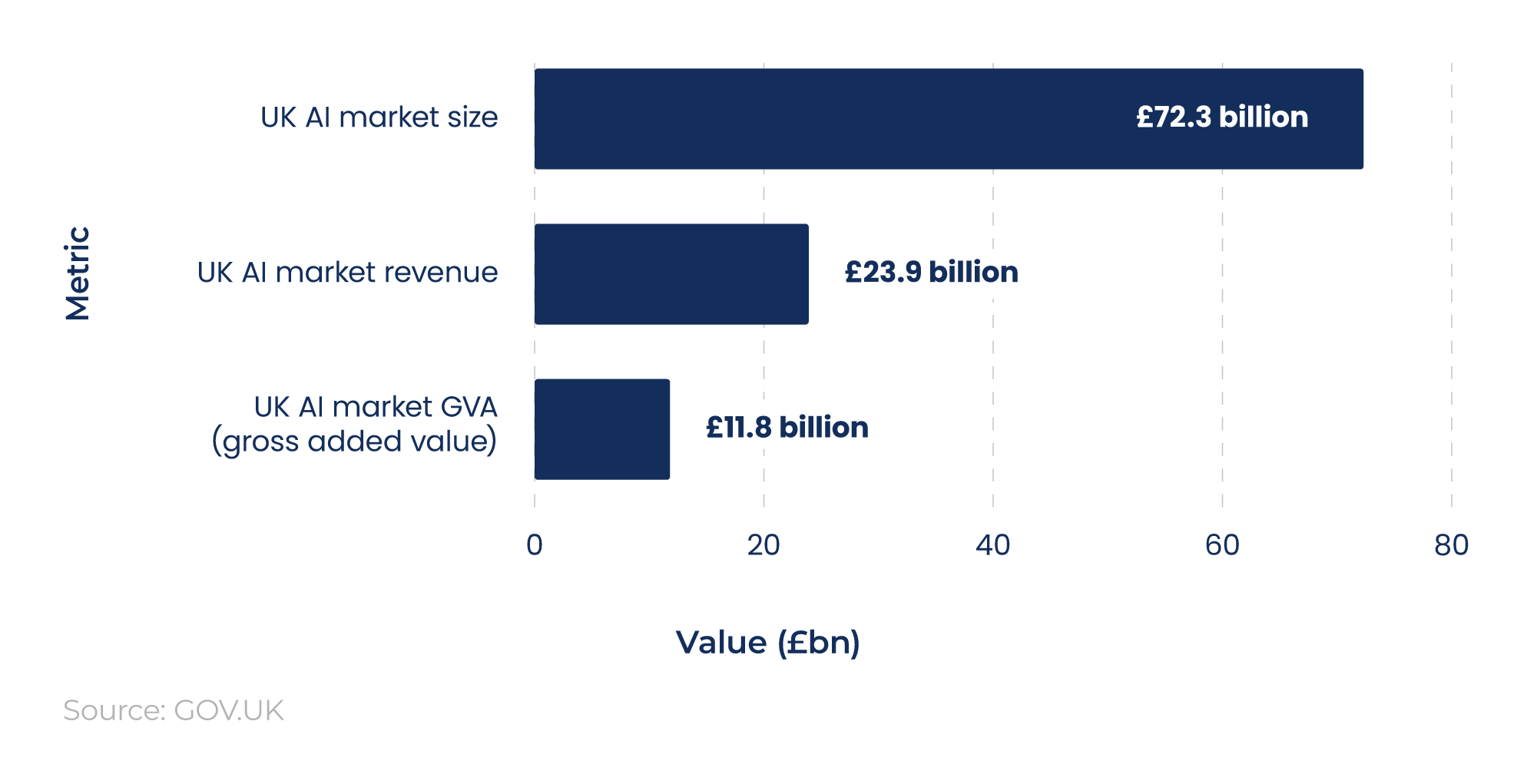 That same year, the UK AI market posted revenue of £23.9 billion, with gross value added of just under £12 billion, highlighting the UK’s position as a major player within artificial intelligence.
This growth is supported by government initiatives such as the AI Research Resource (AIRR), which helps researchers, academics, and public bodies study and develop AI at scale.
AI growth statistics
The strength of the UK’s AI market is in the business landscape. Government-released AI facts revealed that the UK had over 5,800 artificial intelligence firms in 2024, marking a year-on-year rise of 58%.
UK AI employment and company growth by year, 2023-2024
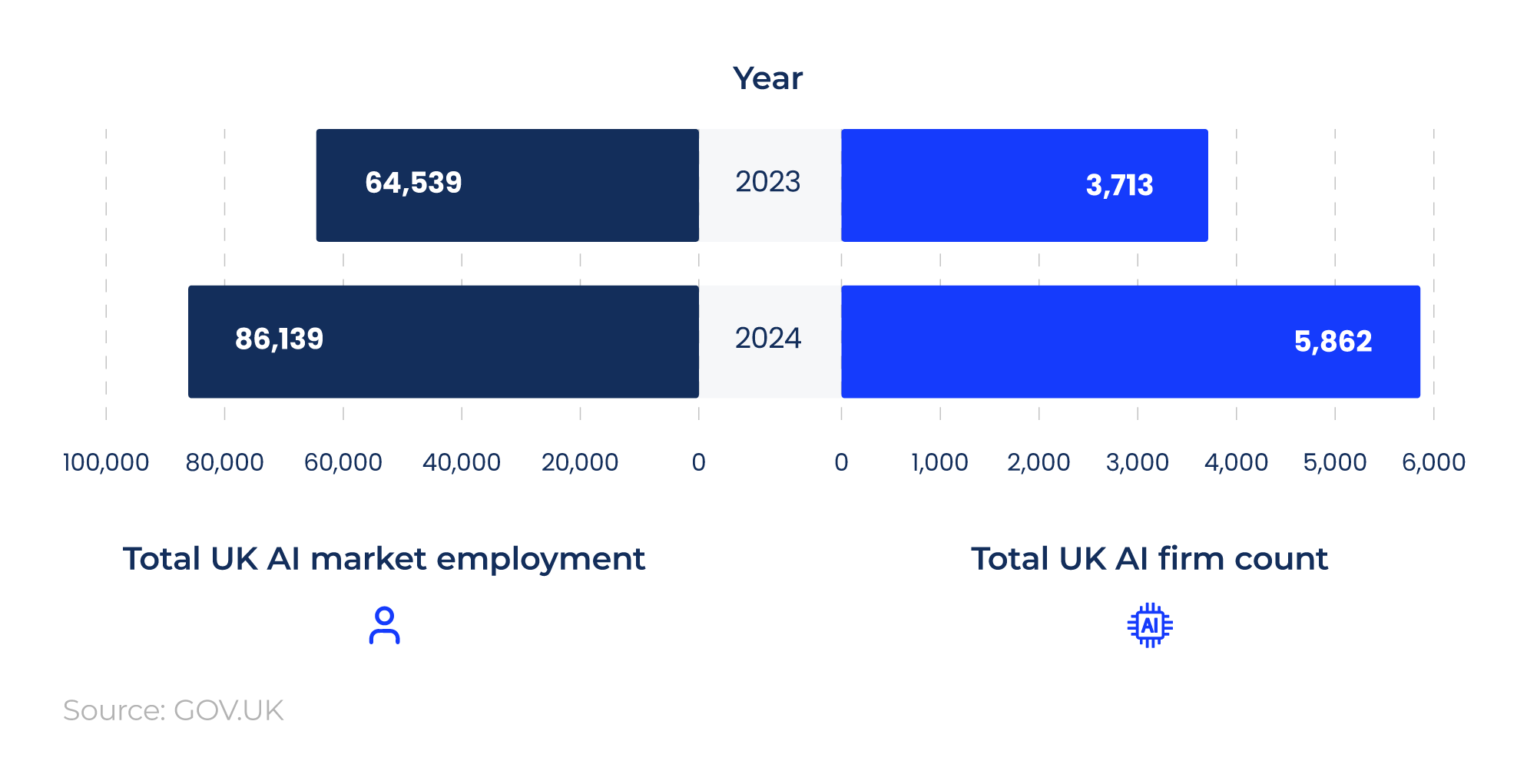 In turn, this has contributed to a growth in UK AI employment, with the industry accounting for more than 86,000 employees in 2024. A rise of over 33% from the previous year, when the total stood at just under 65,000.
AI investment and funding trends
Artificial intelligence was the leading sector for global startup funding for three consecutive years between 2023 and 2025, according to Crunchbase’s latest AI facts. Funding notably increased each year, with the 2025 total of $202 billion, over triple the figure from 2023.
At the end of 2025, OpenAI, the company behind ChatGPT, was valued at $500 billion, making it the most valuable private company at the time.
The scale of AI funding is demonstrated with OpenAI competitor Anthropic, the fourth most valuable company at $183 billion. When combined, the two companies are responsible for almost 10% of the entire value of The Crunchbase Unicorn Board, a curated list of the world's most valuable private companies.
What percentage of business funding is going to AI?
AI stats show that total funding for global artificial intelligence startups reached $202 billion in 2025, an $88 billion rise from 2024.
By comparison, the combined funding for all non-AI startups was $203 billion, only one billion more, meaning that AI startups account for nearly half of all business funding.
Total global funding for AI startups vs non-AI startups by year, 2021-2025
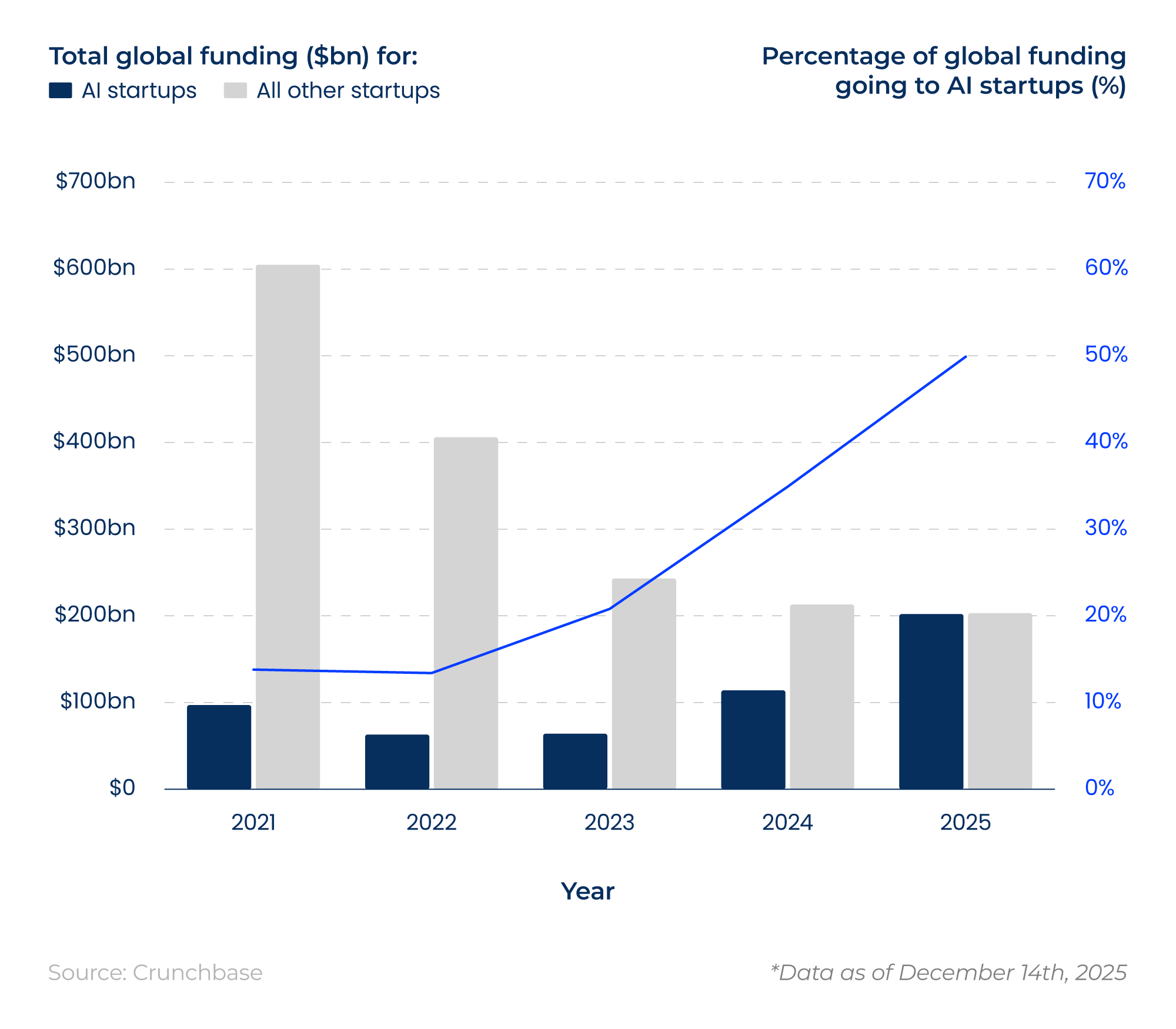 The proportion of global business funding for AI has climbed rapidly since 2022, when the total stood at just 13.4%. Though AI startup funding increased by less than 2% in 2023, the overall reduction in startup funding meant that AI accounted for a significantly higher share (20.8%) than in the previous year.
A rise of $50 billion in 2024 took funding for AI startups to $114 billion, with this figure surpassing $200 billion the following year. AI’s share of startup funding is over three times higher in 2025 than in 2023.
Total AI startup funding in the US vs the rest of the world, 2021-2025
| Year | Total AI startup funding in the US | Total AI startup funding in the rest of the world | Percentage of global AI startup funding coming from the US |
|---|---|---|---|
| 2021 | $61 billion | $35 billion | 63% |
| 2022 | $37 billion | $27 billion | 58% |
| 2023 | $45 billion | $19 billion | 70% |
| 2024 | $87 billion | $27 billion | 77% |
| 2025 | $159 billion | $43 billion | 79% |
Source: Crunchbase | *As of December 14th, 2025
The US has dominated AI startup funding since 2021. With a total of $61 billion that year, the US accounted for 63% of all global funding. Though US figures would fall by $24 billion in 2022, it still accounted for just under three-fifths of the global total.
Funding in the US soared between 2023 and 2025, more than tripling from $45 billion to $159 billion. By comparison, the rest of the world saw total funding rise from $19 billion to $43 billion.
As such, 79% of global AI startup funding now comes from the US, a rise of 16 percentage points from 2021.
AI adoption statistics
Analysis of AI statistics by McKinsey found that 88% of businesses worldwide used AI in at least one business function in 2025. This represents a rise of 10 percentage points from the previous year and is over four times more than in 2017.
The percentage of businesses using AI and generative AI in at least one function, 2017-2025
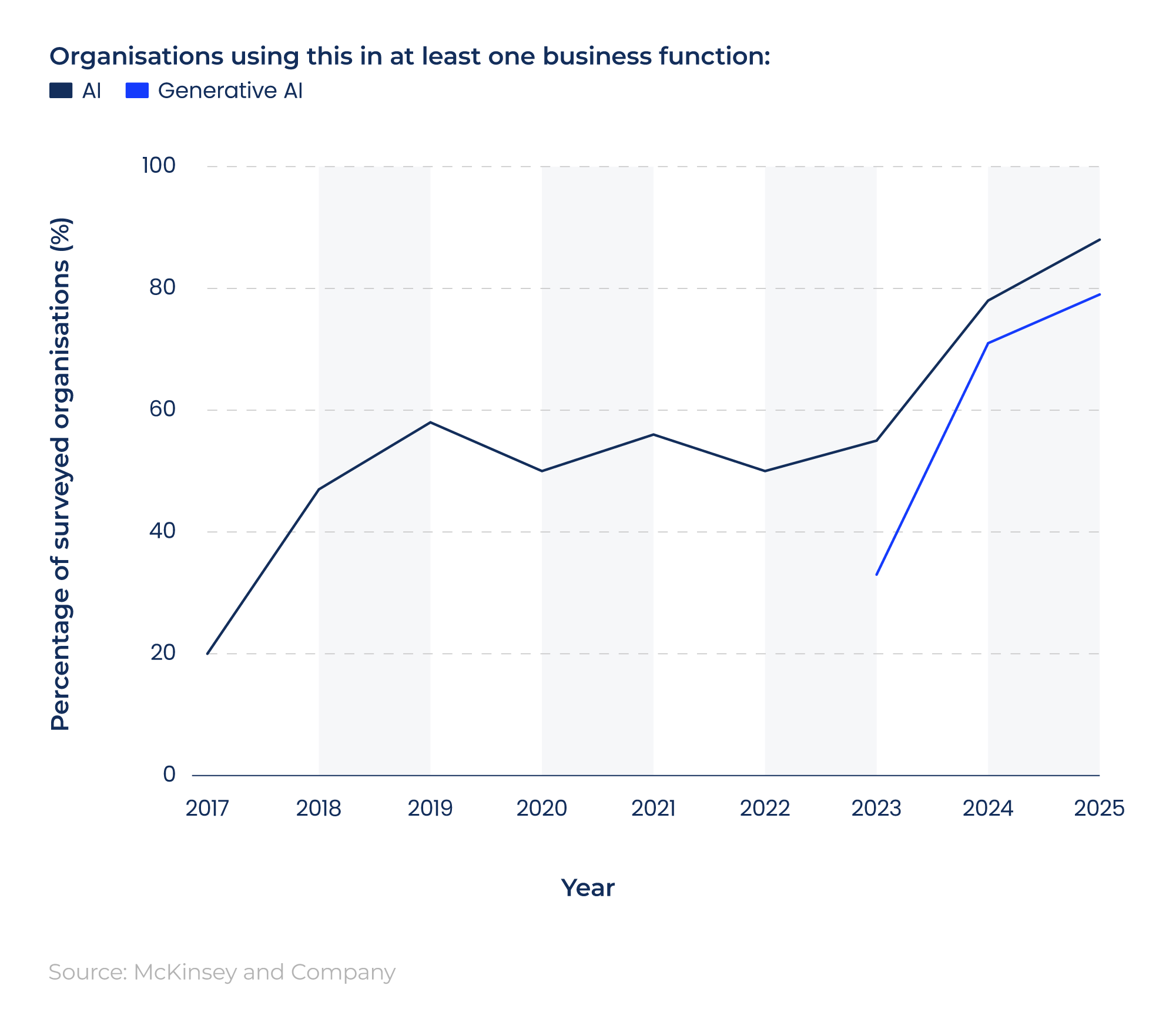 The number of AI-using businesses began to accelerate in 2018, when it more than doubled from 20% to 47%. After surpassing 50% for the first time in 2019, AI implementation would fluctuate over the next four years, before reaching 78% in 2024.
Generative AI has climbed at a similarly rapid rate since 2023, when just a third of businesses used the technology. The number would more than double to 71% a year later, before rising to 79% in 2025.
The percentage of AI-using businesses by integration phase, 2025
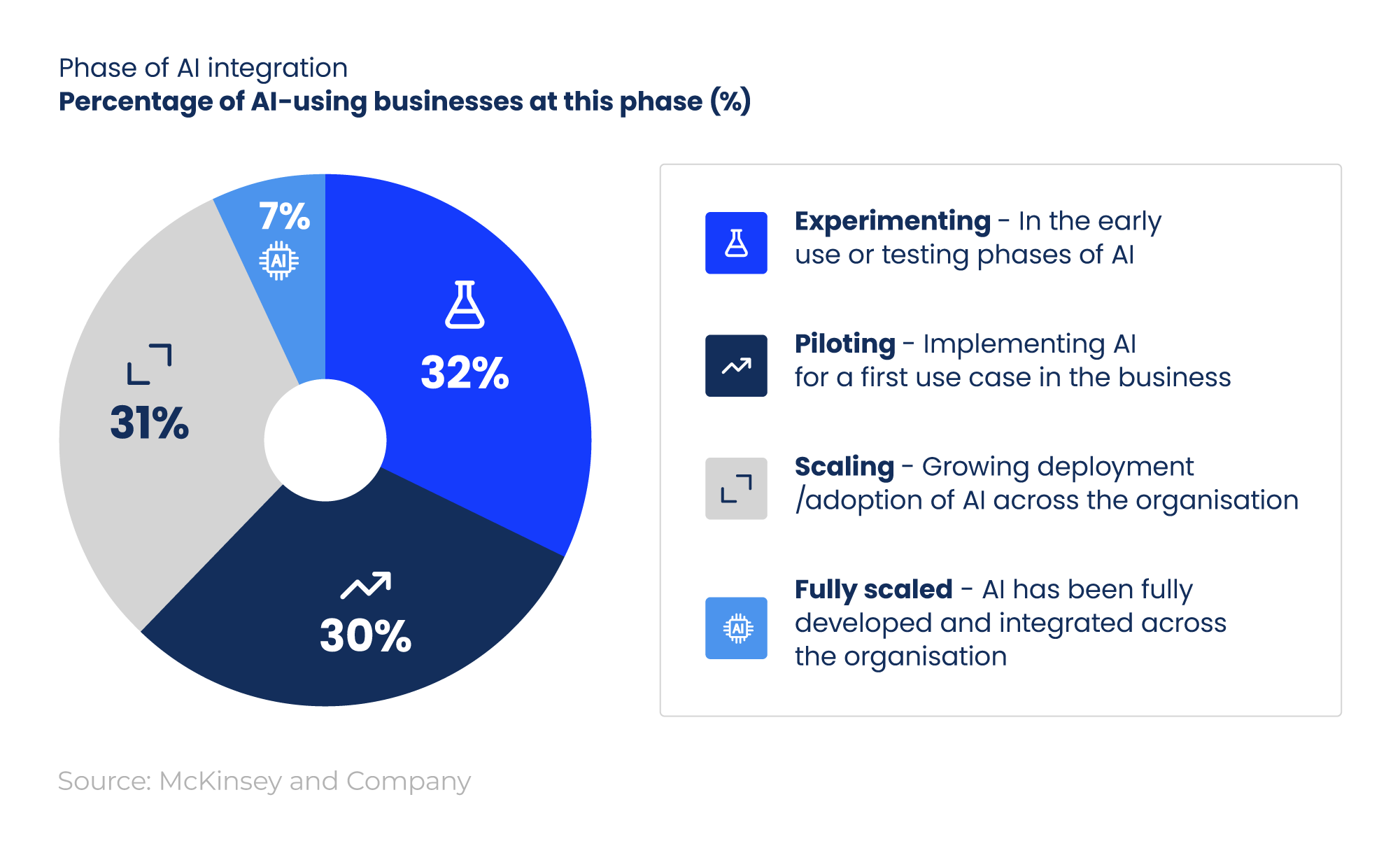 Just 7% of AI-using businesses claim that artificial intelligence has been fully integrated across the organisation. This is four times lower than the number at the scaling stage of AI adoption and 23 percentage points fewer than those piloting AI for a first use case.
32% of AI-using businesses are in the early use or testing phase, making this the most common stage among surveyed companies. Overall, 62% of AI-using businesses have yet to move beyond the piloting phase of adoption.
AI adoption rates by business size
A study from Moneypenny found that the AI adoption rate among businesses tends to increase with larger companies. Nearly all (98%) companies with between 250 and 500 employees had embraced some level of AI adoption, with this falling to 58% for sole traders.
Companies with between 50 and 249 employees were most likely to fully embrace AI adoption (37%), with this number falling among those with over 250 employees (34%).
AI adoption rate by stage and business size, 2025
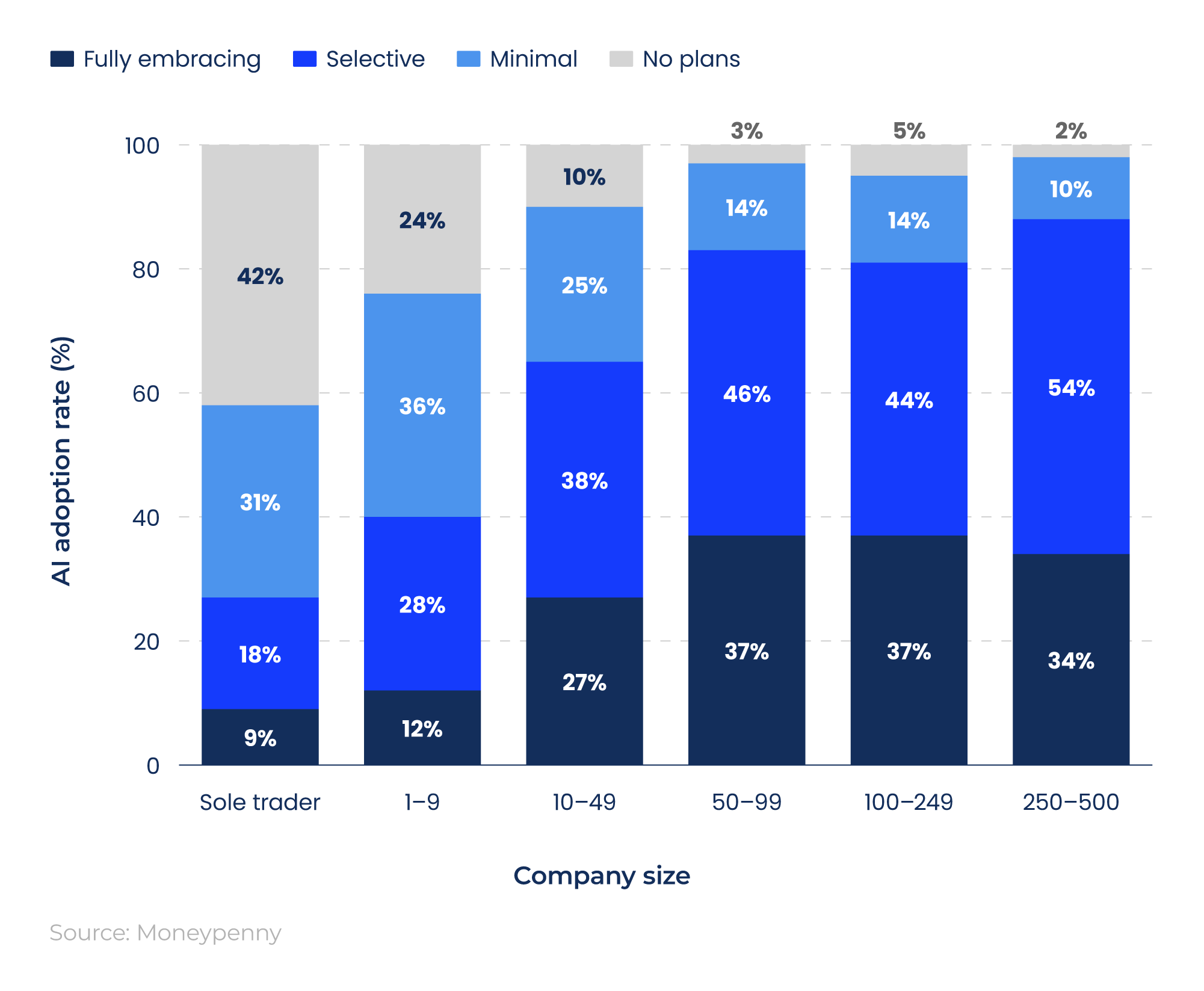 The business AI adoption rate climbs dramatically as companies hit the 10-employee mark. Just 12% of companies with between one and nine employees were fully embracing AI, with this number at least doubling for those employing 10 to 49 people.
AI adoption rate by business function
Analytics and reporting are the most common use cases for AI adoption among businesses, with 46% of companies currently using it for this purpose.
This was one percentage point more than the number using AI for customer support and chatbots, and two more than those using it for content creation and marketing.
AI adoption rate by business function, 2025
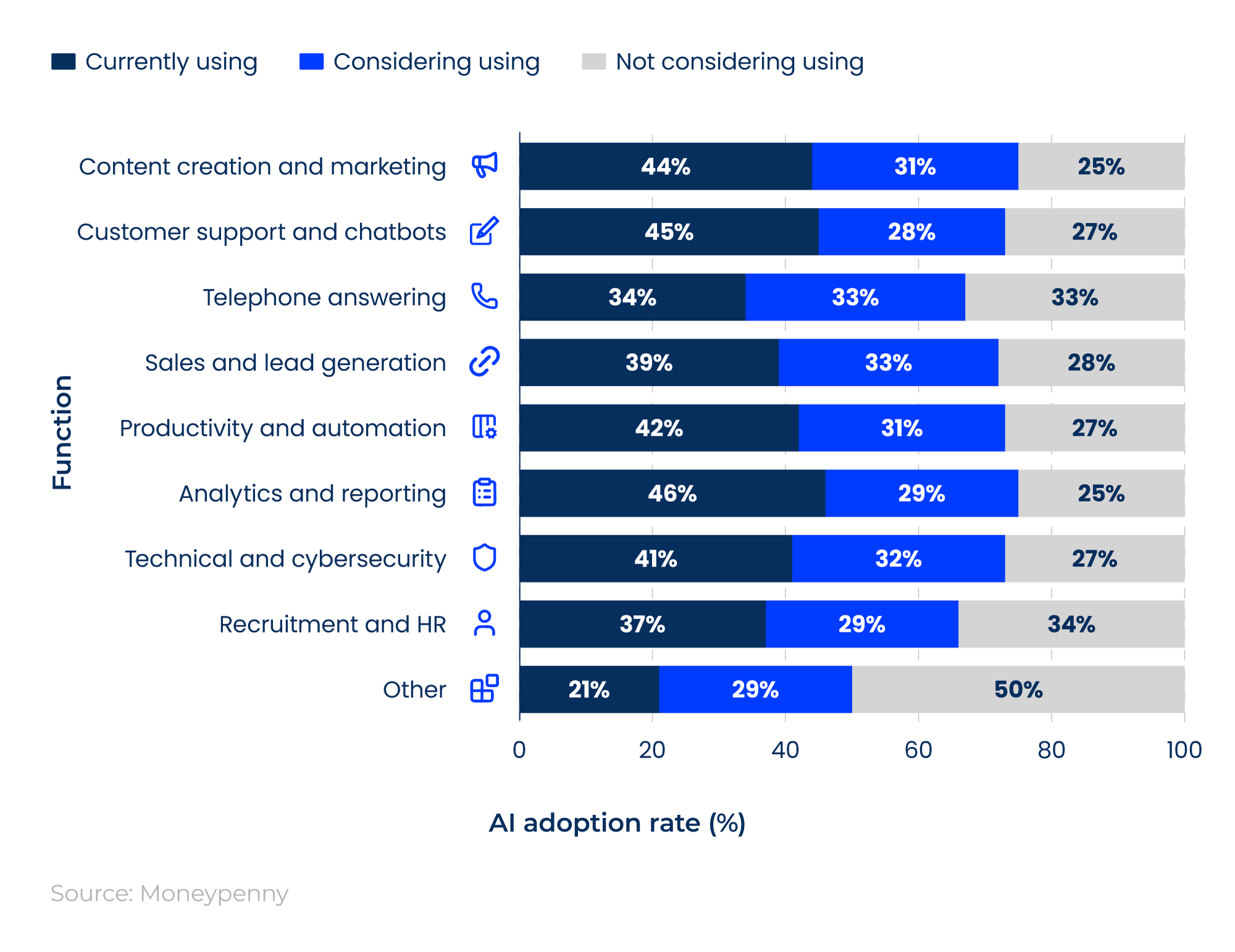 Only a third of businesses were currently using AI for telephone answering. This was five percentage points fewer than those using it for sales and lead generation. 41% of businesses state they employ it for technical and cybersecurity reasons.
AI adoption rate by industry
AI statistics show that 51% of businesses in IT and telecoms are fully embracing AI adoption. This was at least 19 percentage points more than any other industry, and the only sector where over a third of companies are fully embracing AI.
A further 42% of IT and telecoms companies reported selective AI adoption, with 5% citing minimal integration, suggesting that 98% of businesses in this sector are using AI to some extent.
AI adoption rate by scale and industry, 2025
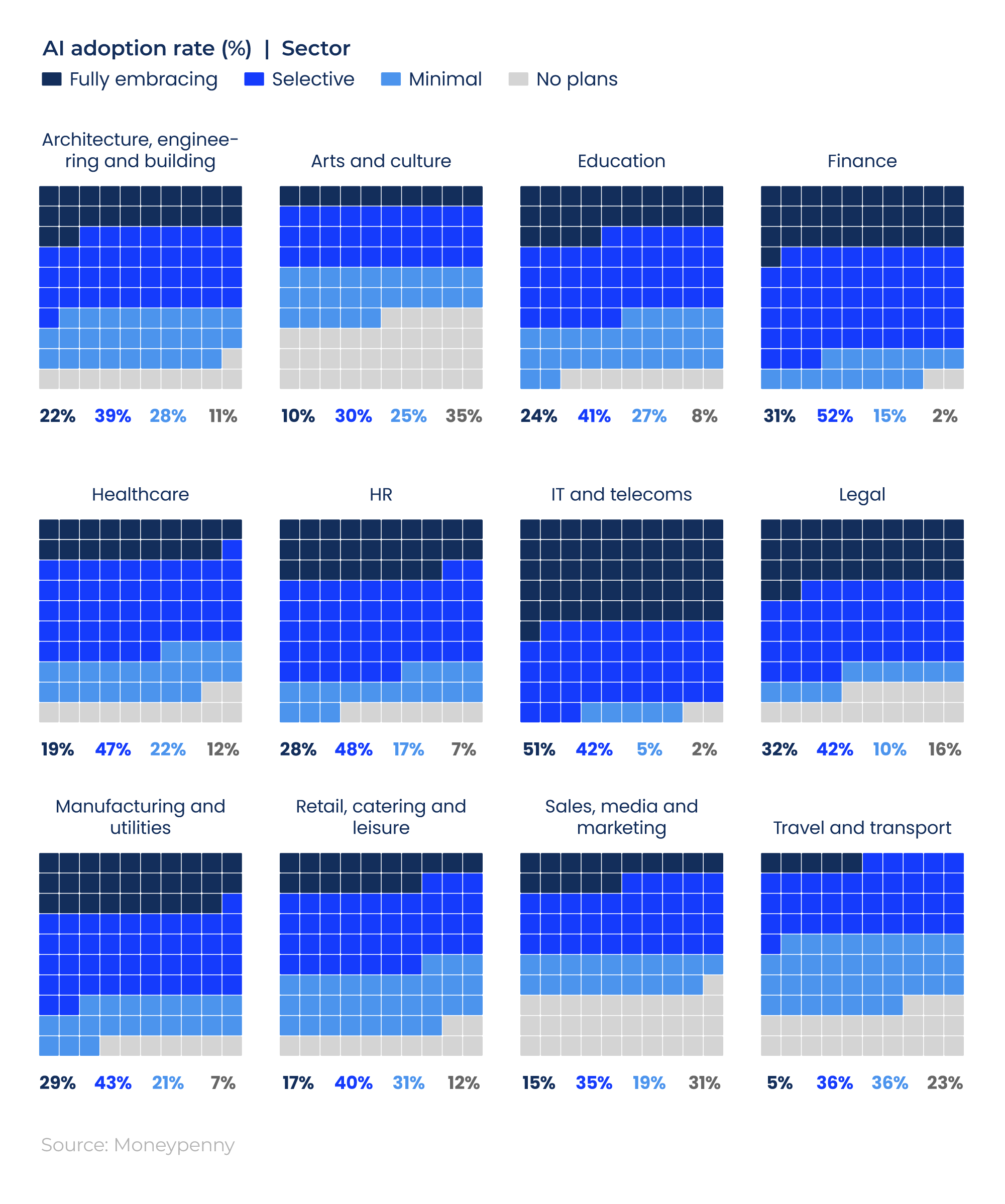 30% of businesses within the legal and financial sectors had fully embraced AI, with totals of 32% and 31%, respectively. This was over six times more than the total for travel and transport (5%) - the sector with the fewest number of businesses fully embracing AI.
Arts and culture was the sector with the highest number of companies reporting no plans for AI adoption, at 35%.
AI adoption by country
The UAE had the highest percentage of AI-adopting citizens in the second half of 2025, with its total of 64% just over three percentage points more than second-placed Singapore.
With a total of 60.9%, Singapore was the only other country where more than half of the residents had adopted artificial intelligence. The top five were rounded off by three European countries, with Norway, Ireland, and France all totalling between 44% and 47%.
AI adoption rate by country, 2025
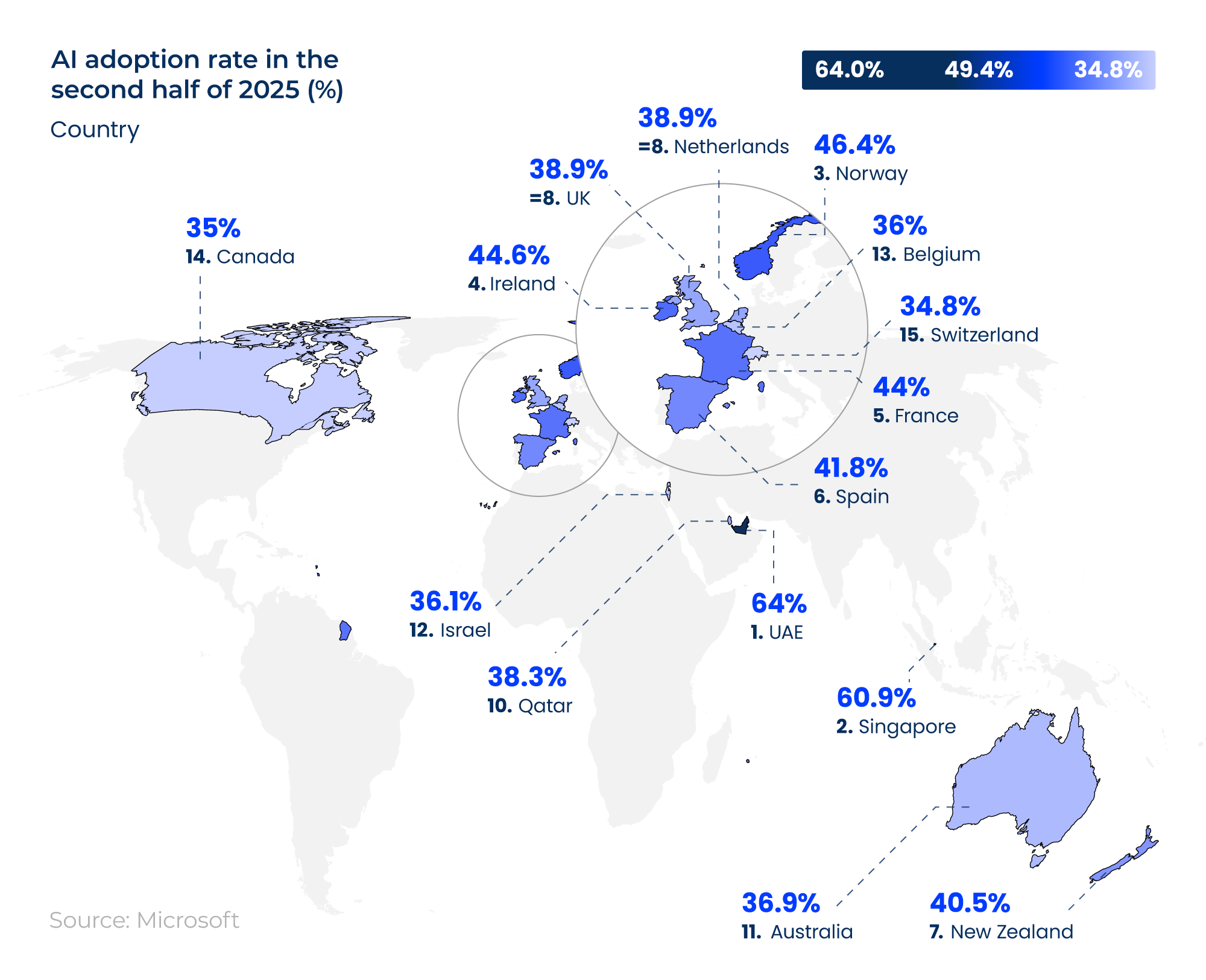 There is a diverse geographic split among the top 15 countries, with eight coming from Europe, four from Asia, two from Oceania, and one from North America. The UK’s AI adoption rate of 38.9% places it in joint eighth with the Netherlands overall.
AI adoption rate by global region, 2025
| Region | AI adoption rate in the first half of 2025 | AI adoption rate in the second half of 2025 | Percentage point increase |
|---|---|---|---|
| Global North | 22.9% | 24.7% | 1.8 |
| Global South | 13.1% | 14.1% | 1.0 |
| World | 15.1% | 16.3% | 1.2 |
Source: Microsoft
Analysis of AI adoption statistics shows that the global adoption rate stood at 16.3% in the second half of 2025. This represents a climb of 1.2 percentage points from the first half of the year.
The Global North is responsible for most AI adopters, with an overall rate of 24.7%, 10.6 percentage points more than the Global South.
The Global North’s adoption rate increased by 1.8 percentage points in the second half of 2025, compared to a jump of just one in the Global South, leading to speculation that the geographical gap in AI adoption may widen further with time.
AI engagement rate by country
The United States has the highest AI engagement rate of any country, according to a study by ApX Machine Learning. The AI engagement rate measures overall activity and interest in technical AI topics, reflecting the overall volume of learners in each nation.
The United States’ score of 100 was over three times more than the next highest country, suggesting that there are far more AI-engaged individuals in the US than in any other nation.
AI engagement rate by country, 2025
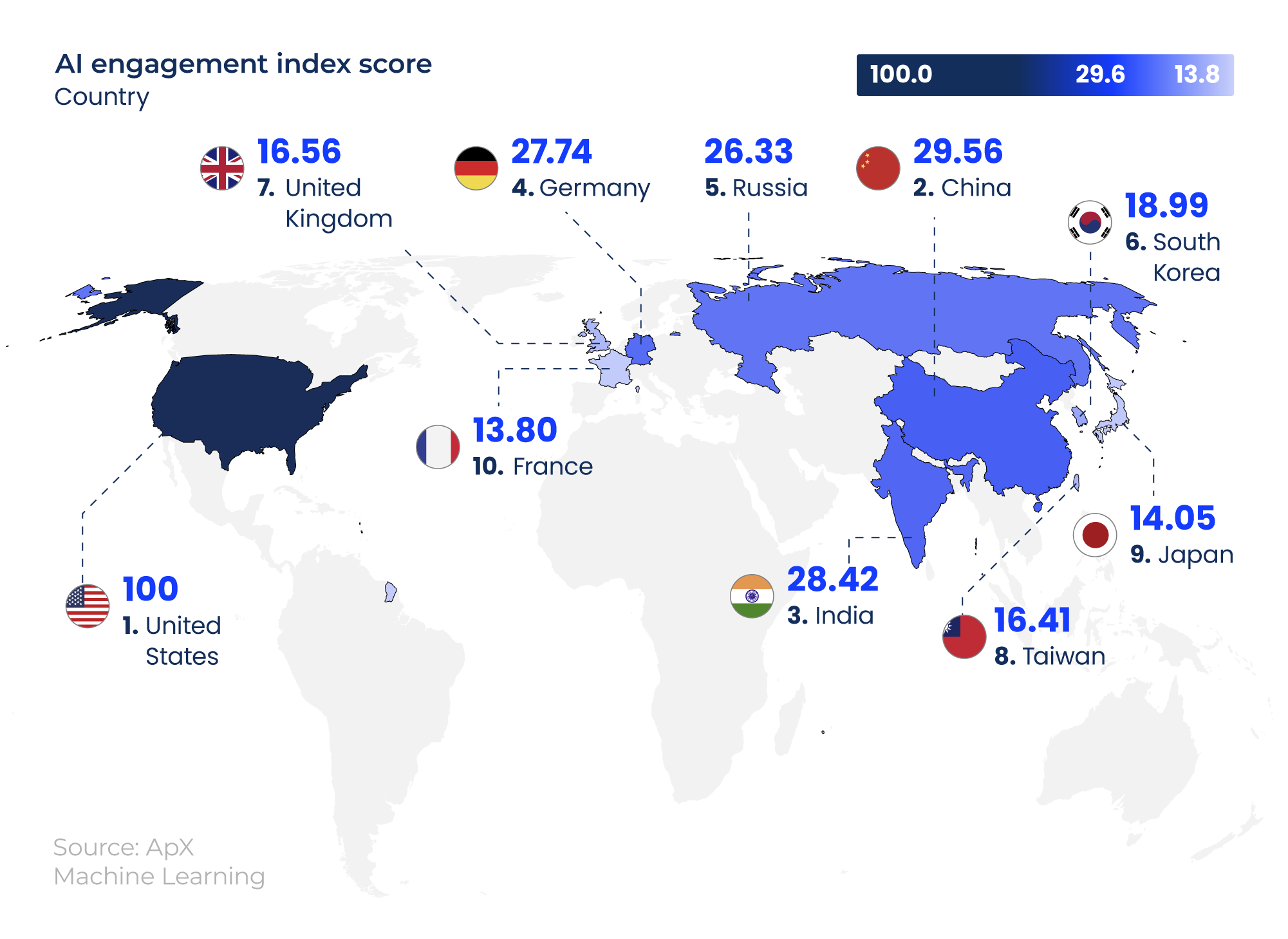 China was the second-highest country for AI engagement, with its index score of 29.56 nominally above third-placed India. The final countries to score above 20 were Germany and Russia, with totals of 27.74 and 26.33, respectively.
Asia was the continent with the most countries in the top 10, accounting for five of the overall list, followed by Europe with four.
AI engagement rate per capita by country, 2025
| Rank | Country | AI Engagement Index (Per Capita) |
|---|---|---|
| 1 | Singapore | 100.00 |
| 2 | Hong Kong | 90.32 |
| 3 | Taiwan | 34.61 |
| 4 | Switzerland | 33.63 |
| 5 | Netherlands | 25.83 |
| 6 | Sweden | 25.01 |
| 7 | Israel | 23.58 |
| 8 | Austria | 22.01 |
| 9 | Norway | 20.65 |
| 10 | South Korea | 17.41 |
Source: ApX Machine Learning
Singapore had the highest index rate per capita of any country. With an index score of 100, Singapore was roughly 10 points higher than neighbouring Hong Kong and around triple the total of third-placed Taiwan.
Fourth-place Switzerland was the highest non-Asian country on the list, with an AI engagement score of 33.63. Switzerland was one of six European countries in the top 10, with the other four coming from Asia.
Overall, the results highlight a clear distinction between scale and intensity. While the United States leads in total AI interest by number of individuals, per-capita engagement is notably higher in smaller, highly digitised countries.
AI adoption rate by region
Four in 10 businesses in Northern Ireland are fully embracing AI adoption, according to Moneypenny’s AI stats. This was the highest total across the UK - one percentage point more than the North East (39%).
Greater London was the only other region with more than a third of businesses fully embracing AI, with its total of 35% placing it third overall. Despite this, Greater London had the highest rates for selective AI adoption (47%), and was the only region where less than a tenth of companies had no plans for AI adoption.
UK business AI adoption rates by region and level, 2025
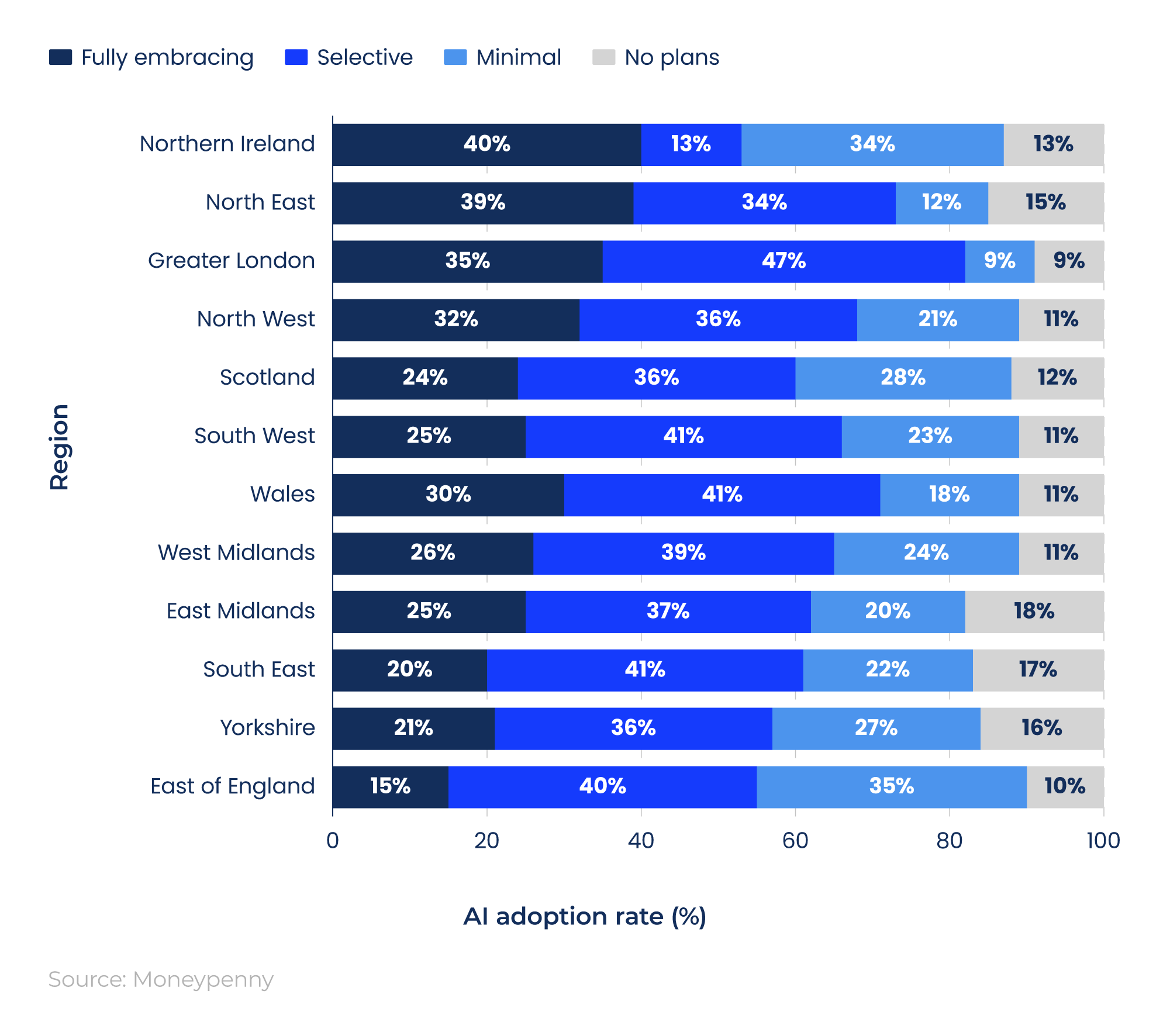 At the other end of the scale, just 15% of businesses in the East of England had fully embraced AI adoption, five percentage points fewer than any other region. The East Midlands had the highest percentage of businesses with no AI adoption plans (18%), followed by the South East (17%) and Yorkshire (16%).
AI adoption rate by age
Those aged between 30 and 49 were most likely to use AI, according to a 2025 American study by the Pew Research Center, with 37% interacting with it at least several times a day. This was four percentage points more than the number of 18-to-29-year-olds who answered the same, and seven more than those aged between 50 and 64.
Just 19% of those aged 65 and over used AI several times a day, the lowest total of any age group. Overall, just 30% in this age group used AI at least once a day, with all other age groups sitting above 40%.
US AI adoption rate by age, 2025
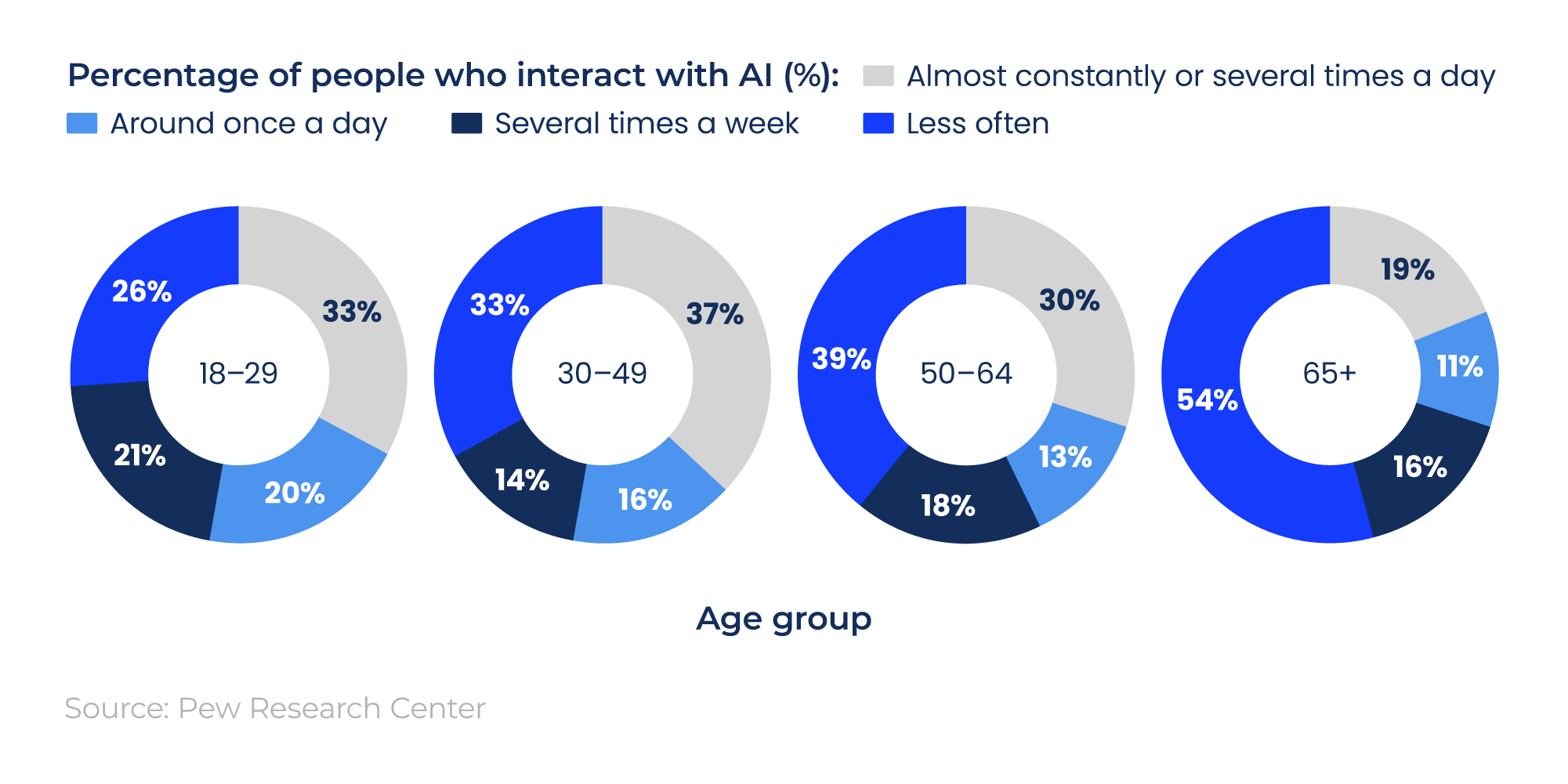 There is a direct correlation between age and minimal AI use, with just 26% of 18-to-29-year-olds using AI less than several times per week. This was less than half the number of those aged 65 and over (54%) who answered the same.
Statistics on the benefits of AI in the workplace
Nearly two-thirds (64%) of surveyed companies believed that AI had improved their company’s innovation efforts in 2025. This was 19 percentage points more than any other workplace measure and the only one in which more than half of businesses reported improvement.
Change in market share was the least positively affected measure, with only 25% of businesses reporting improvement. This made it the only measure for which fewer than one-third of respondents perceived a positive impact, suggesting that AI’s benefits may be more immediate within internal operations than in external competitive outcomes.
AI impact by organisational measure, 2025
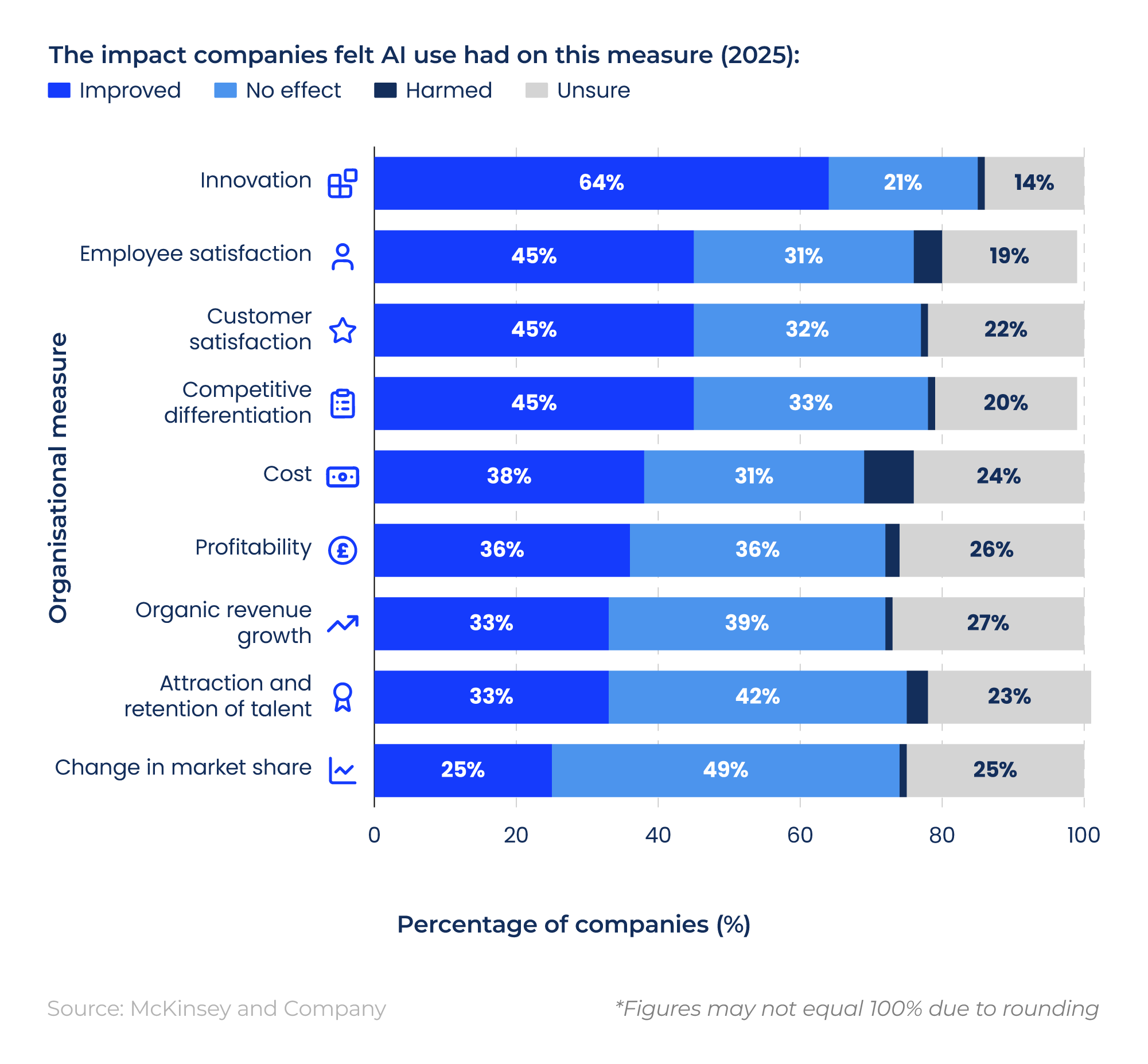 Negative impacts from AI adoption were generally limited across all measures. Cost was the area with the highest reported negative effect, cited by 7% of companies, three percentage points more than any other measure.
However, this proportion was substantially lower than the share of organisations reporting positive cost impacts (38%), highlighting the overall net benefit of AI use in the workplace.
AI productivity statistics
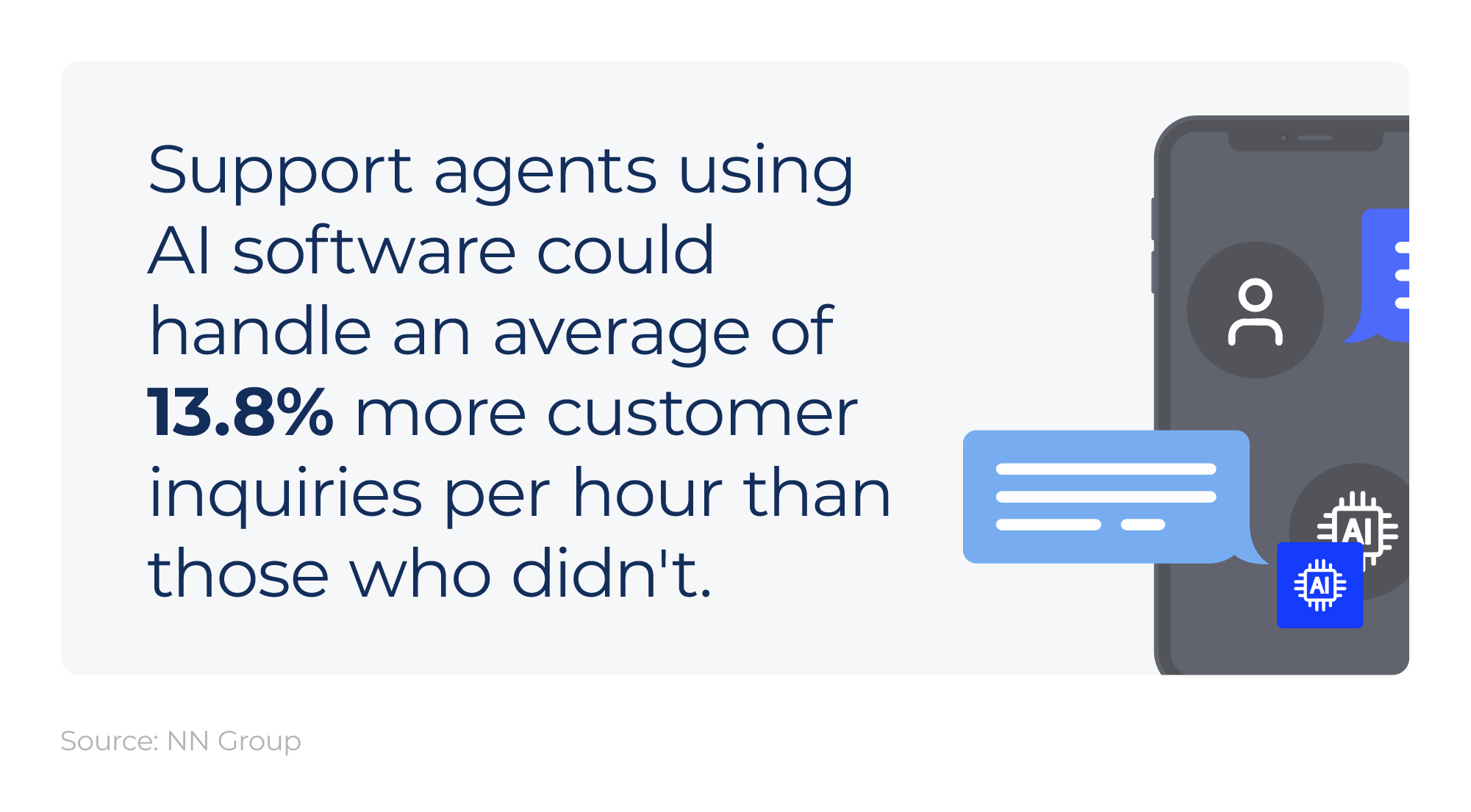
There is a range of productivity benefits from artificial intelligence use in the workplace, an AI trends report by NN Group found. Support agents using generative AI could handle just under 14% more customer enquiries per hour, though business professionals were able to write 59% more documents.
 The same AI statistics found even bigger benefits for programmers, who saw their weekly completed projects more than double (+126%) on average. Taken together, these findings suggest that generative AI tools increased user output by an average of 66% when performing realistic workplace tasks.
To put this in perspective, average annual labour productivity growth was just 1.4% in the United States and 0.8% in the European Union between 2007 and 2019. At these rates, a 66% productivity increase would normally take approximately 47 years to achieve in the US and 88 years in the EU.
These results were gathered using earlier generative AI models; future improvements could be even greater as functionality develops.
AI efficiency statistics
Analysis of AI trends showed a direct correlation between AI usage and the amount of time saved in the workplace. Over a third of workers who used the technology every day reported time savings of at least four hours, with this figure falling to 11.5% for those using it just once a week.
AI time savings by weekly usage levels
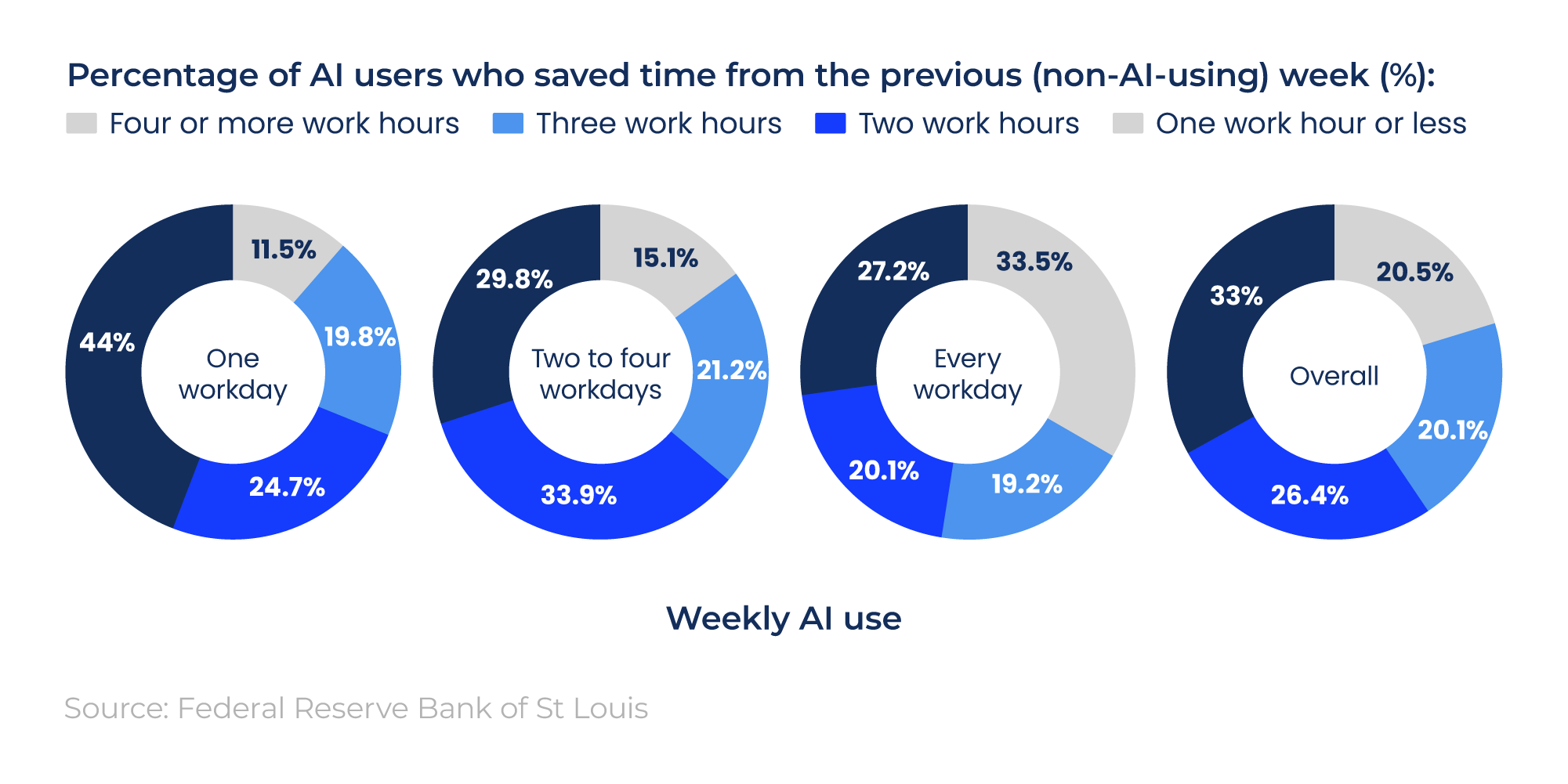
Over 31% of weekly AI users saved at least three hours of work per week, with this figure surpassing 36% for those using it between two and four days a week.
Over half of daily users saved at least three working hours, with 72.8% saving a minimum of two.
Percentage of time saved from AI use by occupation and overall usage
| Occupation | Share of the previous week’s working hours spent using AI | Overall time savings (%) |
|---|---|---|
| Computer and maths | 11.7% | 2.5% |
| Management | 9.7% | 2.2% |
| Business and finance | 6% | 1.7% |
| Education | 5% | 1.5% |
| Health practitioners | 9.1% | 1.3% |
| Art, entertainment, and sports | 7% | 1.3% |
| Architecture, engineering, and science | 6.3% | 1% |
| Sales | 3.4% | 1.1% |
| Blue collar | 4% | 1% |
| Legal and social services | 3.2% | 0.9% |
| Office and administration | 4.6% | 0.6% |
| Personal services | 1.3% | 0.4% |
Source: Federal Reserve Bank of St Louis
AI statistics from the Federal Reserve Bank of St Louis highlighted a link between the volume of generative AI use and the amount of time saved by industry.
Computer and maths occupations saw the biggest time savings from generative AI use (2.5%), followed by management roles (2.2%). These were also the two occupations with the highest percentage of weekly working hours spent using the technology.
Conversely, personal services jobs saw the lowest productivity increases at 0.4%, with the same roles having the lowest percentage of generative AI use in the study (1.3%).
There were some exceptions to the rule, with health practitioners seeing lower productivity increases than those in education, despite having higher usage rates.
AI vs human task completion speed
A study from the UK government compared the time taken to complete a research study with and without generative AI use. The goal was to see whether AI tools could help researchers work faster when reviewing evidence when the topic, brief, and expectations were identical.
Overall, AI assistance was found to cut total project time by over 27 hours, dropping to 90.5 hours from 117.75.
The hours taken to complete a research task with and without AI assistance
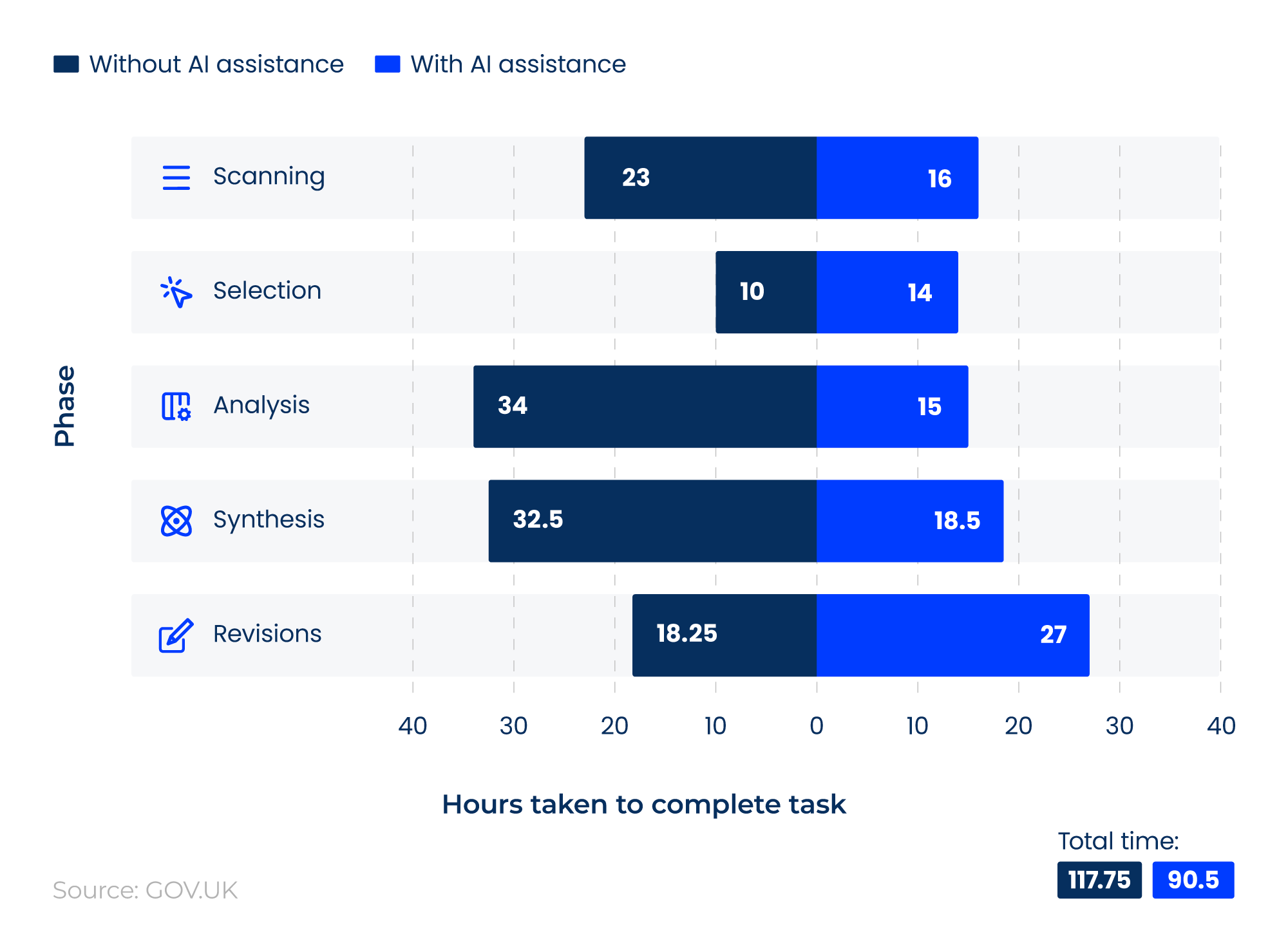 Analysis saw the biggest time savings in individual tasks, with AI use more than halving the required time from 34 hours to just 15.
Despite the overall time benefits, generative AI use actually increased the time needed for two of the five individual tasks. The biggest increases were seen in revisions, which rose nearly 50% from 18.25 hours to 27.
Cost savings from AI automation
Software engineering and manufacturing were the business areas most likely to see savings from AI use, with 56% of AI-using businesses reporting reduced costs in these functions.
In software engineering, just over a fifth of companies achieved cost reductions of at least 11%, including 7% that reported savings of 20% or more. By comparison, just 4% of businesses said they’d cut manufacturing costs by 20% or more from AI use, suggesting more modest savings overall.
Average cost savings from AI use by business area, 2025
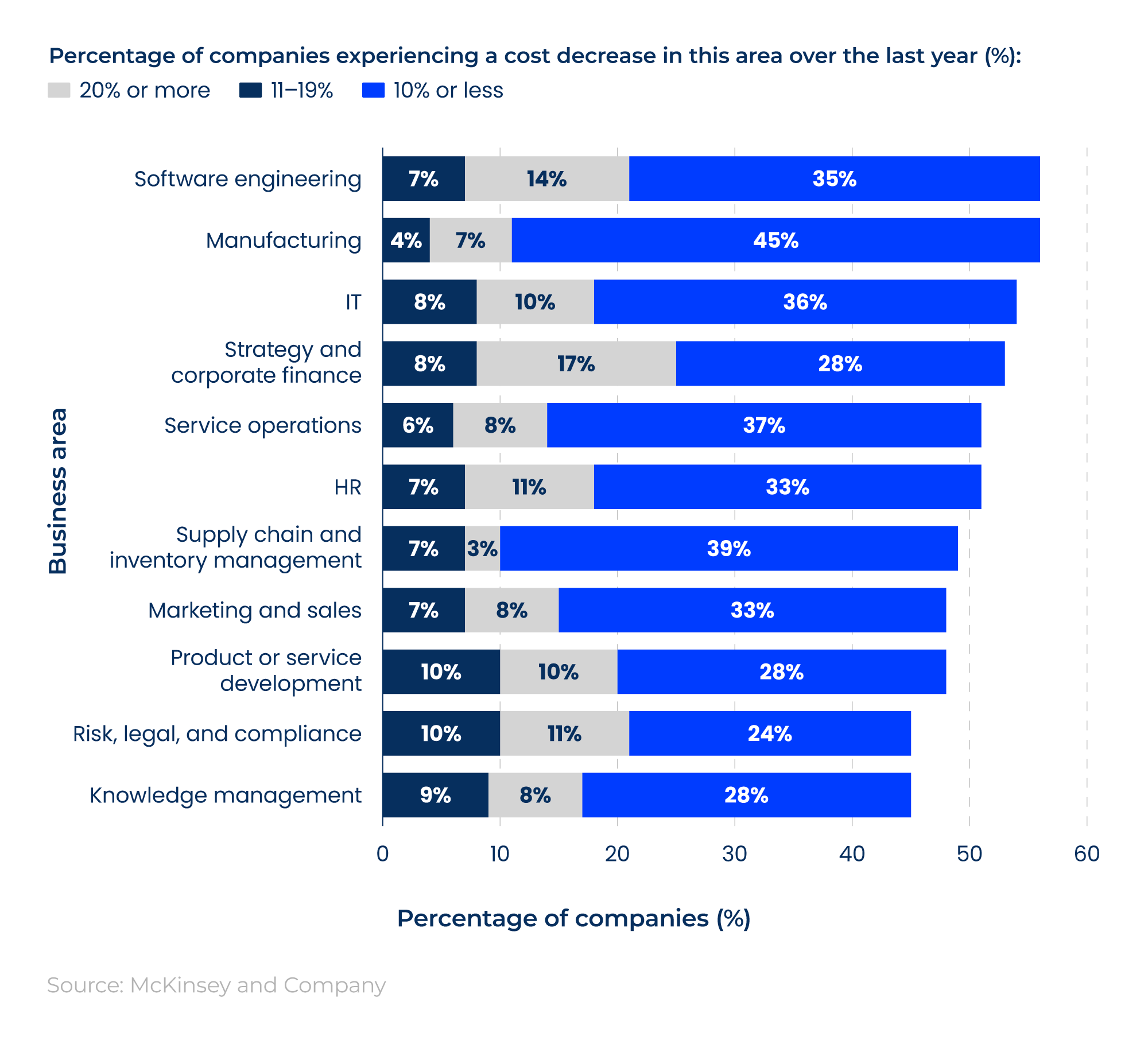 More than half of businesses reported cost reductions in IT (54%), strategy and corporate finance (53%), service operations (51%), and HR (51%). By contrast, knowledge management and risk, legal, and compliance had the lowest overall incidence of cost savings, at 45%
The risk, legal, and compliance sector was one of only two departments in which 10% of companies saved at least 20% from AI use, alongside product or service development.
Revenue increases from AI automation
AI adoption was most strongly linked to revenue growth in marketing and sales, where 67% of AI-using businesses reported increased revenue in 2025. This was the highest total of any business area, with strategy and corporate finance, and product and service development, the only others with totals above 60%.
These three areas were also the only functions in which at least 10% of businesses experienced revenue increases of more than 10%.
Average revenue increases from AI use by business area, 2025
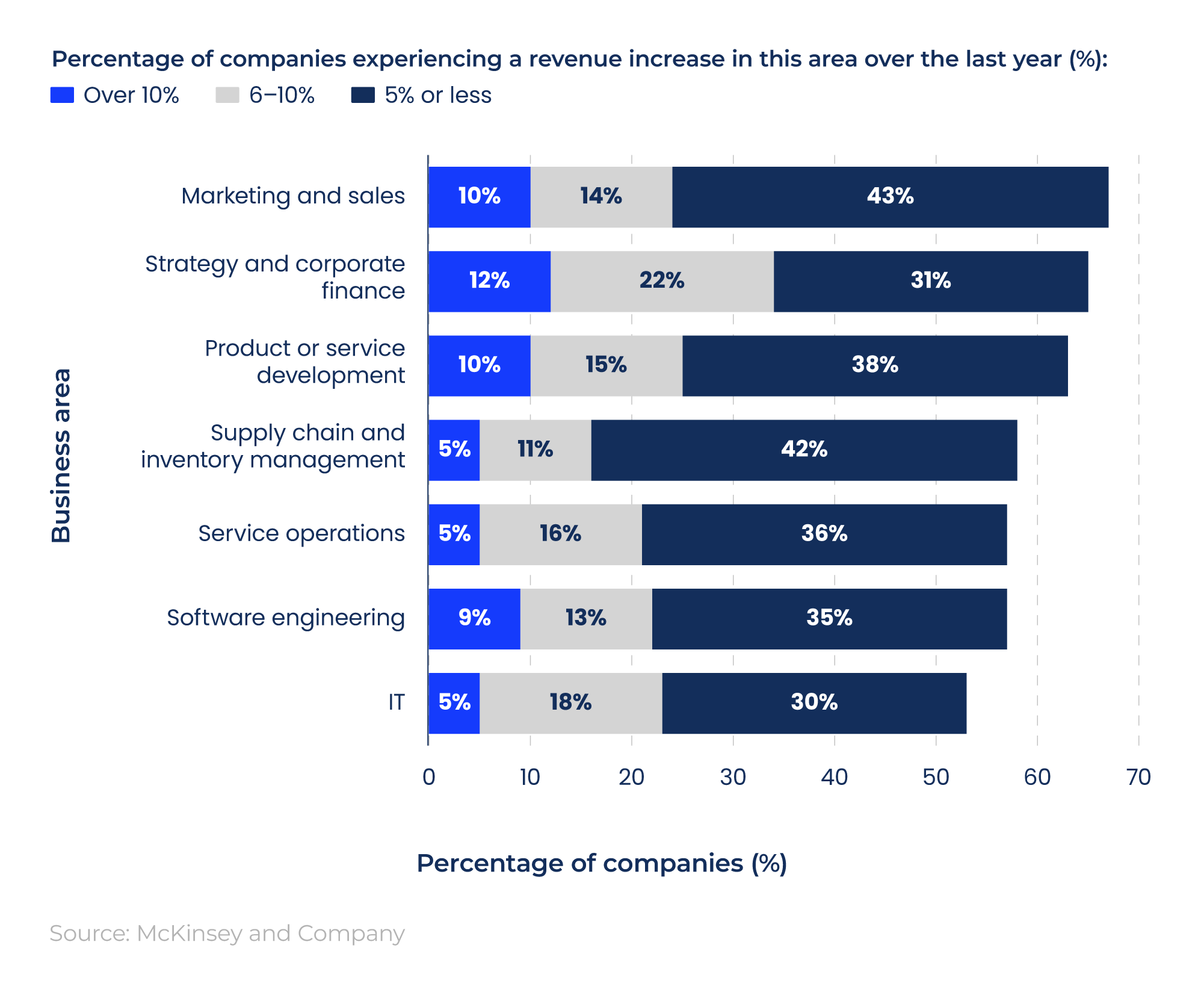 By contrast, 53% of businesses saw revenue increases in their IT operations, with just 5% reporting gains of over 10%. Software engineering and service operations had the next lowest number of revenue increases, with overall totals of 57%, 10 percentage points fewer than marketing and sales.
AI usage statistics by industry
Usage of AI in advertising and marketing
Analysis of AI statistics shows that creative content generation is the most common AI use case among marketing and advertising companies. With 54% using the technology for this purpose, creative content was three percentage points more than audience targeting and segmentation.
The most common AI uses among advertising organisations
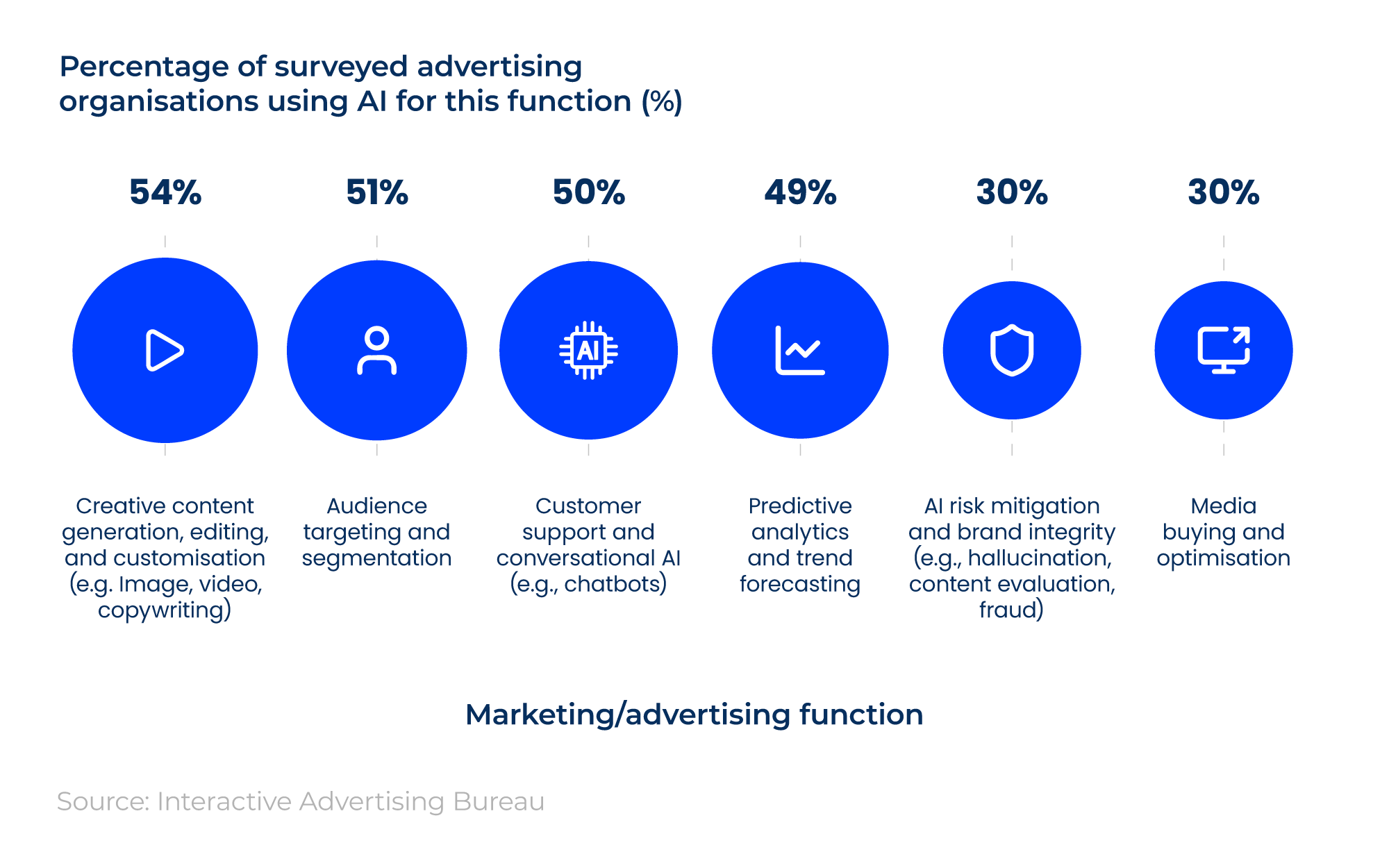 Just 30% of advertising businesses used AI for risk mitigation and brand integrity, which was the joint-lowest function alongside media buying and optimisation. This was 20 percentage points fewer than those who’d employed it for customer support and conversational AI.
The top AI usage concerns among advertising organisations
| Concern | Percentage of surveyed advertising organisations citing this among their top three concerns relating to AI usage |
|---|---|
| Misinformation and deepfakes | 40% |
| Loss of creative control | 39% |
| Brand integrity risks | 37% |
| Consumer scepticism and trust issues | 37% |
| Bias, fairness, and discrimination | 26% |
| Loss of internal expertise or tools for oversight | 24% |
| Compliance with standards and regulations | 23% |
| Susceptibility to adversarial attacks and prompt manipulation | 22% |
| Inability to monitor or validate outputs at scale | 16% |
Source: Interactive Advertising Bureau
Misinformation and deepfakes were the most common concerns among advertising companies around AI usage, with 40% expressing concern. This was one percentage point more than those who cited loss of creative control, and three more than those referencing brand integrity risks.
By contrast, just 16% were concerned about the ability to monitor or validate outputs at scale. This was six percentage points fewer than any other concern, and less than half the total worried about misinformation and deepfakes.
Usage of AI in retail and eCommerce
AI statistics from Bloomreach revealed that the eCommerce AI market is projected to be worth $22.6 billion by 2032, reflecting the widespread demand and investment in AI use within the industry.
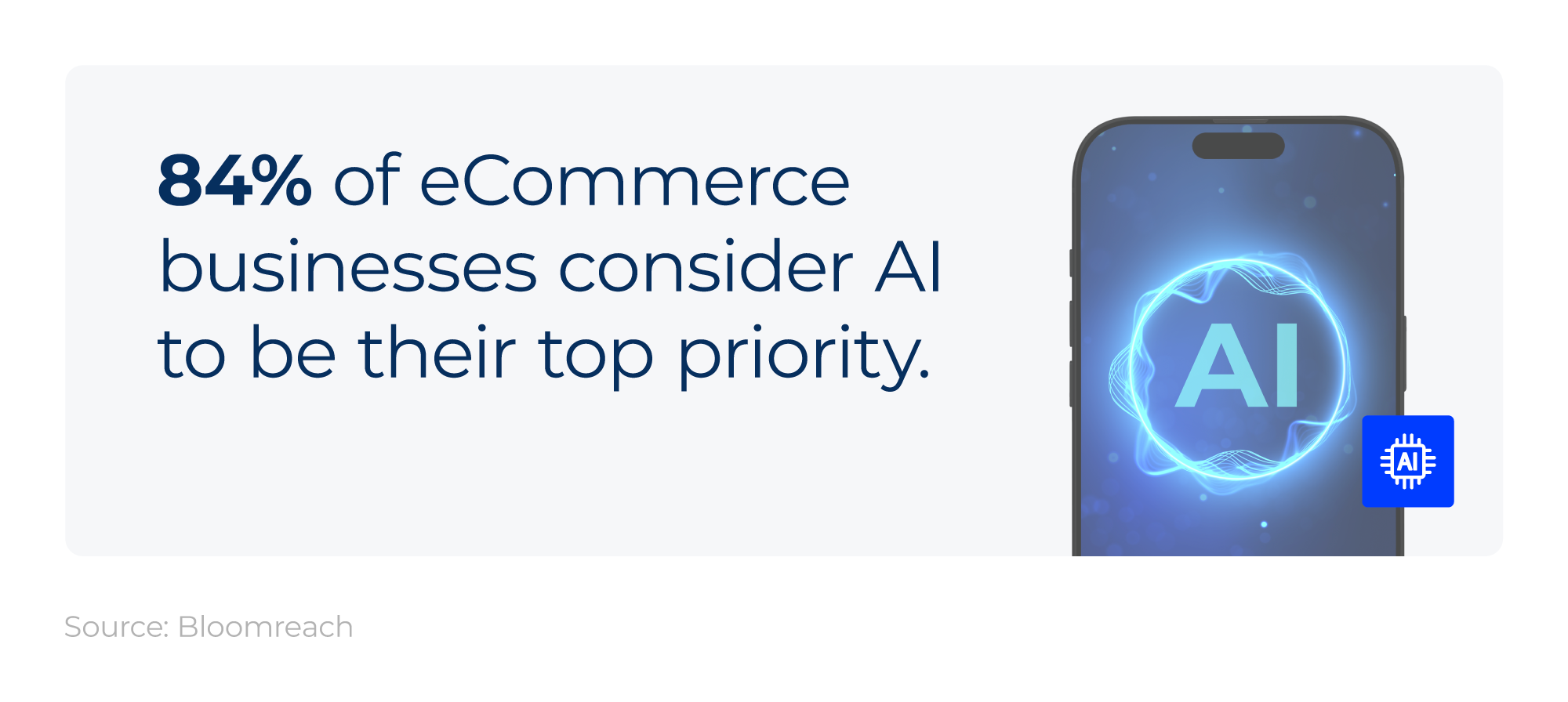 The same report revealed that 84% of eCommerce businesses consider AI to be their top priority, with the technology delivering more than 25% improvements in revenue, customer satisfaction, and costs. It’s no surprise that 93% of eCommerce brands view AI agents as a competitive advantage.
The impact of AI in eCommerce was further validated by another report, which found that AI chatbot use can boost conversions by 35%. The benefits extended to future planning, with around 60% of retail buyers saying AI had improved their demand forecasting accuracy.
As AI becomes more familiar to customers in eCommerce, trust increases. Around 70% of consumers said they’d purchase flights using AI agents, with 65% happy to use them to book hotels and resorts.
AI is making similar inroads within retail, with over 90% of retailers either actively using AI in their operations or assessing AI projects. This has brought notable results, with 87% saying AI had positively impacted revenue and a further 94% citing reduced operational costs.
Discover the latest search trends powering the eCommerce industry in our comprehensive eCommerce SEO statistics report.
Use of AI in banking and finance
AI in financial markets is projected to be worth $190.33 billion in 2030 – up from $38.36 billion in 2024. This signals a CAGR of 30.6% over six years.
Chatbots are commonplace in the banking and finance sectors, and customer trust remains an issue regardless of AI agents. Just 10% of surveyed consumers said they completely trust AI agents, with a further 44% saying they somewhat trust them.
 The caution around AI capability can also be seen through a business lens, with 88% of technical decision makers feeling that the technology’s outputs are only as good as its data inputs.
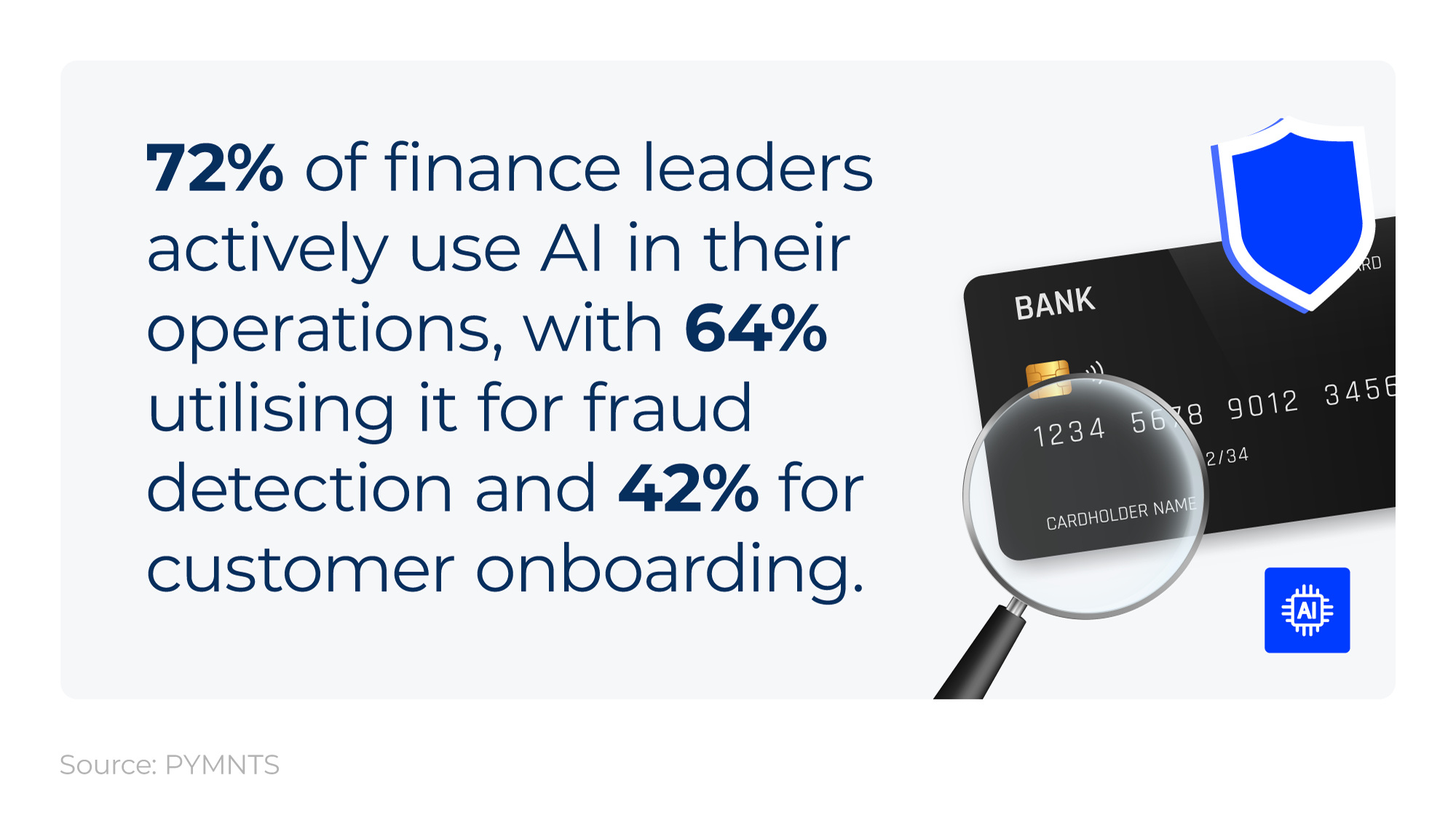
Despite this, 72% of finance leaders are actively using AI in their operations, with 64% utilising it for fraud detection and 42% for customer onboarding.
What are the benefits of AI in banking?
Recent AI stats by Citrusbug found that AI automation helped reduce operations costs in major US banks by 13% in 2025. Processing errors fell by 40%, although compliance monitoring tools helped cut audit preparation times by 50%.
The same report found:
- Banks utilising AI for underwriting improved loan processing times by 25%.
- AI reduced data capture, reconciliation, and compliance checking by up to 35%.
- AI-powered chatbots can cut banking call centre costs by up to 70%.
The productivity impact of AI in banking brings financial benefits, with analysts estimating that AI could drive net cost reductions of 15% to 20%.
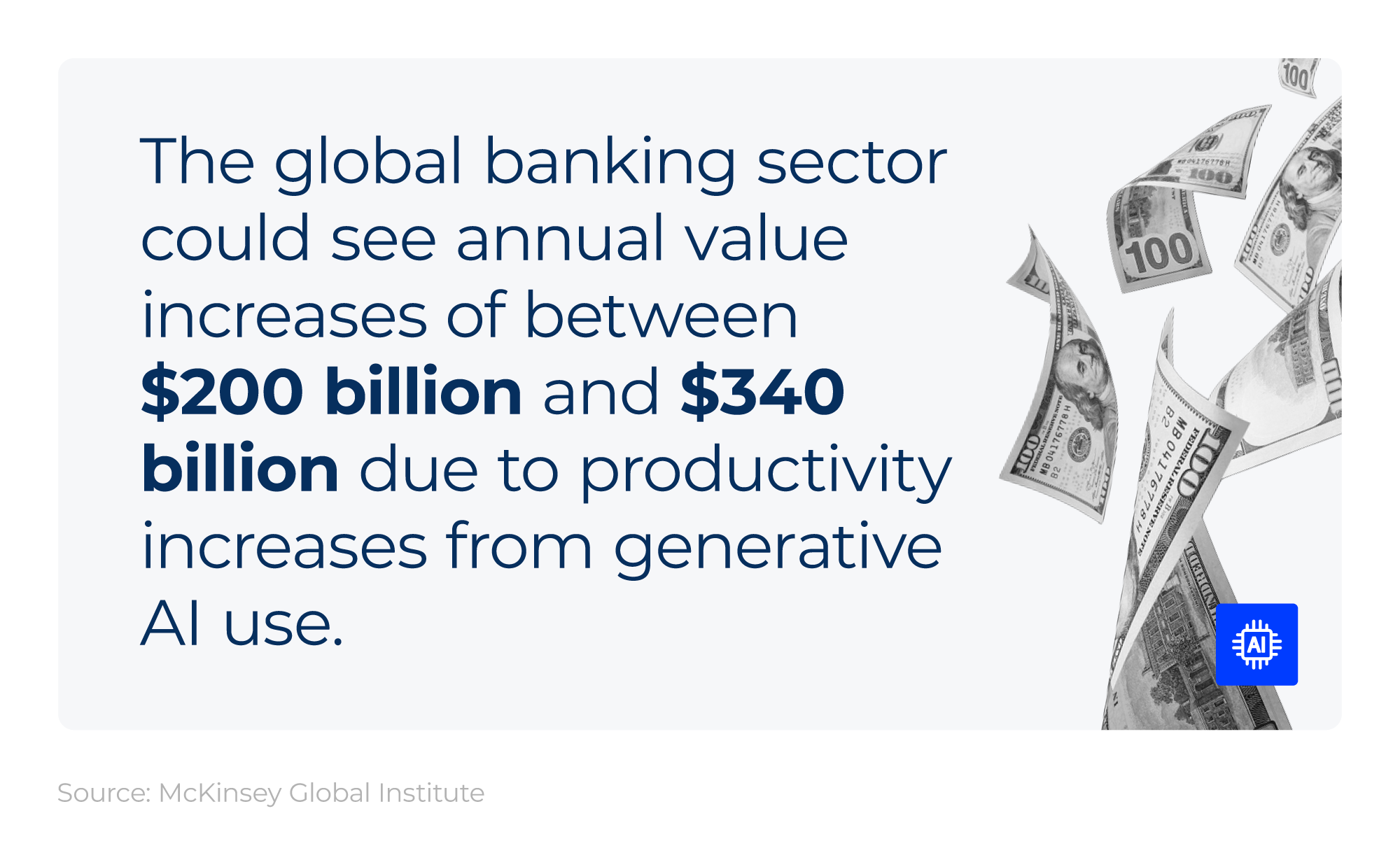 Elsewhere, McKinsey Global Institute estimated that generative AI could add between $200 billion and $340 billion per year to the banking sector, through increased productivity. This equates to between 2.8% and 4.7% of total industry revenue.
Use of AI in healthcare and life sciences
Generative AI use has brought numerous benefits across the healthcare and life science sectors, with 72% of organisations citing increased productivity. A further 61% claimed the software had enhanced patient experience, with over half citing business growth.
The most common areas for improvement from generative AI use in healthcare and life sciences
| Area of use | Percentage of healthcare and life science organisations reporting improvements from generative AI use |
|---|---|
| Productivity | 72% |
| Patient experience | 61% |
| Business growth | 52% |
| Marketing | 49% |
| Security | 46% |
Source: Google Cloud
Marketing and security were other areas seeing improvements, with 49% and 46% reporting positive impacts in these areas, respectively. This demonstrates the cross-departmental benefits generative AI can bring across these industries.
With so many benefits reported across the workplace, it’s no surprise that 73% of healthcare and life science leaders reported a positive ROI in their first year of generative AI adoption.
AI impact on jobs and employment
Just under a third (32%) of businesses expected AI adoption to decrease their number of employees over the next year in 2025. Of these, the largest portion (20%) expected their employee count to drop between 3% and 10%, with a smaller group (4%) anticipating decreases of over 20%.
AI impact on employee numbers over the next year among surveyed companies, 2025
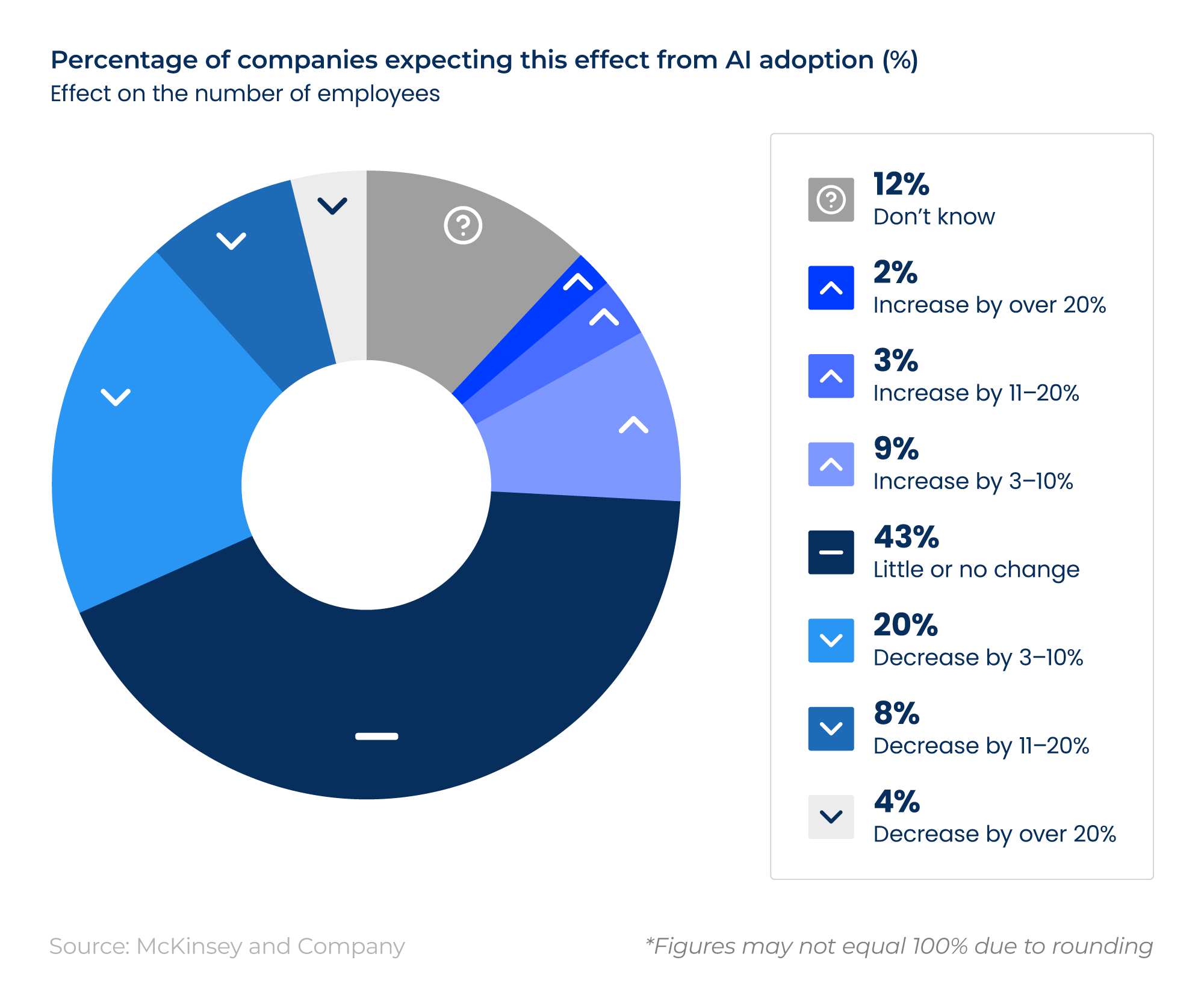 Just 14% of businesses expect their employee count to increase in the wake of AI, with the majority of these (9%) predicting rises of between 3% and 10%. Just 3% anticipated rises of between 11% and 20% over the year, with a further 2% expecting even greater increases.
Despite AI’s substantial impact on the workplace, 43% of companies expect no or very little change in their employee headcount over the year. This was 11 percentage points more than the number expecting employment reductions and more than triple the total anticipating increases.
Elsewhere, our AI in marketing statistics report revealed that 53% of marketing professionals think AI will eliminate more jobs than it creates in the next three years, suggesting that concern may be greater among professionals in strategic and communications-based roles.
Jobs most affected by AI
A Microsoft AI statistics study found that 98% of common tasks in interpreter and translator roles can be performed by AI.
The data indicated that other specialist knowledge and language-based roles were among the most automatable, with historians, mathematicians, and proofreaders each recording scores above 90%.
The jobs with the highest number of common tasks that AI can replicate
| Job | Percentage of common tasks that AI could perform |
|---|---|
| Interpreters and translators | 98% |
| Historians | 91% |
| Mathematicians | 91% |
| Proofreaders | 91% |
| Automatic machine coders | 90% |
| Writers and authors | 85% |
| Statistical assistants | 85% |
| Sales representatives | 84% |
| Technical writers | 83% |
| Journalists | 81% |
| Passenger attendants | 80% |
| Telephone operators | 80% |
| Editors | 78% |
| Farm and home management educators | 77% |
| Political scientists | 77% |
| Data scientists | 77% |
| Geographers | 77% |
| Announcers and radio DJs | 74% |
| Brokerage clerks | 74% |
| Web developers | 73% |
Source: Microsoft via Sky News
A wider range of roles, including writers, journalists, statistical assistants, and sales representatives, fall into the middle of the list. Although these jobs still require human judgment and creativity, AI can handle much of the routine work involved, resulting in scores of between 80% and 90%.
AI skills demand and salary uplift
A 2025 AI report revealed that AI-skilled workers saw an average wage premium of 56% in 2024, compared to non-AI-skilled workers. This represents a rise of more than double from the previous year, when the total stood at 25%.
The study revealed that job availability grew 38% in the roles most exposed to AI, suggesting a preference for augmentation and upskilling over job replacement. However, the growth rate was below that experienced by less AI-exposed roles (65%).
 The sectors most exposed to AI saw their average revenue per employee climb by 27%, three times more than those in the least exposed jobs (9%). This suggests that the productivity and efficiency gains from increased AI use are providing financial benefit through task automation.
The skills sought by employers changed at a 66% faster rate in the roles most exposed to AI, compared to less exposed occupations. This is nearly double the total from the previous year, when changes occurred at a 25% faster rate. This indicates that adaptability will become an increasingly important trait in the roles most exposed to AI.
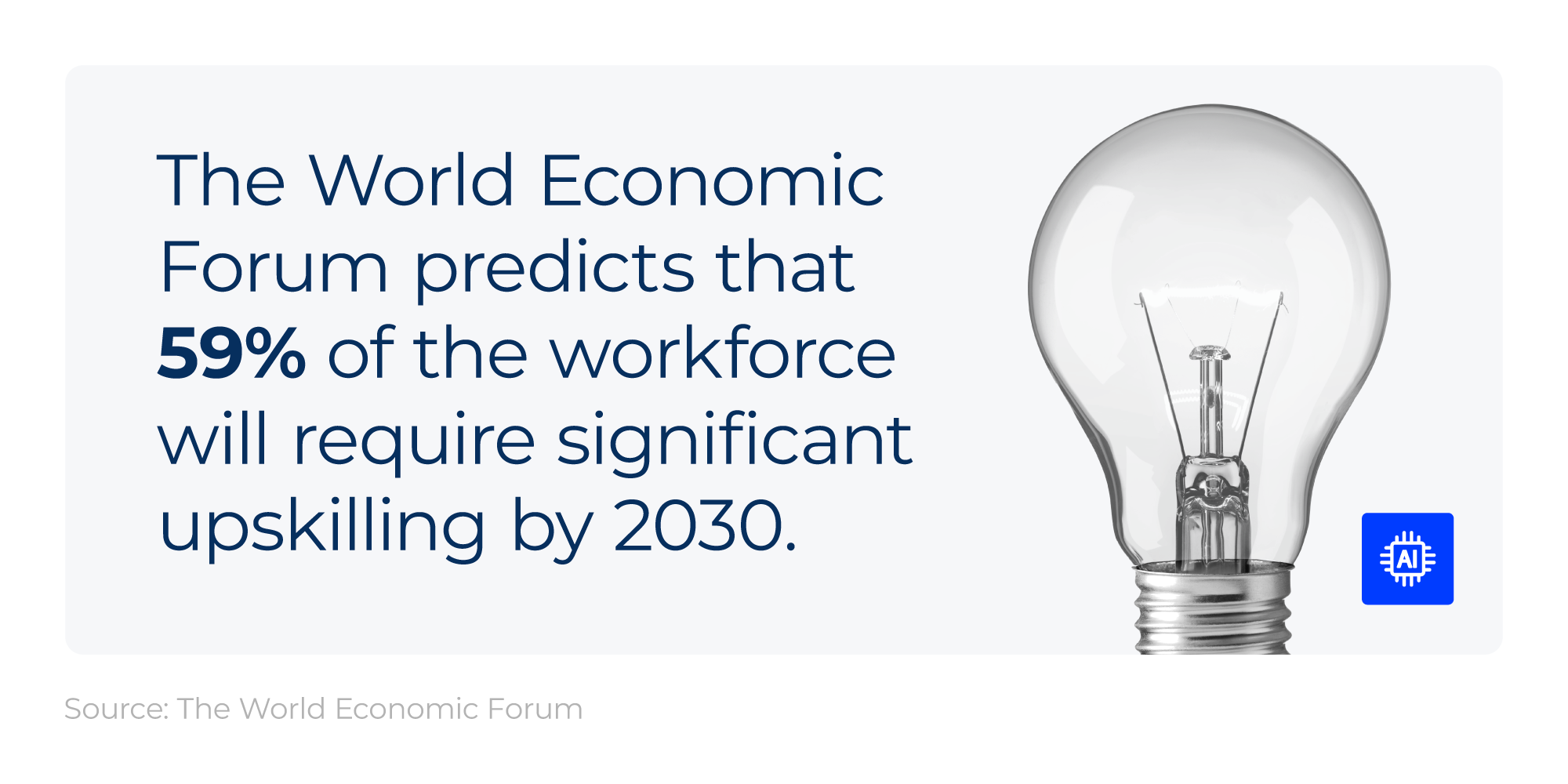
With AI at the forefront of a multitude of jobs, the World Economic Forum reports that 59% of the global workforce will require significant upskilling by 2030.
Which jobs are prioritising AI the most?
An independent study from Reboot sought to determine which industries were prioritising AI skills the most during the hiring process.
Our data revealed that jobs in translation and localisation were most likely to prioritise AI skills, with around 67% of listed jobs containing AI-related terms.
Software engineering and data science were the only other sectors with AI-related terms in more than half of the roles, demonstrating the growing importance of artificial intelligence in technical sectors.
The industries with the highest proportion of jobs prioritising AI skills
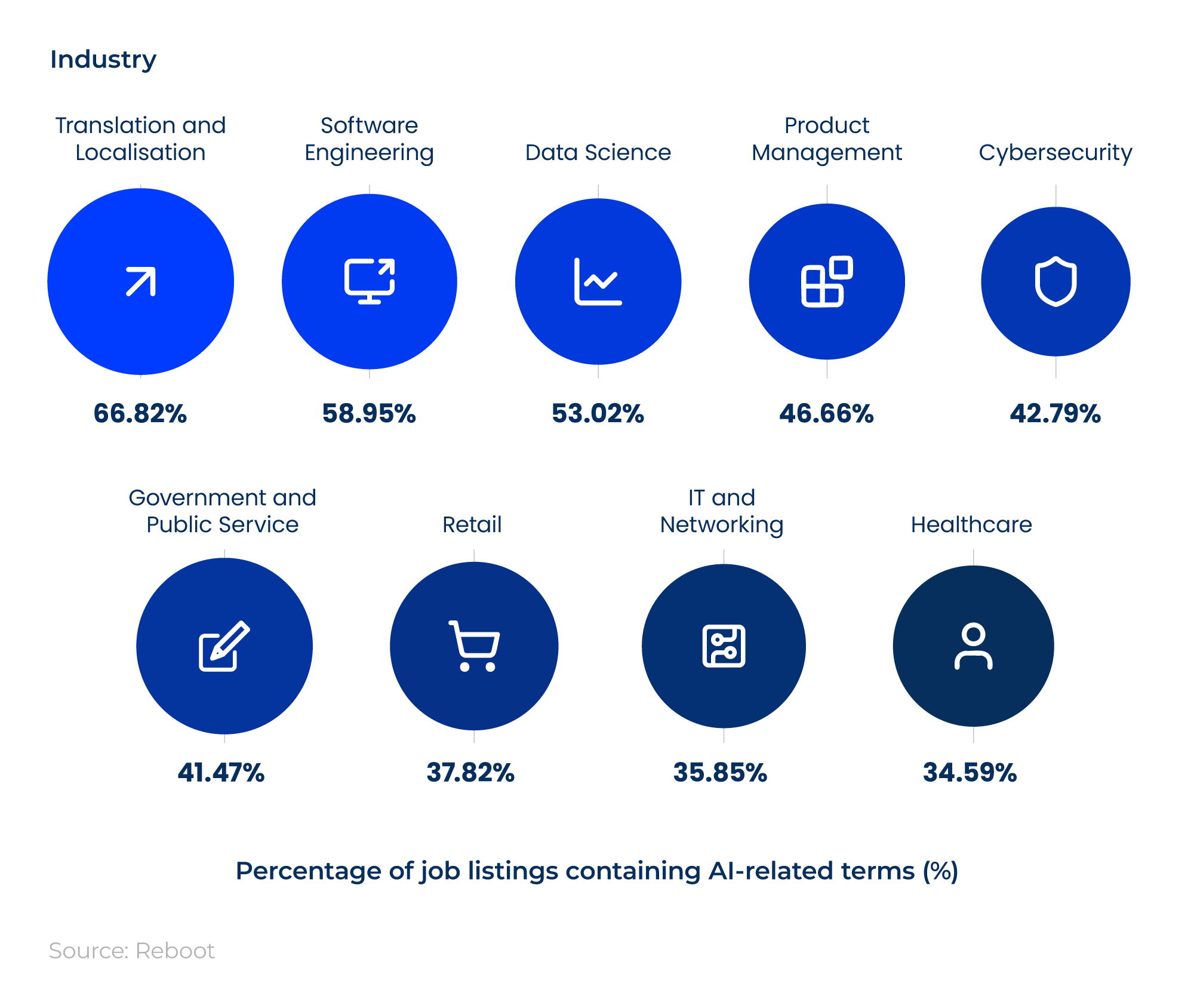 Beyond traditionally technical roles, the findings show that AI skills are becoming increasingly valuable across a wide range of industries.
Sectors such as product management, cybersecurity, and government all had AI-mentions in over 40% of job listings, highlighting how the technology is shifting from a specialist skill to a broader workplace requirement.
This is evidenced by the wider data, which found that AI-terms featured in just over 30% of jobs across all analysed industries, with AI Assistant, AI, and AI Automation the three most used terms.
Which jobs are prioritising AI the least?
Real estate was the industry least likely to prioritise AI, with related terms appearing in less than 11% of job listings. This was over two percentage points fewer than any other sector, with construction and manufacturing the only others falling below 15%.
Several site-based and operational sectors appear on the list, suggesting that artificial intelligence is currently less prioritised in more manual roles, despite the high potential for automation and productivity increases.
The industries with the lowest proportion of jobs prioritising AI skills
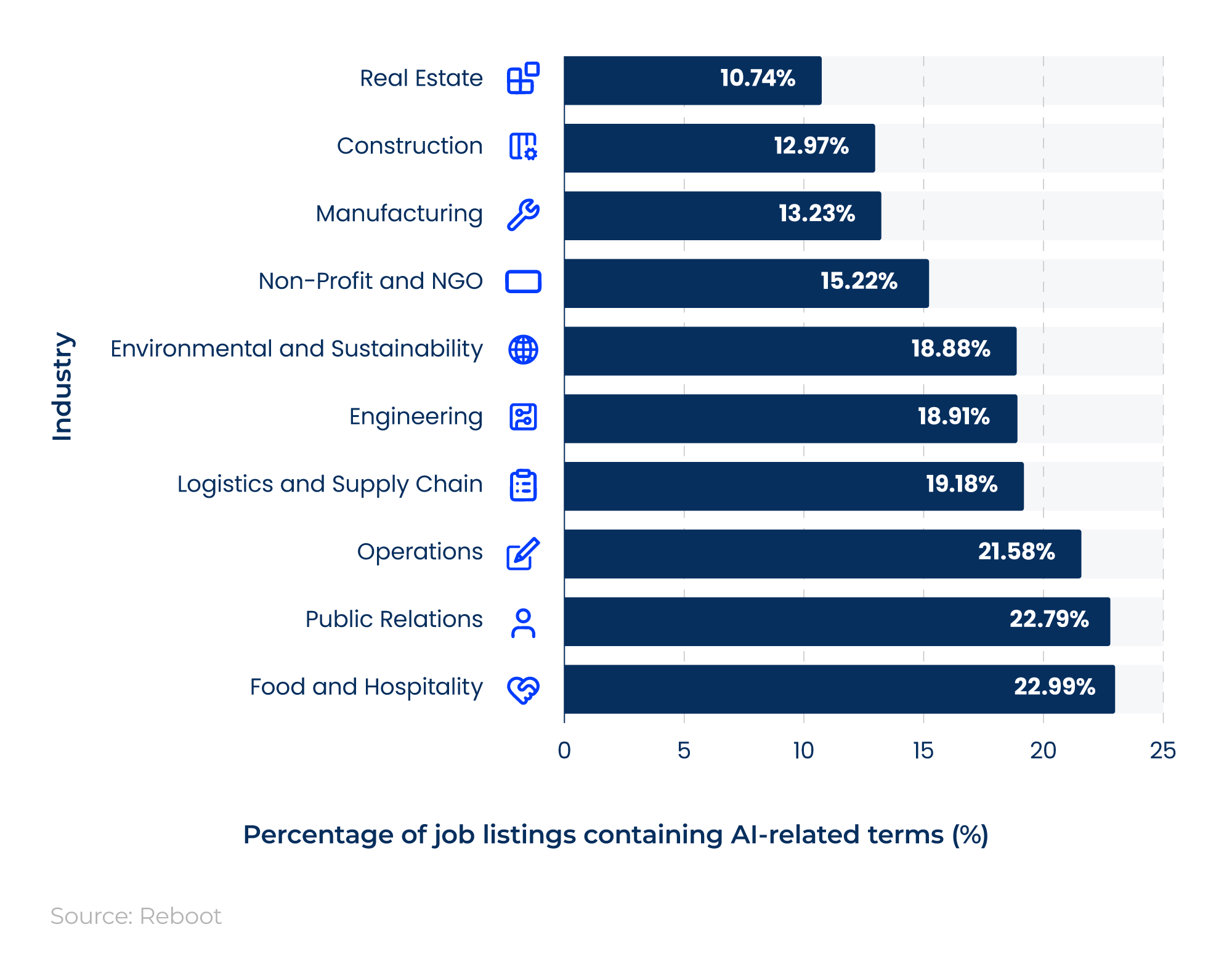 Public relations, along with food and hospitality, also ranked among the industries with lower levels of AI prioritisation, with less than 23% of jobs featuring AI-related terms. These roles will likely continue to prioritise human interaction and real-time decision-making over AI automation.
Which jobs see the largest salary benefits from AI skills?
Non-profit and non-governmental organisations (NGOs) offer the largest salary increases for AI skills on average. Jobs citing AI skills in this field paid around 37% more than those that didn’t, making it the only sector where AI skills brought an average salary increase of more than 30%.
Non-profits and NGOs also saw the highest monetary gains, with average salary increases of nearly £21,000, over £8,000 more than any other sector.
The industries with the highest average salary uplift associated with AI skills
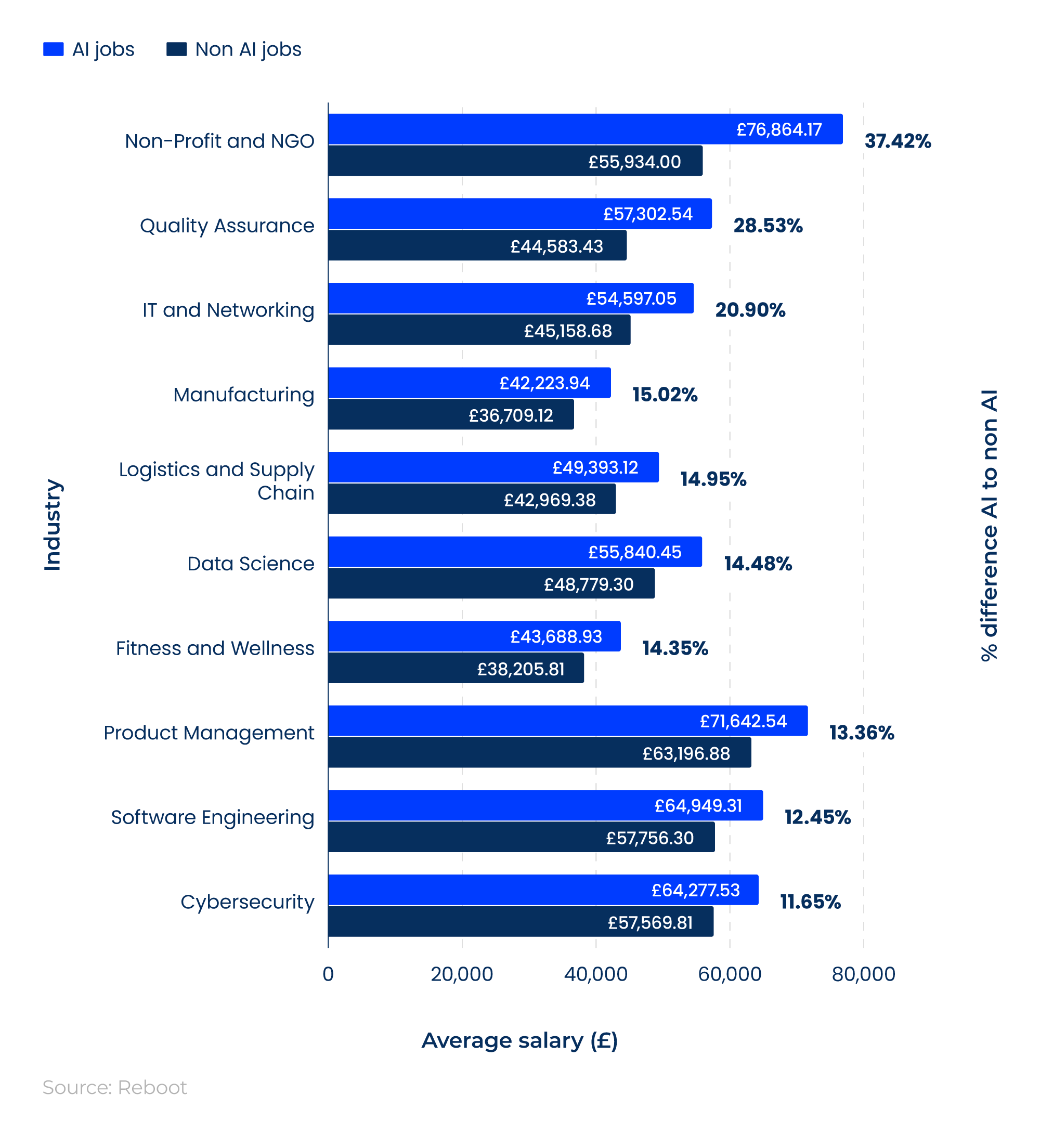 The top 10 is dominated by technology and product-focused roles, highlighting the widespread impact of AI in processes throughout these sectors. Quality Assurance had the second-highest salary increase, at 28.53%, with IT and Networking the final sector to see rises of more than a fifth.
The AI salary uplift can be seen across industries, with jobs citing AI skills paying around £2,930 more on average – a difference of 5.84%.
Which jobs see the smallest salary benefits from AI skills?
Healthcare jobs citing AI skills paid nearly 23% less on average than roles that didn’t, marking the largest salary decrease of any industry. It was also the only sector to see a drop of more than a fifth when AI-related terms were included in job listings.
Overall, nine industries showed lower average pay for roles mentioning AI skills, with the majority falling into service-based and public-facing sectors. AI appears to be more commonly referenced in lower-paid, task-oriented roles within these industries, though higher-paid positions remain more resistant to automation.
The industries with the lowest average salary uplift associated with AI skills
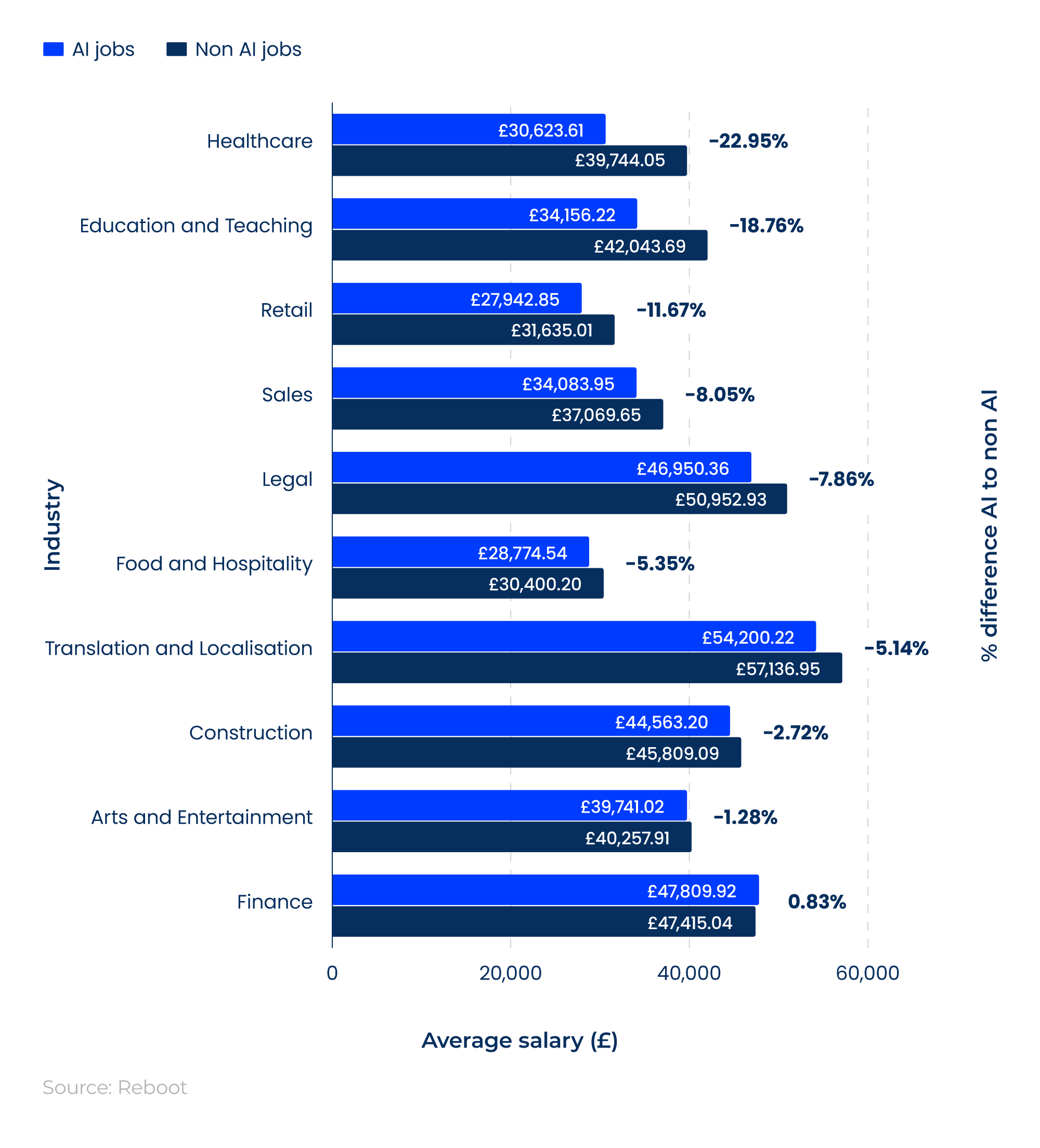 Education and teaching saw the second-highest salary drop, at 18.76%, over seven percentage points more than third-placed retail. Legal saw the fifth-highest percentage drop at 7.86%; its average pay decrease of around £4,003 was over £1,000 more than that of the sales sector, which ranked fourth in terms of percentage decrease.
Finance was the only sector in the bottom 10 where AI skills increased salary prospects, with its average rise of £394.88 per year equating to a difference of 0.83%.
Generative AI statistics
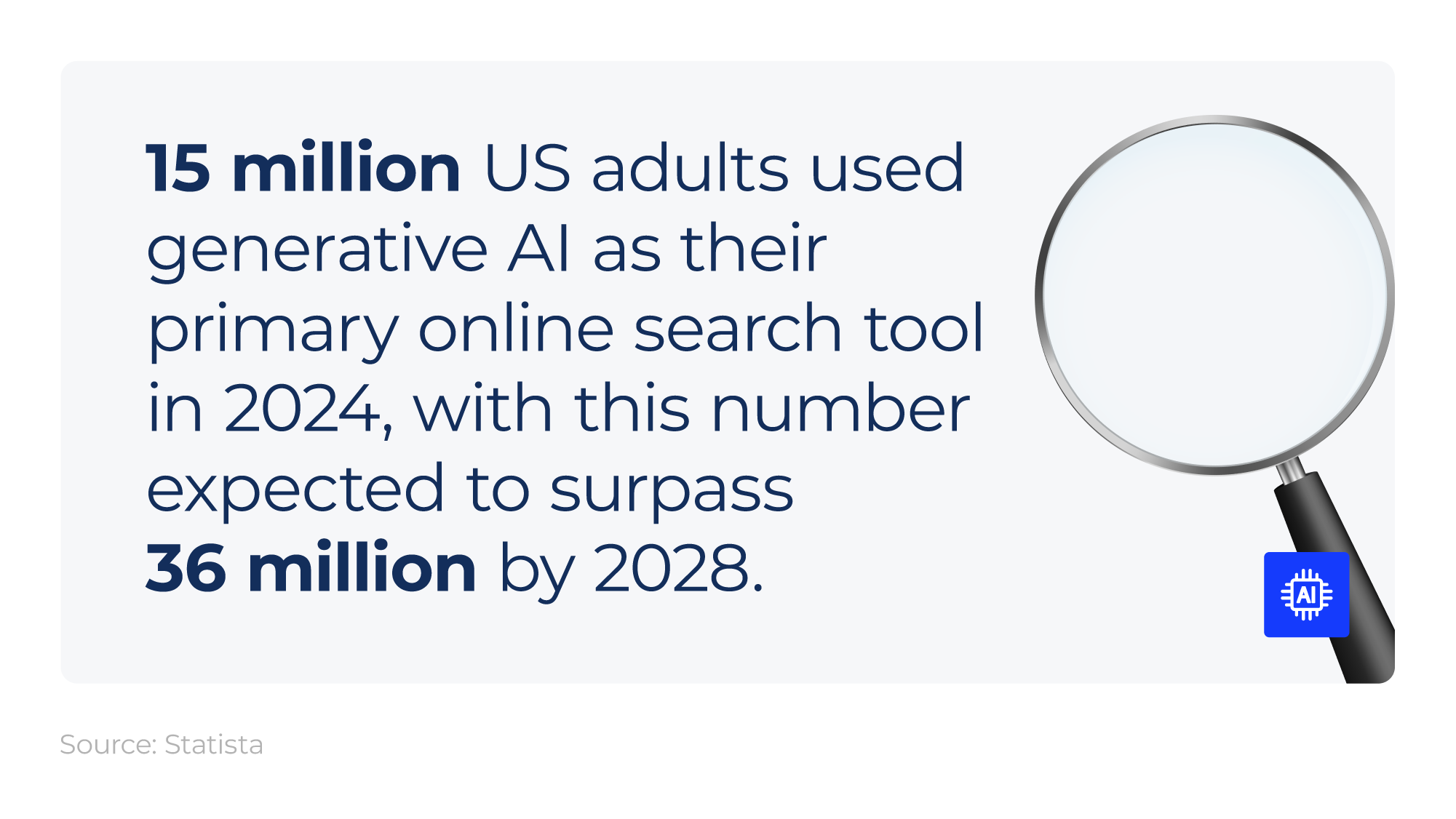
The number of people using generative AI as their primary search tool is projected to reach 36 million in the US alone by 2028. This marks a rise of more than 100% from 2024, when the figure stood at 15 million.
AI statistics from Salesforce revealed that nearly six in 10 AI users believe they’re on their way to mastering the technology. Around 70% of Gen Z say they use generative AI, with over half saying they’d trust it to help them make informed decisions.
The same report revealed that nearly two-thirds of users fall into millennial or Gen Z age categories, with 68% of non-users being either Generation X or Baby Boomers. Additionally, 52% of users claim they use generative AI more now than when they started, highlighting the technology’s capacity to integrate into everyday life.
 Common intentions among generative AI users include:
- 75% are looking to automate work tasks and use generative AI for workplace communications.
- 38% use the technology for fun or messing around.
- 34% use it to learn about fun topics that interest them.
Despite the growing use, 40% still feel they’re not familiar enough with the technology, with 88% unclear about how generative AI will impact their life, and just under a third feeling it’s not useful for them.
Generative AI adoption by industry
A report from Hostinger found that 88% of technology companies were using generative AI in 2024. This was eight percentage points more than any other industry, making technology the only one in which over 80% of companies used generative AI.
Professional services had the next highest proportion of generative AI-using companies, with its total of 80% slightly above advanced industries and media and telecom (both 79%).
The percentage of companies using generative AI by industry, 2024
| Industry | Percentage of companies using generative AI |
|---|---|
| Technology | 88% |
| Professional services | 80% |
| Advanced industries | 79% |
| Media and telecom | 79% |
| Consumer goods and retail | 68% |
| Financial services | 65% |
| Healthcare, pharma, and medical products | 63% |
| Energy and materials | 59% |
Source: Hostinger
Energy and materials had the lowest proportion of generative AI-using businesses, at 59%. This was four percentage points fewer than the next lowest sector and 29 percentage points less than technology.
What are the most popular generative AI tools?
ChatGPT is by far the most popular generative AI platform worldwide, with an average monthly mobile user count of 557 million in August 2025. This was over eight times more than any other competitor, making ChatGPT the only generative AI tool to attract over a hundred million mobile users a month.
Monthly generative AI mobile users by platform, August 2025
| AI tool | Active monthly mobile users in August 2025 (millions) |
|---|---|
| ChatGPT | 557 |
| Google Gemini | 70.1 |
| DeepSeek | 59.9 |
| Perplexity | 39.4 |
| Grok | 38.9 |
| Microsoft Copilot | 23.4 |
| Claude | 14.8 |
Source: DataReportal
Google Gemini was the next most popular tool, with just over 70 million monthly mobile users. This was over 10 million more than third-placed DeepSeek and more than 30 million higher than Perplexity.
Overall, this means that ChatGPT's monthly mobile users are more than double the total of the rest of the top seven combined.
The most well-known and popular generative AI tools, Q4 2025
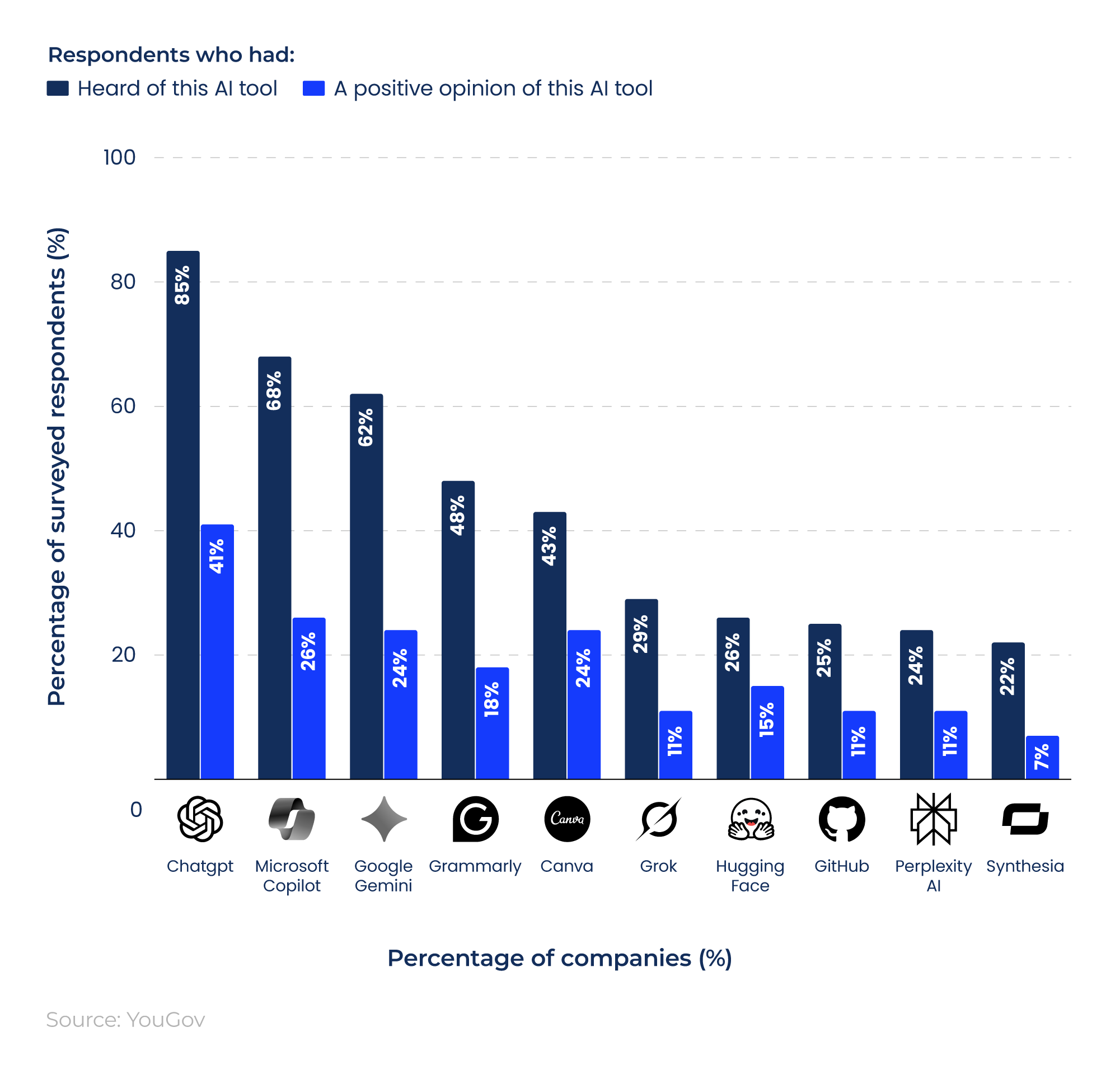 The most well-known generative AI platform is ChatGPT, with a YouGov survey finding that 85% of respondents had heard of the platform. This was 17 percentage points more than Microsoft Copilot, and 23 more than Google Gemini, the only other platforms known by more than half of respondents.
ChatGPT was the platform most likely to generate positive opinions, with 41% citing favourable views about the OpenAI tool. This was 15 percentage points more than Microsoft Copilot, which was the only other platform to receive positive opinions from over a quarter of respondents.
AI in SEO statistics
AI is reshaping how people discover and evaluate brands online, as well as the tools used to do so. Recent studies show that 40 to 55% of consumers in major sectors now use AI-powered search when making purchasing decisions, signalling a fundamental shift in search behaviour.
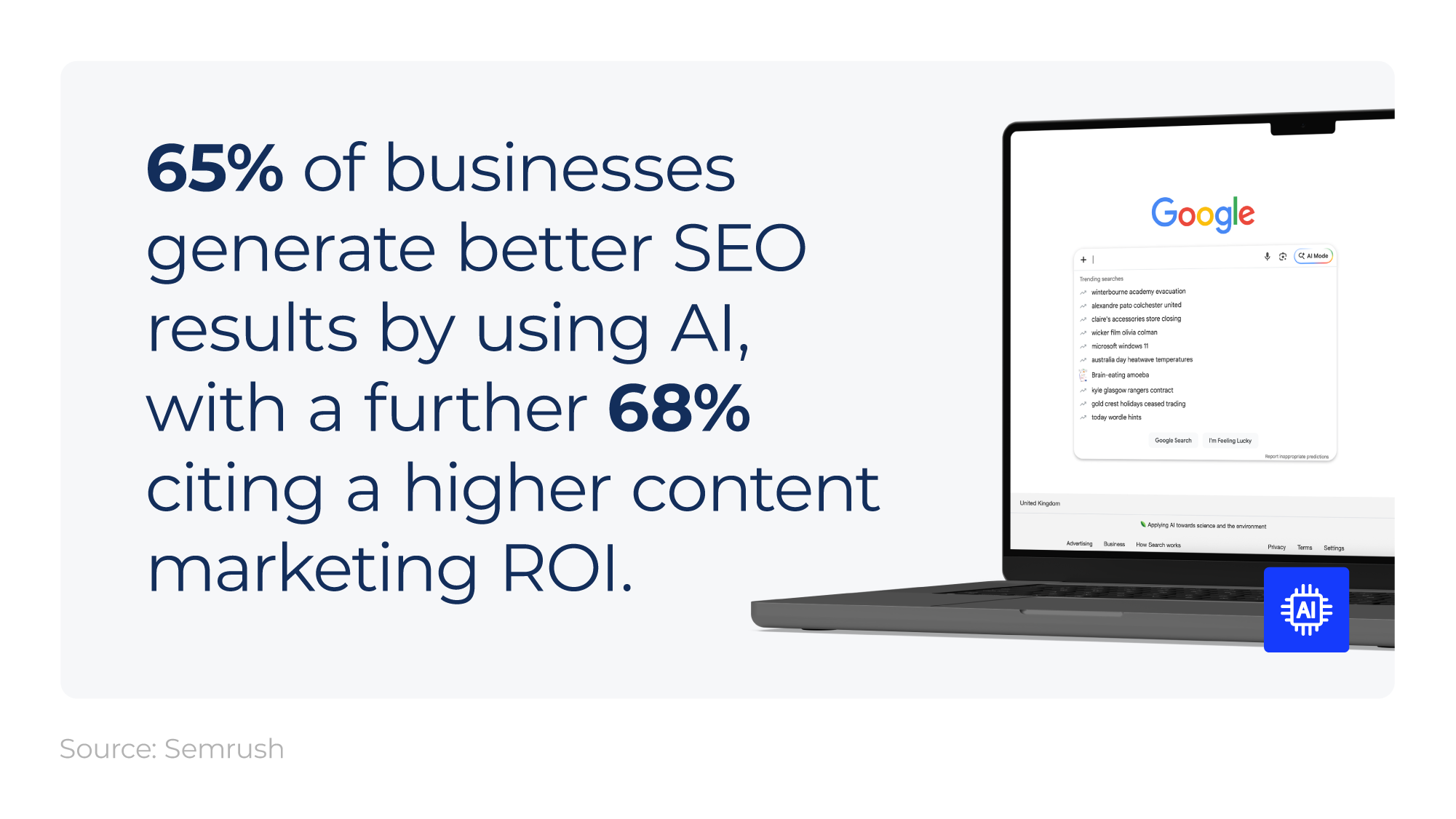
For businesses, adoption is accelerating, with 65% reporting better SEO results when using AI. In addition, 68% reported a higher content marketing ROI, with 67% citing improvements in content quality.
The impact is also visible in traffic patterns and user behaviour. AI-driven search traffic grew more than 500% year-on-year in early 2025, while at least 60% of searches result in no clicks as users get answers directly from AI-generated summaries.
 Despite strong performance gains, uncertainty remains across the industry. Around 90% of businesses expressed concern about the future of SEO in an AI-dominated landscape, prompting increased investment in AI-focused optimisation strategies.
AI use is widespread across SEO, with 51% of marketers using AI tools to optimise their content for email campaigns and search engines. Equally, trust and oversight remain key to success, with 93% of organisations reviewing AI-generated content before publication.
Online search trends also reflect the prevalence of AI, with our 2025 SEO statistics report revealing that global search volumes for AI keywords had reached over 100 million per month.
AI in content marketing statistics
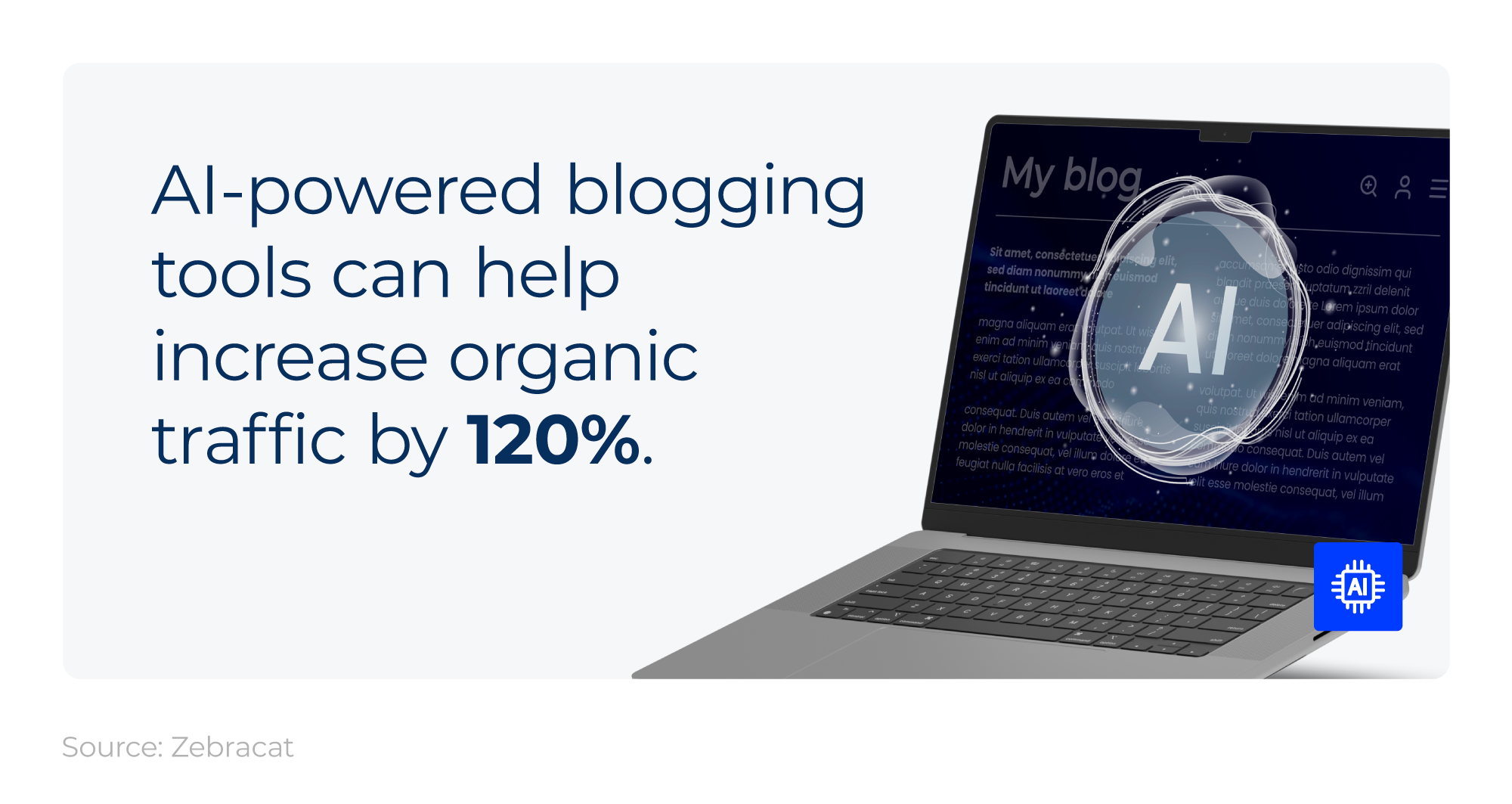
A report from Zebracat found that AI-powered blogging tools can help increase organic traffic by 120%, with ad click-through rates (CTRs) boosted by 38%, and cost-per-click (CPC) reduced by 32%.
 AI-using companies were found to produce 17 articles per month on average, 42% more than those not using AI. Artificial intelligence use appears to be boosting internal performance, with just 21.5% of AI-using content marketers claiming their strategy is underperforming, compared to 36.2% of non-users.
AI content appears to be performing in the SERPs, with studies finding that 86.5% of top-ranking content includes at least some AI-generated material. Its presence is even more prevalent within Google’s AI overviews, where over 91% of cited pages feature AI-generated copy.
Discover the most compelling statistics shaping the content marketing and SEO landscapes.
AI search statistics
In October 2025, more than 57% of searches that triggered AI overviews were informational in nature. This aligns with the rapid rise of generative AI as a primary tool for answering questions since the launch of ChatGPT in 2022.
However, this represents a sharp decline from March 2025, when more than 88% of AI overviews were tied to informational queries. The shift suggests that AI overviews are increasingly appearing across a wider range of search intents, rather than being limited primarily to informational use cases.
The percentage of global searches with AI overviews by intent
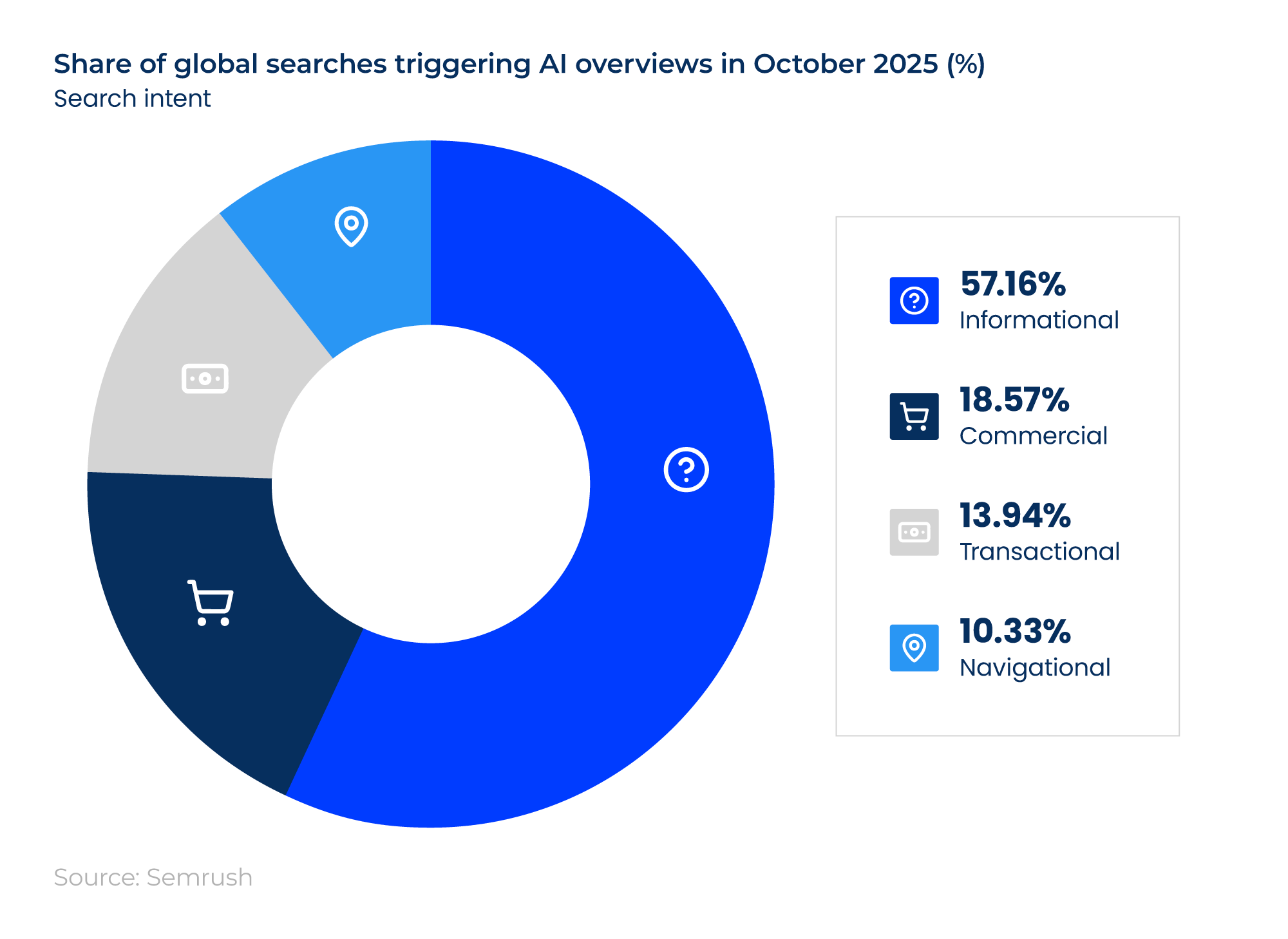
Commercial queries accounted for the next largest share, at 18.57%, more than double the total from March.
Transactional and navigational searches accounted for just under a quarter of AI overviews combined. However, this marks a significant climb from March, when they accounted for just 1.76% and 1.43% of overviews, respectively.
Despite the expansion, these numbers highlight the continued importance of traditional SEO practices for driving conversions and brand-led search behaviour, with transactional and navigational queries still representing smaller shares of AI-generated results.
How will AI change the search landscape?
"We are seeing a gradual shift in AI search, from purely informational content into broader commercial and transactional queries. Informational queries continue to dominate AI search, which reflects how heavily users rely on AI and LLMs to understand topics and explore ideas. However, shifts in intent patterns suggest that AI search is evolving beyond simple question-answering to support a broader range of user needs.
As AI Search continues to evolve, we expect it to become increasingly intent-aware, blending informational, commercial, and transactional elements within a single response. Rather than serving just one type of query, AI search will guide users through the full decision journey, rewarding content that demonstrates clarity, credibility, and usefulness at every stage."
Shai Aharony
How has AI affected the SERPs?
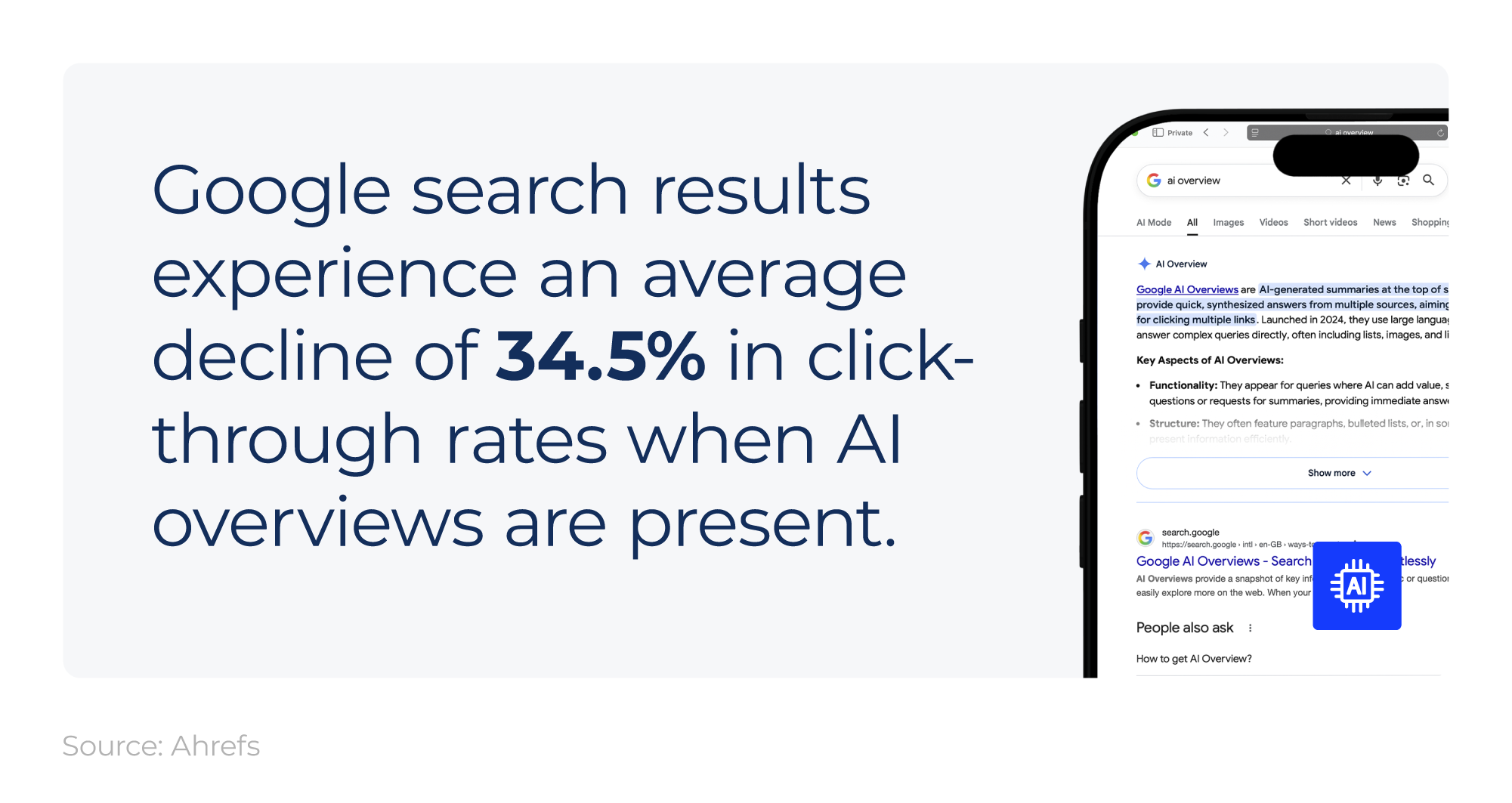
Recent AI statistics revealed that top-ranking Google results see a 34.5% reduction in click-through rates (CTR) when an AI overview is present. Despite this, 49% of people still click on traditional blue links after consuming an AI-generated answer.
 Over three-quarters of AI overview citations matched those in Google’s top 10, suggesting a strong overlap between SEO and Generative Engine Optimisation (GEO) strategies.
Brand web mentions were found to be the greatest factor in generating AI overviews, followed by brand anchors and brand search volume. This reinforces that brand visibility and authority across the web play a key role in influencing AI-driven search results.
Can AI search responses be influenced by humans?
An independent Reboot study found that AI-generated search responses can be influenced by what information is available on the internet. In a controlled experiment, we tested whether publishing the same piece of information across several independent websites would change how AI tools answered a specific question.
The team chose a light-hearted but well-established topic and deliberately positioned a new name at the top of multiple online lists to see if AI models would repeat it in their responses.
The results showed that some AI platforms, including ChatGPT and Perplexity, began referencing the new information after it was published online. Other models were less responsive, suggesting they rely more heavily on established sources or older information.
Overall, the experiment demonstrated that AI responses can be influenced through consistent online mentions, even without highly authoritative websites. However, the impact varied by platform, showing that structuring content for AI visibility requires ongoing testing and a combination of traditional SEO and newer tactics.
As AI reshapes the search landscape, ensure your brand is ahead of the curve with a comprehensive GEO audit.
How does AI-driven content perform in the SERPs against human-written content?
Around 82% of pages in Google's top 20 SERP results are a mix of human-written and AI-generated content, on average. Ahrefs data shows that just 13.5% of high-ranking content is purely human-written, with even less (4.6%) considered ‘pure AI’.
The study divided every page into one of six categories based on the level of AI use. The largest share (40%) used moderate AI (meaning that 11-40% of the content was AI created), nearly double any other category. Just over 20% fell into the substantial AI range (41-70% AI created).
Percentage of top 20 ranked SERP pages by level of AI use
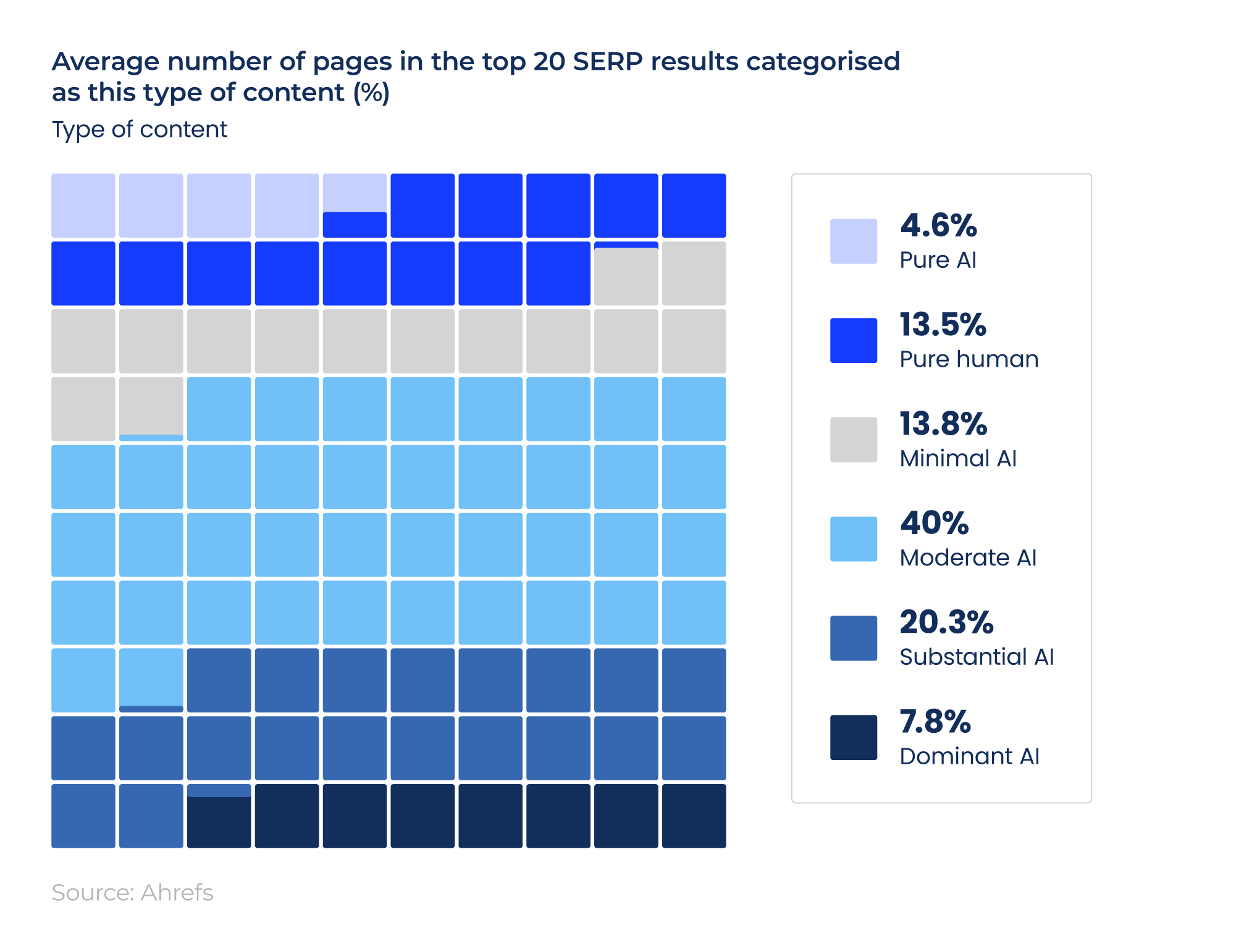 Just under 14% was found to use minimal AI (1-10% AI created), with 7.8% considered dominant AI (71-99% AI created). This suggests that a hybrid approach combining AI use and traditional content writing is the most effective method for consistent SERP success.
The percentage of AI magazine readers who consider AI search more efficient than traditional search
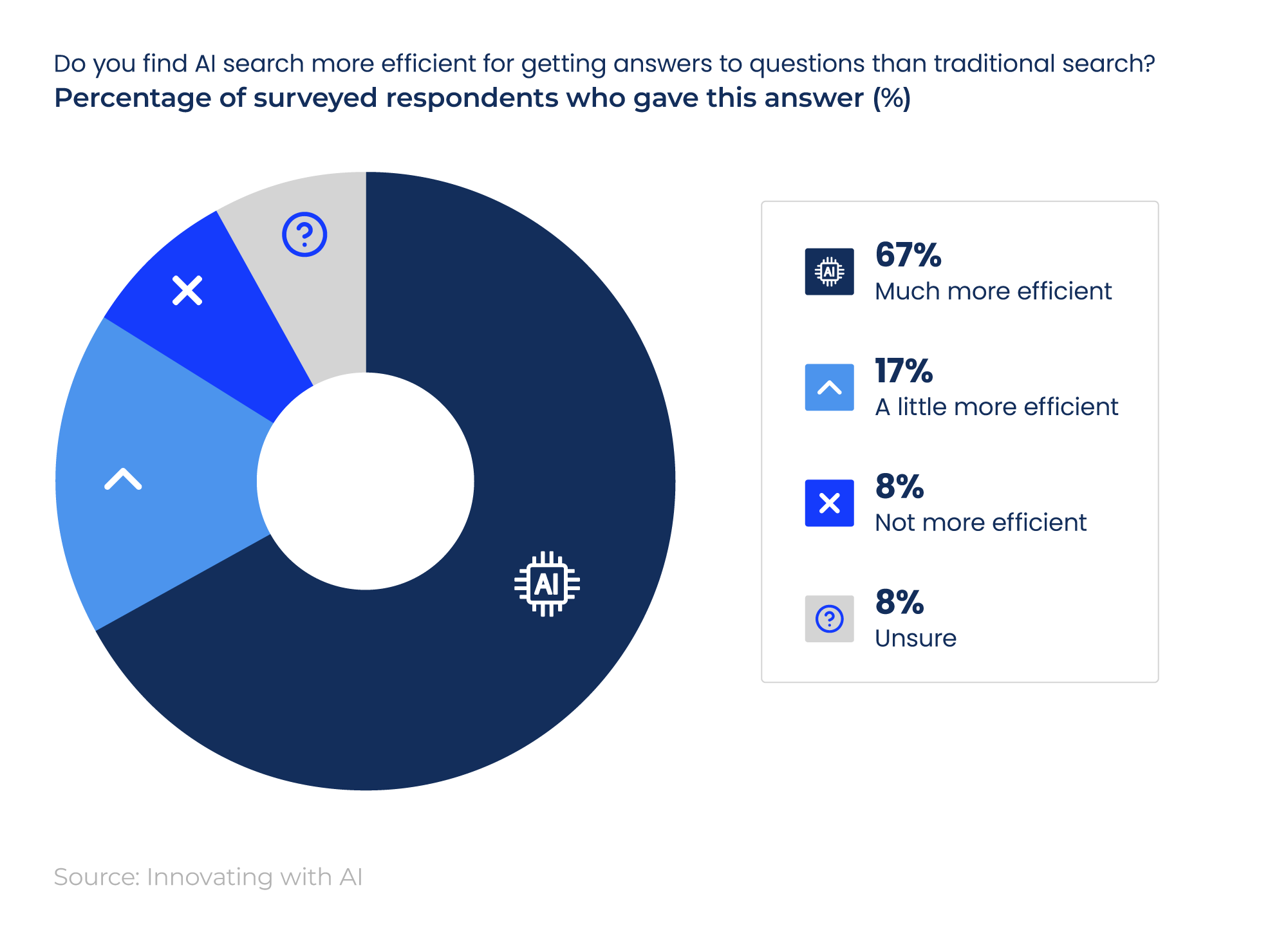 A survey of Innovating with AI readers found that 67% of respondents considered AI search much more efficient for getting answers to questions than traditional search.
A further 17% considered it a ‘little more efficient’, with just 8% deeming it ‘not more efficient’. This means that 84% thought AI search improved question answering efficiency to some extent.
The percentage of AI magazine readers who believe AI search will replace traditional search
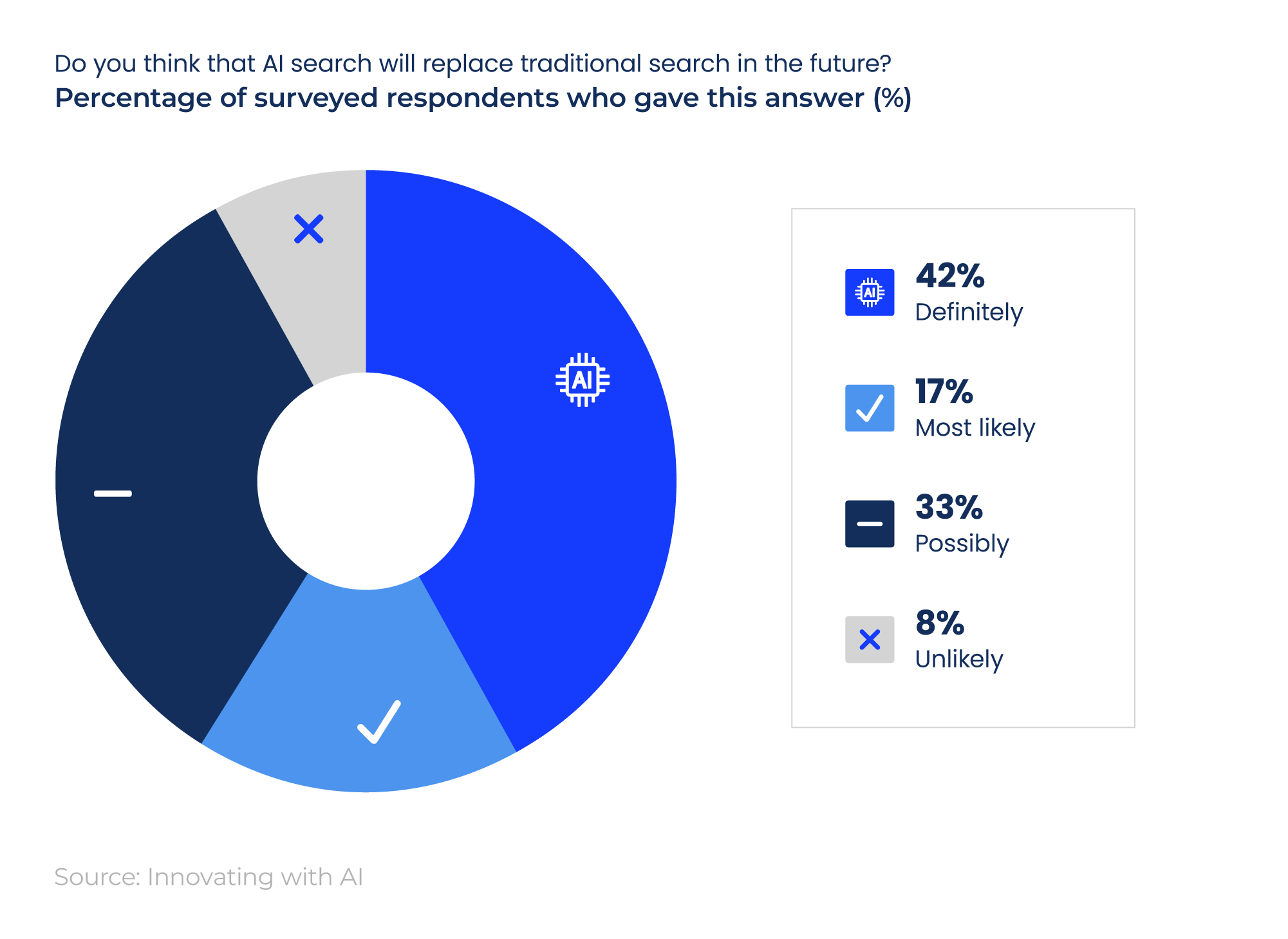 AI statistics found 42% of people believe AI search will definitely replace traditional search in the future. This was over five times the number who considered it unlikely (8%), and nine percentage points more than those who only feel it’s a possibility.
It’s worth noting that these figures come from a survey of readers of an AI magazine, a group likely to hold more favourable views toward AI than the general population.
Learn the key differences between SEO and GEO and how to harness both to maximise your online potential.
How is AI used in digital PR and link building?
As with many SEO disciplines, AI has become a regularly utilised tool in digital PR and link building. Over two-thirds (68%) of industry professionals think link building will become more important in the next two years due to AI.
A further 62% are prioritising citation in AI-generated results, highlighting how AI has revolutionised the search landscape and priorities in SEO.
Just over 73% of link-building professionals believe backlinks directly influence the chance of appearing in AI search results. However, only 11% feel they have a repeatable process for getting content featured in these results, suggesting many professionals are still getting to grips with new search demands.
How successful are link builders in getting content cited in AI-generated results?
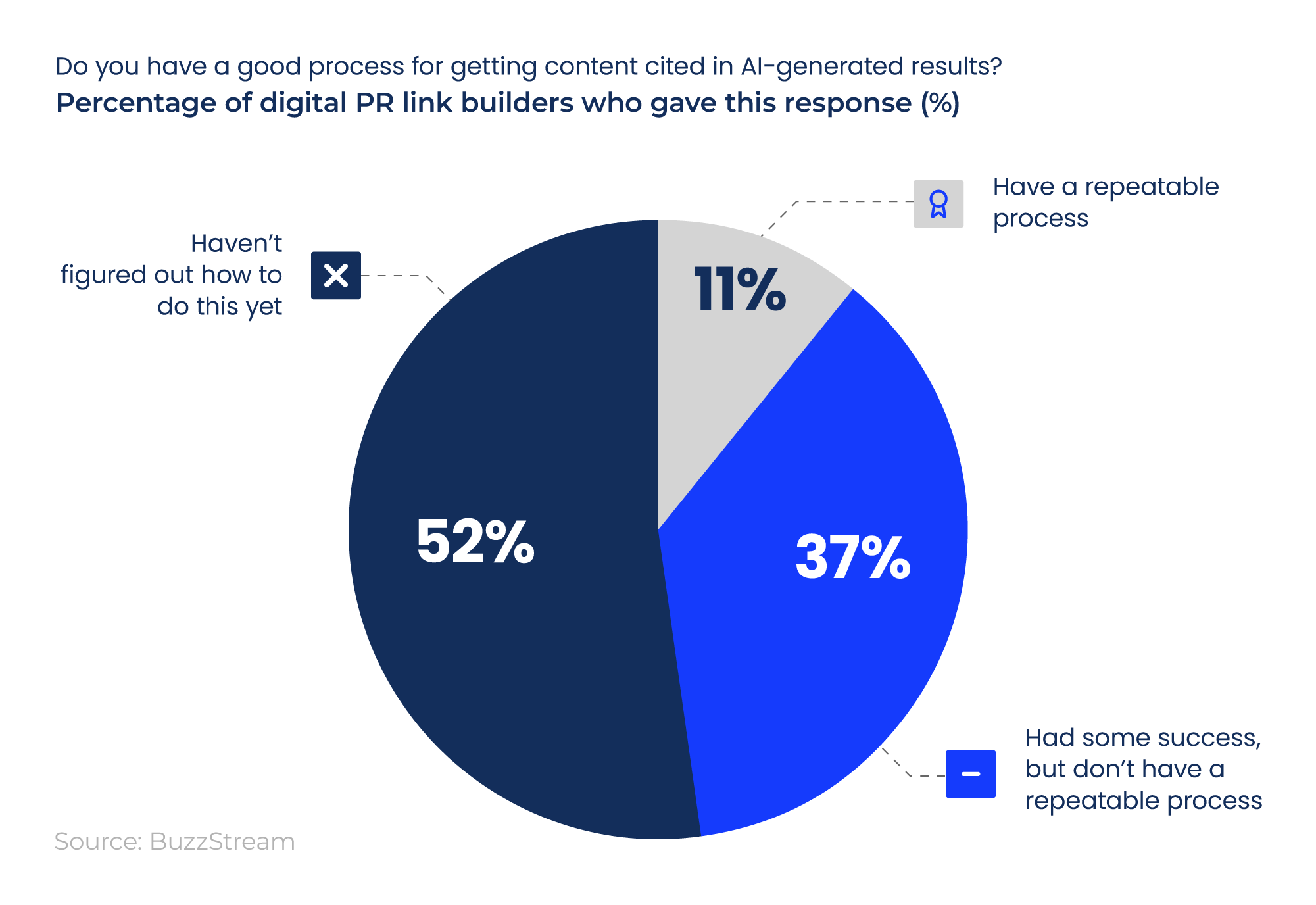
37% of digital PR link builders said they’d had some success, but don’t yet have a repeatable process. This indicates that many professionals are at the trial-and-error stage with AI search, as they work toward defining a reliable process for AI visibility and citations.
At least half claimed they hadn’t yet figured out how to consistently get content featured in AI-generated search results. This was the most common answer, and over four times those with a repeatable process.
How will AI change digital PR strategy?
"As AI-driven search grows, Digital PR, AiPR, and link building have become more fundamental. The context around brand mentions, links, and citations is increasingly tied to visibility within AI-generated results, not just traditional rankings.
What’s clear is that while many teams are experimenting and seeing early wins, repeatable processes for earning AI citations are still emerging. Over the next few years, the most effective digital PR strategies will be those that combine strong brand relevancy, topical expertise, and a clear understanding of how AI systems assess authority, relevance, and credibility."
Shai Aharony
Optimise your off-site SEO approach and maximise AI visibility with a designated AiPR™ strategy.
Public opinions on AI
A survey from the Office for National Statistics (ONS) in 2025 found that 41% of UK citizens believe that AI will benefit them, with 8% strongly agreeing.
‘To what extent do you agree or disagree that AI will benefit you?’
| Level of agreement | Percentage of respondents |
|---|---|
| Strongly agree | 8 |
| Agree | 33 |
| Neither agree nor disagree | 39 |
| Disagree | 14 |
| Strongly disagree | 5 |
Source: ONS | *Figures may not equal 100% due to rounding
In contrast, just 19% disagreed that AI would benefit them, 5% of whom strongly disagreed. This suggests that public sentiment around AI in the UK is cautiously optimistic.
To what extent do you agree or disagree with the following statement? ‘I trust the government to use artificial intelligence (AI) to complete some of its tasks.’
| Level of agreement | Percentage of respondents |
|---|---|
| Strongly agree | 3 |
| Agree | 27 |
| Neither agree nor disagree | 27 |
| Disagree | 26 |
| Strongly disagree | 17 |
Source: ONS | *Figures may not equal 100% due to rounding
ONS data shows that only 30% of the UK public trusts the government to use artificial intelligence, with 3% expressing strong trust.
By contrast, 43% claimed they don’t trust the government with AI use, including 17% who expressed strong mistrust. Illustrating that, while enthusiasm around AI is high, public scepticism remains a significant concern around its use by government bodies.
Comfort levels with AI use among the UK public by purpose
| Purpose | Percentage of respondents who’d feel comfortable with AI being used for this purpose |
|---|---|
| Analysing data to inform policy | 51 |
| Identifying fraud | 51 |
| Measuring the environmental impact of transport projects | 42 |
| Controlling traffic lights and congestion | 40 |
| Inspecting bridges, rail lines, and roads for damage or hazards | 22 |
| Responding to customer queries in real time | 33 |
| Replying to communication from the public | 25 |
| Managing air traffic and flight routes | 15 |
| Self-driving vehicles | 15 |
| Other | 1 |
| None of the above | 23 |
Source: ONS | *Figures may not equal 100% due to rounding
AI statistics show that public comfort with AI varies significantly by use case. Identifying fraud and analysing data to inform policy rank highest, each supported by 51% of respondents. AI trust appears to tend higher when used for analytical and risk management purposes.
The survey showed growing public comfort in AI use for sustainability purposes, with 42% trusting AI to measure the environmental impact of transport projects. The potential use in sustainable practices was solidified by a United Nations (UN) artificial intelligence report, which claims that AI could potentially accelerate nearly 80% of the organisations’ Sustainable Development Goals (SDGs).
By contrast, confidence drops sharply for fully autonomous, safety-critical applications, with only 15% supporting AI-managed air traffic or self-driving vehicles.
Opinions on AI impact by age group, 2025
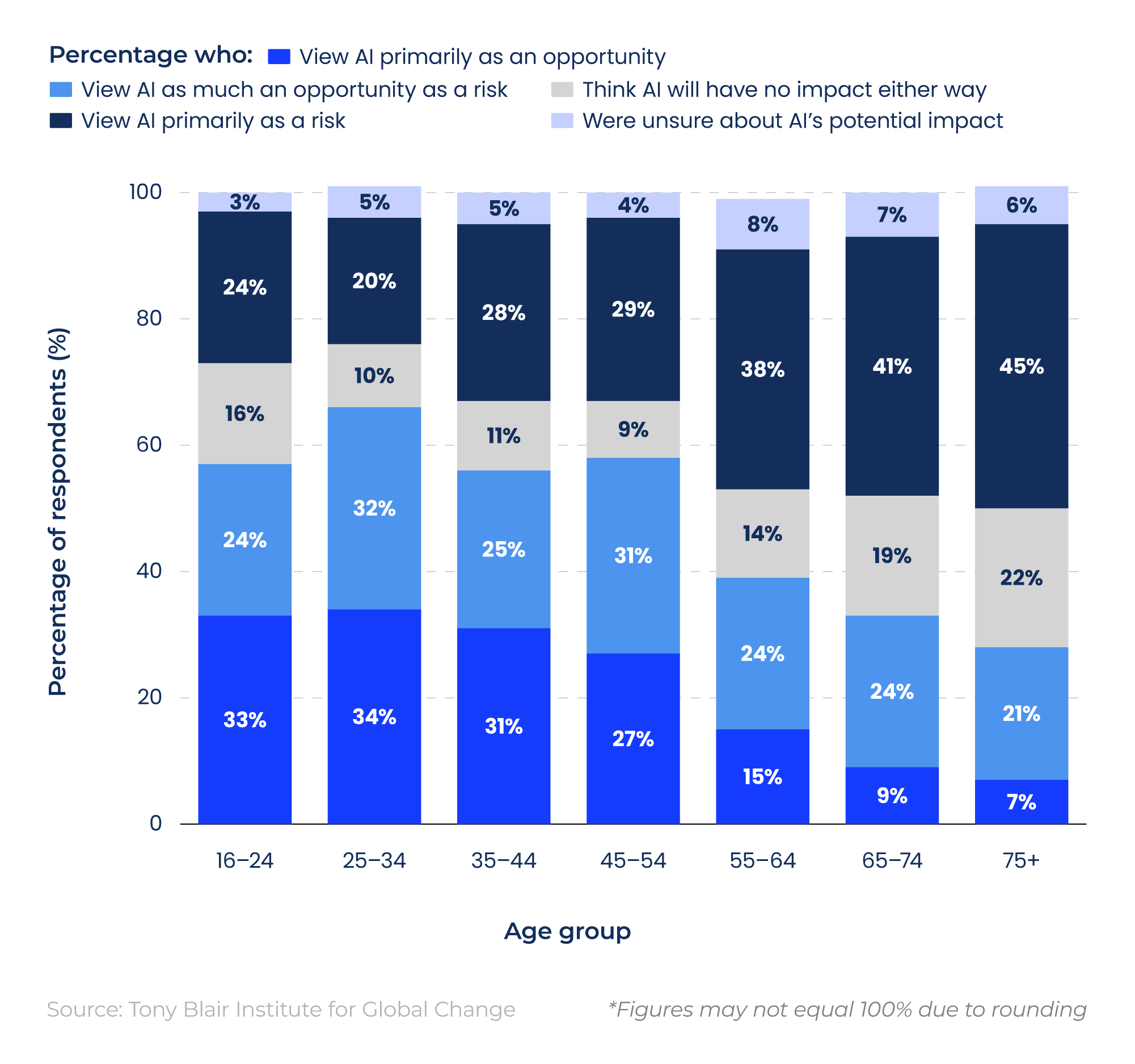 Younger age groups are more likely to view AI positively, with a third of 16-24-year-olds viewing the technology primarily as an opportunity. This sentiment peaks at ages 25 to 34 (34%) before falling rapidly from age 45 onwards.
Just 7% of those aged 75 and over viewed AI as mainly an opportunity, less than a quarter of those aged 25 to 34.
In contrast, the number of people who view AI primarily as a risk tends to increase with age. Just 24% of people in the youngest age group expressed this opinion, with this number falling to just a fifth for those aged 25 to 34.
Concerns around AI privacy, bias, and ethical issues
Lack of trust in content was the most common AI issue cited by surveyed UK citizens, with 38% considering this concern. This was six percentage points more than any other concern, making it the only one selected by more than a third of respondents.
Concerns around privacy and data security followed at 32%, with a further 28% citing ethical worries.
The most common concerns around AI use among UK citizens, 2025
| Concern with AI | Percentage who cited this as a concern |
|---|---|
| Lack of trust in AI content | 38% |
| Concern about privacy and data security | 32% |
| No interest in using AI tools | 31% |
| Ethical concerns about AI use | 28% |
| Uncertainty about how to use AI tools | 25% |
| Cost of accessing AI tools | 15% |
| Company policy restrictions | 10% |
| Time constraints from using AI tools | 8% |
| Limited access to technology | 3% |
Source: Tony Blair Institute for Global Change | *Figures may not equal 100% due to rounding
At the other end of the scale, just 3% cited a lack of AI access as a concern, with 8% referencing time constraints. Trust, ethics, and data security remain the primary factors shaping public attitudes toward AI, rather than access or practical barriers.
Regulatory bodies are introducing measures in an attempt to address these concerns. The EU AI Act was introduced in August 2024, with its primary goal to establish safe, trustworthy AI development and adoption across the European Union through a risk-based legal framework.
Measures that would increase trust in AI use among UK citizens, 2025
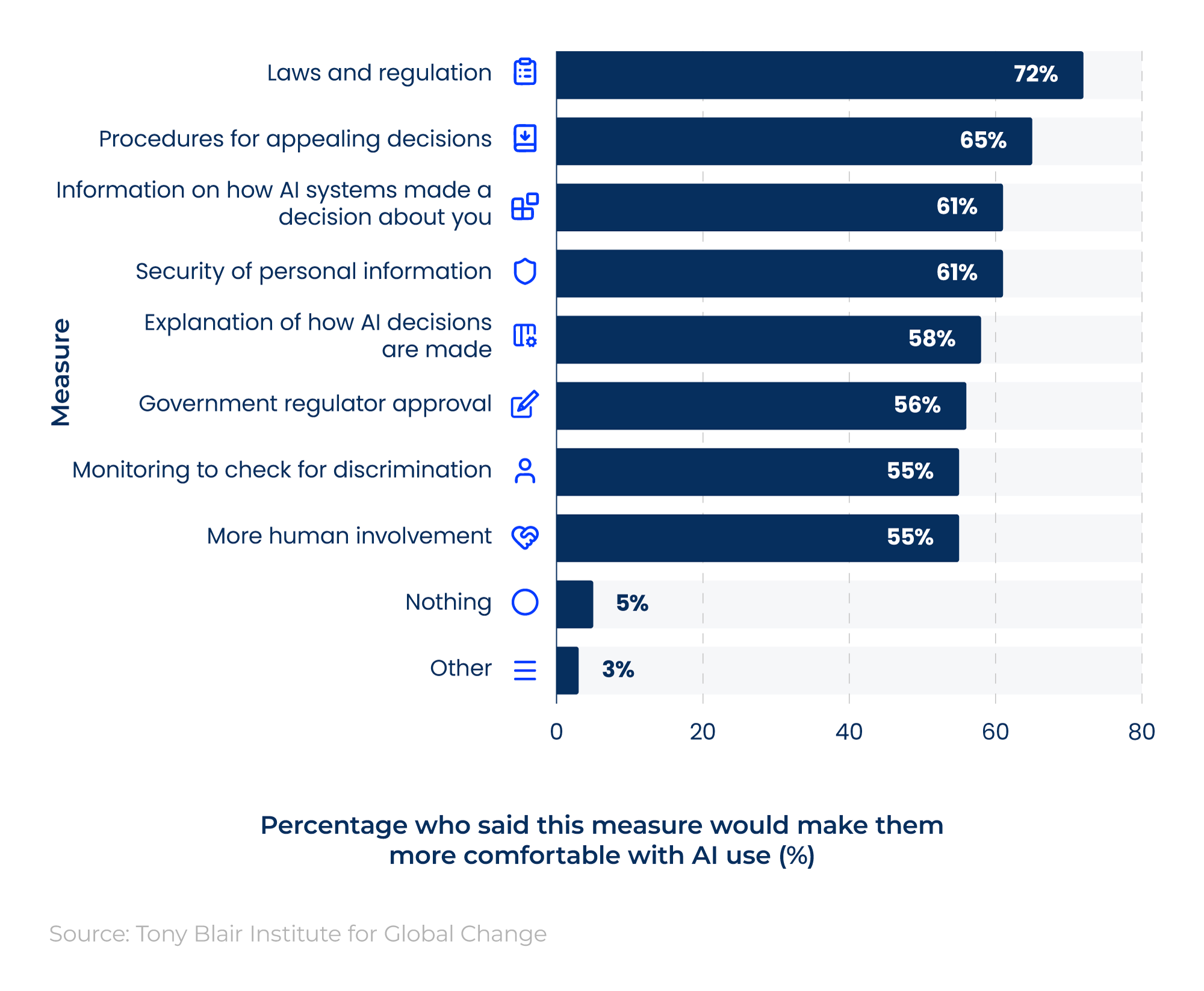 Public opinion suggests that stronger laws and regulations would help increase trust in artificial intelligence, with 72% saying they would be more comfortable with AI.
Transparency is another key factor, with 65% wanting more procedures for appealing decisions, and 61% seeking greater information about how AI decisions are made about them.
Over half (55%) wanted greater checks on discrimination, hinting that bias and ethics remain a prominent obstacle to widespread AI trust.
AI FAQs
What is generative AI?
Generative AI is a type of artificial intelligence that uses deep learning models to generate new content, such as text, images, audio, and video, in response to human prompts and patterns learned from its training data. Prominent generative AI models include ChatGPT, Microsoft Copilot, Gemini, and Claude.
How does AI affect the environment?
AI’s high energy consumption has an impact on the environment, water usage, and growing electronic waste. Much of the electricity generated to run AI is from fossil fuels, with data centres using significant amounts of water for cooling.
Additionally, the production of certain AI hardware, such as servers and chips, requires mining for rare earth minerals, contributing to growing carbon emissions. A Guardian report revealed that AI had been responsible for the same amount of carbon dioxide emissions in 2025 as the whole of New York City.
While AI’s resource demands remain a concern, there is much optimism about its ability to support sustainability by making existing efficiency measures more effective, streamlining processes through automation, and improving resource planning.
How can AI help my business?
AI can help businesses across many sectors by automating routine tasks, enhancing decision-making, personalising customer experiences, and producing or refining brand content.
By handling tasks at speed, AI can enhance productivity and efficiency across departments. The time saved on routine work can also encourage greater creativity and higher-level thinking, allowing employees to focus on ideas and strategies that deliver measurable improvements in brand performance.
How is AI used in education?
AI is used in education to support teaching and learning in several ways, including:
- Personalising the learning experience (e.g., adapting educational content to suit each student's needs).
- Automating teacher tasks (e.g., grading, lesson planning).
- Providing support through generative AI (e.g., ideation, proofreading, sourcing)
- Administrative support.
AI can also enhance accessibility through methods like language translation, tutoring tools, and adaptive learning platforms. By streamlining administrative processes and enabling more targeted learning, AI helps create better conditions for students and teachers to focus on meaningful progress and outcomes.
How to use AI in sales?
Sales cycles can use AI in a range of ways, including email personalisation, analysing consumer behaviour, task management, and training through call analysis.
By automating repetitive administration tasks and assisting with lead and content generation, AI can free up more time for sales agents to focus on individual interactions, helping them refine their process and maximise conversions.
How is AI transforming the future of digital marketing?
AI is having a significant impact on the present and future of digital marketing with unprecedented levels of task automation, data analysis, and hyper-personalisation. The impact can be seen through many areas of digital marketing, including digital PR, outreach, content marketing, and SEO.
As well as transforming internal processes, AI has reshaped consumer behaviour, with the use of chatbots, AI search overviews, and personalised recommendations giving customers new ways to review products, compare brands, and make purchasing decisions.
How is AI used in customer service?
AI is used in customer service to improve response times, automate administrative tasks, personalise interactions, and support service teams. Common examples of AI in customer service include chatbots, personal assistants, and automated account updates.
AI can analyse data and past interactions to produce more relevant responses and predict customer needs. By automating repetitive tasks and assisting agents in real time, AI allows teams to focus more time on complex issues and deliver a higher level of customer service.
Sources
https://www.sellerscommerce.com/blog/ai-in-ecommerce-statistics/
https://www.grandviewresearch.com/industry-analysis/artificial-intelligence-ai-market
https://www.business.gov.uk/campaign/grow-your-business-in-the-uk/artificial-intelligence/
https://news.crunchbase.com/ai/big-funding-trends-charts-eoy-2025/
https://www.moneypenny.com/uk/resources/blog/the-state-of-ai-adoption-in-uk-businesses/
https://www.mckinsey.com/capabilities/quantumblack/our-insights/the-state-of-ai
https://apxml.com/posts/ai-engagement-index-country-rankings
https://www.nngroup.com/articles/ai-tools-productivity-gains/
https://www.stlouisfed.org/on-the-economy/2025/feb/impact-generative-ai-work-productivity
https://www.bloomreach.com/en/blog/why-ai-is-the-future-of-e-commerce
https://www.shopify.com/blog/ai-ecommerce
https://citrusbug.com/blog/ai-in-banking-statistics/
https://cloud.google.com/transform/healthcare-and-life-sciences-ai-innovation-gen-ai-agents
https://news.sky.com/story/the-40-jobs-most-at-risk-of-ai-and-40-it-cant-touch-13447013
https://www.salesforce.com/news/stories/generative-ai-statistics/
https://www.hostinger.com/tutorials/how-many-companies-use-ai
https://yougov.co.uk/ratings/technology/fame/ai-tools/all
https://datareportal.com/reports/digital-2026-one-billion-people-using-ai
https://www.surveymonkey.com/mp/ai-marketing-statistics/
https://www.semrush.com/news/288870-new-report-reveals-the-top-ai-content-and-seo-trends-for-2024/
https://searchengineland.com/ai-traffic-up-seo-rewritten-459954
https://digitalmarketinginstitute.com/blog/10-eye-opening-ai-marketing-stats-in-2025
https://chad-wyatt.com/ai/ai-marketing-statistics/
https://www.zebracat.ai/post/ai-marketing-statistics
https://www.buzzstream.com/blog/link-building-statistics/
https://www.buzzstream.com/blog/link-building-trends/
https://www.semrush.com/blog/semrush-ai-overviews-study/
https://ahrefs.com/blog/ai-overviews-reduce-clicks/
https://www.greatbritishbusinessshow.co.uk/blog-library/ai-search-summaries-affect-website
https://www.emarketer.com/content/google-ai-overviews-decrease-ctrs-by-34-5-per-new-study
https://ahrefs.com/blog/ai-overview-brand-correlation/
https://ahrefs.com/blog/do-ai-assistants-prefer-to-cite-fresh-content/
https://ahrefs.com/blog/search-rankings-ai-citations/
https://www.searchenginejournal.com/impact-of-ai-overviews-how-publishers-need-to-adapt/556843/
https://www.rebootonline.com/controlled-geo-experiment/
https://innovatingwithai.com/is-ai-search-replacing-traditional-search/
Primary data methodology
Reboot Online sought to find out which industries prioritise AI skills, as well as the number of AI jobs available. To gather this information, Reboot’s job market database was used.
The database was created by scraping various job listing websites from May 2025. This resulted in more than a million job advertisements whose posting dates range from January 2021 to January 2026.
To distinguish between jobs that prioritise AI skills and those that don’t, a list of appropriate terms was created. The list was then run through each job description using fuzzy matching to check whether or not AI is mentioned.
The data was then further aggregated by industry and salary to find the number of AI jobs within a given industry and to determine whether there is a difference in salary for jobs that mention AI against those that don’t.
Additionally, a count of AI terms was calculated to find the most used AI term in job descriptions.
