


- Assuming good Google rankings equate AI visibility
- Prioritising money pages over informational content
- Avoiding comparison and “best-of” content
- Overlooking the technical foundations of GEO
- Failing to communicate what makes your brand different
- Submit a form to enquire about our GEO auditing service
_____ Common GEO mistakes
200+ hours of GEO audits reveal 5 common GEO mistakes
We all know that AI is changing the way brands are discovered, how they appear in LLMs and how users engage with websites. Of course as a GEO agency we’re seeing first-hand how visibility is shifting from rankings and clicks towards influence within AI-generated answers.
In fact we recently pulled together all the statics we know about the change in organic search as part of our AI statistics. We found out that:
- Around 60% of searches now result in zero clicks
- Top-ranking Google results see a 34.5% drop in CTR when AI Overviews appear
- AI-driven search traffic has grown more than 500% year-on-year
Many brands are noticing their once top-ranking positions and key traffic-driving terms have been replaced by AI overviews that either no longer feature their brand, or do not result in clicks to the site.
Our analysis of the GEO audits we’ve conducted in the last year reveal that, on average, over half of a brand’s ranking keywords now trigger AI answers - but it can be as much as 76%
Clearly, optimising your website for AI discoverability is becoming increasingly important. This is reflected in the types of questions we are asked by our clients, with the biggest one being “why am I not appearing in AI search results?”. From the 200+ hours of audits we’ve conducted for brands in the last year, we have found commonalities between those struggling for AI visibility.
We’re now disclosing some of the most frequent mistakes brands are making when it comes to GEO (or Generative Engine Optimisation), and what you can do about it.
Find out more about our GEO services and how we can help you get found in AI search
Find out more
Assuming good Google rankings equate AI visibility
Unfortunately for the many brands that have slaved away at SEO for years to secure top spots on the SERP, this hard work does not always translate to AI citations. At least, not according to our GEO audit findings.
- Across the audits, brands appeared in between 0% and 30% of eligible AI answers
- The average AI visibility rate across the audits was under 15%
- Some sites ranking for thousands of keywords appeared in less than 2% of AI answers
- In one case, a site ranking for over 7,000 keywords appeared in just 69 AI answers
This doesn’t mean that ranking for keywords is no longer useful, or you shouldn’t be optimising for it, but GEO is a separate discipline that often needs different tactics in order for you to rank.
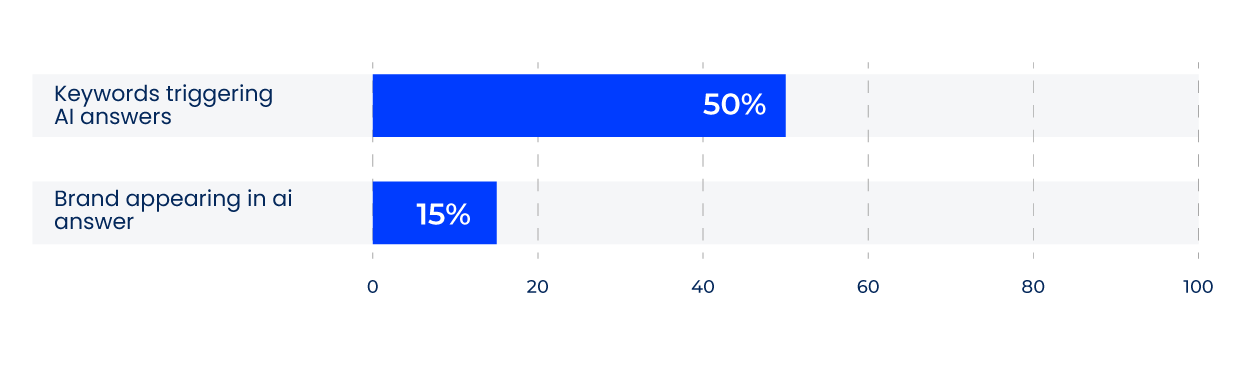
Chart detailing the average number of AI overviews for keywords vs average appearance of brands.
Tactics we recommend to brands looking to optimise for LLMs:
Context wrapping through AiPR
LLMs don’t just evaluate a single webpage; they interpret the broader context surrounding a brand across the web. AiPR focuses on earning coverage optimised for LLMs and from trusted publications so AI models repeatedly encounter your brand alongside relevant topics, entities, and expertise areas.
This “context wrapping” helps LLMs understand what your brand is known for, increasing the likelihood of inclusion in AI-generated answers, recommendations, and comparisons.
Several brands we analysed were excluded from AI answers due to weak third-party mentions, despite having strong websites.
Context wrapping in 5 steps

Resource and data page creation
Using statistical content assets, data hubs, topical guides and niche indexes means there is relevant and unique information on your site - which LLMs love.
Resource and data pages help your brand get found by answering real questions, supporting key topics and giving search engines and LLMs clear signals of your expertise.
Outreach for appearance in listicles
AI models frequently draw from comparison articles, rankings, and “best of” listicles when generating brand recommendations. Strategic outreach ensures your brand appears in high-quality editorial roundups and industry recommendation pages that LLMs are likely to reference.
These placements act as strong trust signals, helping position your brand as a recognised solution within a category. The more trust signals a brand has, the more chances of being surfaced when users ask AI tools for suggestions.
Prioritising money pages over informational content
It makes sense why most websites focus on their product and services pages. Optimising these pages means driving traffic to the places most likely to convert.
However, AI engines often prioritise informational content, because they are built for answering questions. So creating guides, and other educational content should form an important part of your GEO plan.
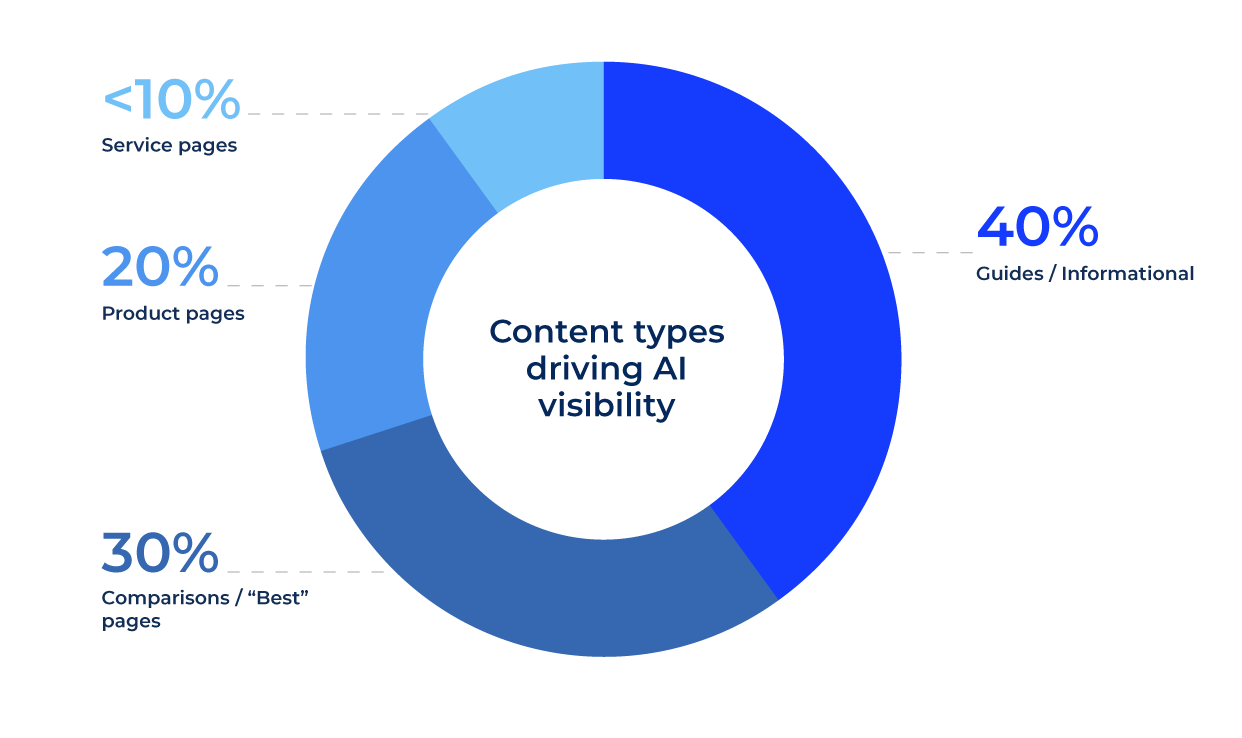
Data from our GEO audits revealed that informational content generated 40-70% of AI traffic for brands.
Another common mistake we found was brands thinking more content meant more AI citations. This is simply not true if it isn’t the right type of content. Indeed, in some cases on the same website we found that certain page types produced up to 30x more AI appearances than others. This goes to show that the content has to be what LLMs are looking for.
When it comes to the types of content you should look at, our audits showed that:
- Guide pages produced over 40% of AI traffic - while only representing 16% of pages in one brand’s case
- Advice-style content accounted for around 50% of AI visibility in another sector
- Best of pages generated up to 43% of aI traffic for the brands that used them
Take a look at our guide on creating and structuring onsite content for GEO for a better understanding on how you can get AI to find your content.
Avoiding comparison and “best-of” content
This content isn’t always the best fit for all brands, and it can feel a little bit too “affiliate”, but LLMs do use comparison content a lot when generating their responses.
“A recurring pattern in our audits is that brands simply aren’t present in the industry directories, listings, or platforms where their competitors appear. That absence limits external authority signals and reduces discoverability in AI answers.”
Anna Khlyshch
This is because when a user asks AI what the “best” option is, the model needs structured comparison data to draw from. You will want to make sure your brand is in the running. This can be done by creating this type of content yourself, providing aI platforms with detailed, honest comparison guides. But you can also actively outreach to be featured in comparison guides and reviews online, too.
Our analysis tells us that comparison pages generated 20x more AI appearances per page than other content.
Plus what’s great is that these user searches are often with high buyer intent. It’s a good one to prioritise to assist with not only LLM references, but conversions from AI search, too.
Overlooking the technical foundations of GEO
Our GEO audit analysis told us a simple truth - that most websites still aren’t technically structured for AI pick-up.
Structured data recommendations appeared in 100% of our audits.
Across different brands and industries, technical issues appeared repeatedly in our audits. A focus on making your site technically optimised will go a long way in helping AI confidently reference your brand.
A good start would be to look at basic scheme types, such as:

Organisation schema
LocalBusiness schema
FAQ schema
Review schema
“One of the most common issues we see in GEO audits is incomplete or poorly implemented structured data. Organisation schema is often missing or not fully parsable, which makes it harder for search engines and AI systems to clearly understand who the brand is and what it does.”
Anna Khlyshch
If you’re unsure where to start, check out our guide to technical GEO.
Failing to communicate what makes your brand different
One pattern that emerged across the audits was that many websites describe their products and services, but do not communicate what makes them unique.
Why does this matter for AI search?
If a brand cannot define what makes them different or credible, there is little reason for an AI platform to cite or recommend them over competitors.
In fact, the audits show that AI systems actively prioritise brands that provide clear proof points and differentiation signals.
For example, when analysing how AI selects sources, one audit found that AI systems consistently prioritise brands that demonstrate:
Quantifiable credibility (e.g. years of experience or cases handled)
Regulatory authority or professional accreditation
Clear service specialisation
Transparent pricing signals
These signals help AI models determine which brand is most trustworthy or relevant when generating answers.
Across several audits, the brands that dominated AI answers tended to have clear, easily identifiable differentiators.
For example:
- one competitor stood out due to a unique product policy
- another due to a mobile-first positioning
- others through strong comparison content and expert-led guides
This is by no means an exhaustive list of recommendations for optimising for GEO, but the most commonly missed tricks is a great place to start.
If you’re interested in learning more about GEO, peruse our GEO playbook where you’ll find more information on on-site and off-site GEO, as well as how to track, monitor and report on your AI search performance.
Submit a form to enquire about our GEO auditing service
